Election Day is one month and one day away. That’s right: November 8 is coming fast.
And there are many opportunities, all across Massachusetts, to help ensure victory for Question 1 and Question 4 this November.
Question 1: The Fair Share Amendment
As a reminder, Question 1, the Fair Share Amendment, would add a 4% surtax to the portion of someone’s annual income over $1 million to raise $2 billion in constitutionally dedicated funds for public education and transportation across the Commonwealth. 99+% of us won’t pay a penny more, but we will all benefit from the investments the revenue would make possible.
Those investments can mean greater funding for early education, for more teachers and counselors in our schools, for lowering tuition and hiring faculty and at our public colleges and universities, for fixing potholes, for upgrading structurally deficient bridges, and for expanding access to high-quality public transit.
Here’s how you can help:
Find a canvass near you.
Sign up for a phone bank.
Sign up for a relational organizing training.
Question 4: The Work & Family Mobility Act / YES for Safer Roads
As a reminder, in June over 75% of Massachusetts State Senators and Representatives voted to override a gubernatorial veto so that all qualified state residents, regardless of immigration status, can apply for a standard Massachusetts driver’s license starting on July 1, 2023, joining 18 other states with such laws including our neighbors New York, Connecticut, Rhode Island, and Vermont.
Unfortunately, xenophobes and reactionaries in the state are trying to overturn this and are hoping to repeal it by ballot. But we won’t let them.
Vote YES to keep the law in place for safer roads, greater public safety, and work and family mobility.
Did you know that the current legislative session at the MA State House ends in just two weeks?
That’s right: any bills that don’t pass between now and July 31st are done until next year (at the earliest).
That means that there will be a flurry of activity in the coming weeks, and we want to keep you in the loop.
Stop the MA Legislature from Giving Massive Tax Breaks to the Wealthiest Estates
The Massachusetts tax system hits the wallets of lower-income people harder than high earners, with the bottom 20% of earners paying a higher percentage of their income in state and local taxes than the top 1%. An exception is the Commonwealth’s relatively robust estate tax. The estate tax is one of the main policies we have focused on reducing the gaping racial wealth gap in Massachusetts.
Nonetheless, the Massachusetts House voted last week to roll back the estate tax, to the cost of $207 million. This lost revenue means money isn’t available for important investments or for tax relief for the struggling residents of the Commonwealth.
Even worse, the estate tax rollback was designed in a way that disproportionately benefits the largest estates, namely those over $3 million. This would be the biggest increase in the racial wealth gap in decades.
If legislators want to help comparatively smaller estates, they should design their design their policies to do so, not advance a costly giveaway to the wealthiest estates.
A climate bill is in the works, but it hasn’t reached the Governor’s desk yet. Together, the provisions laid forth in the House and Senate proposed bills put Massachusetts in a good position to implement strategies to reduce our emissions 50% by 2030 – as required by law – and create healthier communities.
But these strategies cannot wait two years more to be passed into law! Let’s ensure that lawmakers finalize a climate bill that moves us toward our shared climate and justice goals.
The conference committee and House and Senate leaders must send a bill to the Governor’s deskby Thursday, July 21 to avoid the chance of a pocket veto by Governor Baker.
Your legislators need to hear from you: no climate bill is not an option! Advocates are circulating a public sign-on letter for legislators to show their support for moving this forward swiftly. Your legislators need to hear from you that it’s important they demonstrate support!!
Take action!
Check if your legislators have signed onto the letter
If not, send your legislators a message asking them to sign on – either by emailing them or calling them.
Email
Dear _________
I am alarmed to hear that, in the final days of the legislative session, a comprehensive climate bill is still not on the governor’s desk. We have very little time before the end of the session.
[why passing a climate and justice bill is important to you]
We must get a climate bill to the governor’s desk by Thursday. Please join me in voicing your support for swift passage by signing on to this public “Dear Colleague” letter.
Thank you,
Call
I’m calling to voice concern that the legislature has still not passed a climate bill this session. Climate advocates are circulating a public sign-on letter for legislators in support of quickly moving a bill. Has the Representative/Senator seen the letter? You can view the form and the letter at bit.ly/maclimate22. Will the Representative/Senator sign on?
If yes: Wonderful, thank you. They can use the sign-on form found in the letter
If not sure/need to get back to you: Please let me know what the legislator says.
What do eggs, lotion, and Slurpees have in common?
All of them have been deemed “dangerous weapons” in courts that made young people ineligible for judicial diversion to community supervision instead of incarceration.
This Thursday, the MA Senate will be voting on an important juvenile justice reform bill (S.2942) to expand opportunities for judicial diversion for youth, as well as another bill (S.2943) that eliminates the requirement that youth pay an $40 administrative bail fee as a condition of being released on bail.
The Senate also has the opportunity to strengthen these reforms by including an amendment (#4 to S.2942, filed by Sen. Pat Jehlen) to preserve the right to education of students who are accused of a felony offense allowing them to remain in school as long as their case has not moved towards an arraignment and that the felony be a “serious violent felony” before a student is suspended from school.
TOMORROW: Fair Share Canvass with Elizabeth Warren
Join Fair Share for Massachusetts and Senator Elizabeth Warren TOMORROW at 5:30 PM to canvass voters and spread the word to vote YES of Fair Share this November!
The kickoff will be at Lincoln Commons Park, Bryant and Cross Street, Malden.
RSVP HERE.
Tell Your Legislator: Pass Child Care Legislation This Legislative Session!
In early 2021, the Common Start Coalition drafted legislation, originally filed by Reps. Gordon & Madaro and Senators Lewis & Moran, that would establish a framework for delivering increased access to affordable, high-quality early education and child care to Massachusetts families, over the course of several years. On May 18, the Legislature’s Education Committee approved a landmark bill, H.4795/S.2883, titled An Act to Expand Access to High-Quality, Affordable Early Education and Care.
Major sections of the Education Committee’s legislation are heavily based on the Common Start bill. Now, we have until the end of the current legislative session on July 31 to pass H.4795/S.2883 and make progress this year on transforming the childcare system in Massachusetts!
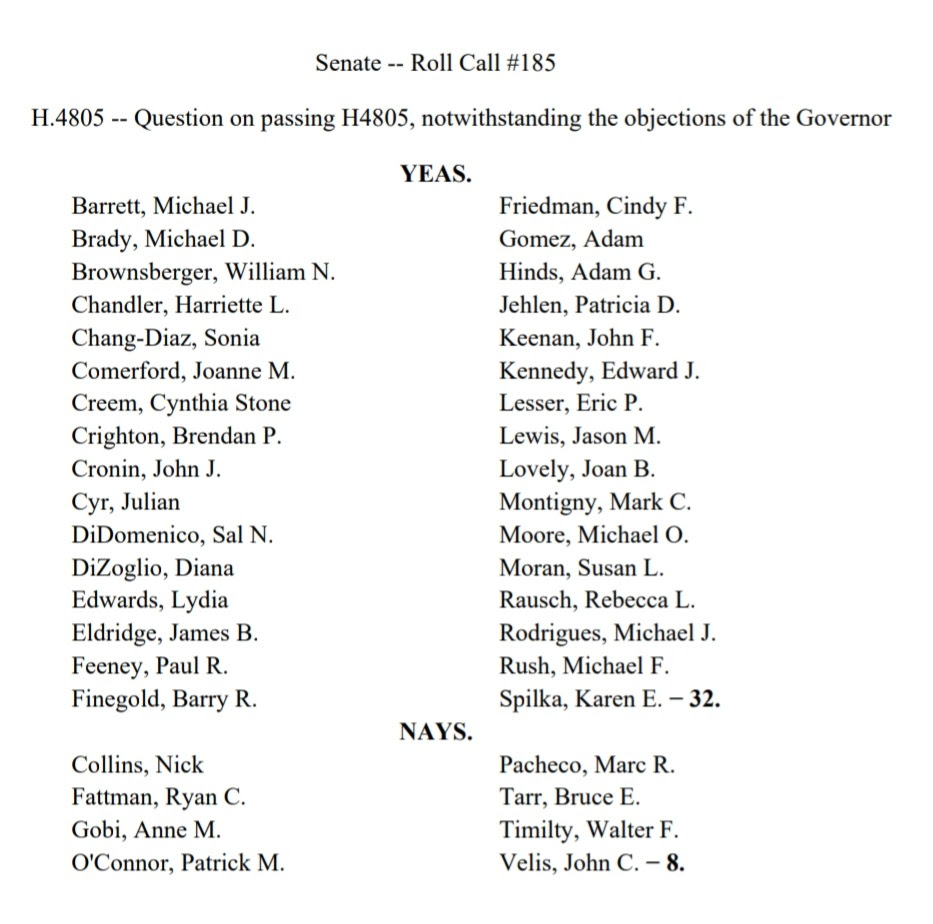
Last week was an exciting week at the Massachusetts State House, as both the House and Senate voted to override the Governor’s veto of the Work & Family Mobility Act, making Massachusetts the 17th state to ensure that all qualified residents, regardless of immigration status, are able to get a driver’s license.
You can see how your legislators voted below.
VOTES Act Advances…But With a Big Gap
Last week, the House and Senate released their final version of the VOTES Act. The bill contains many important reforms, like making the option to vote early-by-mail permanent, expanding early voting options, and strengthening the protections for jail-based voting. Unfortunately, however, the House’s opposition to Same Day Registration carried the day, and Massachusetts will continue to lag behind our neighbors with our arbitrary and exclusionary voter registration cutoff. The bill would shorten the deadline from 20 days before an election to 10 days, but that’s still 10 days too many.
The bill passed the Senate last week and is on track to pass the House soon.
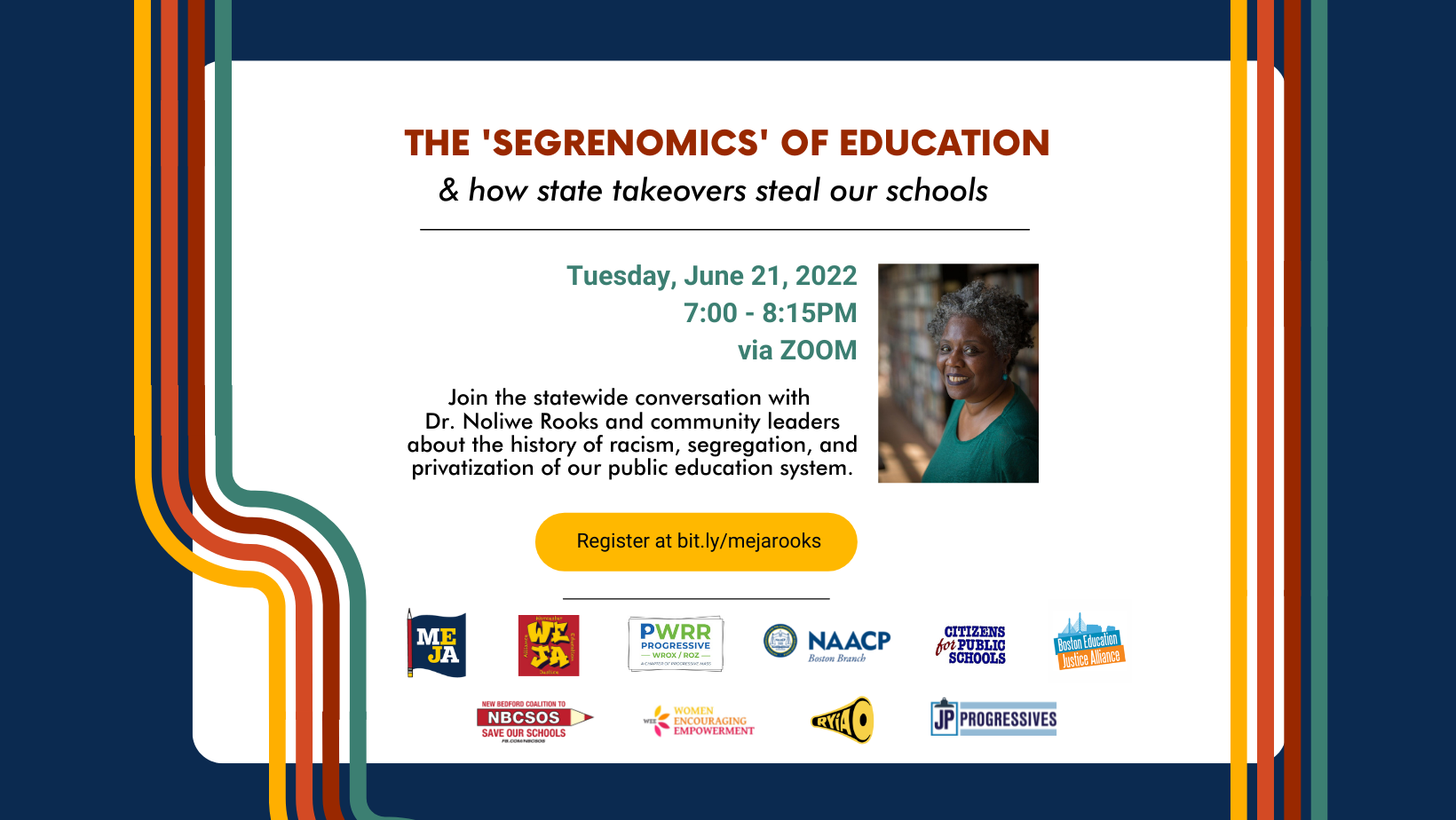
Many of the educational issues and controversies we face today — state takeovers, standardized testing, charter schools, many more — have interconnected historical roots and mutually reinforcing current impacts that result in huge gaps in school quality and huge gaps in student opportunity. Understanding that history is crucial for finding solutions.
Join the important discussion with Dr. Rooks about her research on: segrenomics, connecting the dots between economics with segregated schooling and community organizers from across the state on their work.
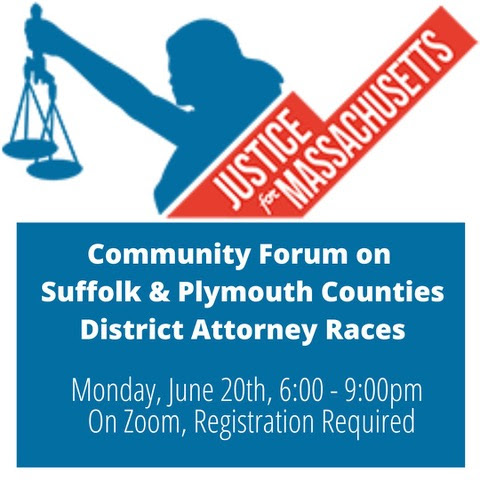
Community Forum on Suffolk & Plymouth County DA Races
We’ll be joining community partners from the Justice for Massachusetts coalition for a forum with the Suffolk and Plymouth County DA candidates on Monday, June 20, from 6 pm to 9 pm.
“Policy is my love language.” This is a quote that Congresswoman Ayanna Pressley often uses, and it rings so true. If we want to build a society where people truly love, care for, and respect each other, then we need policies that reflect that, rather than policies that dehumanize and marginalize.
Tell Your State Rep to Vote YES on the Work & Family Mobility Act!
Last Friday, the Work & Family Mobility Act was reported out of the Joint Transportation Committee.
This bill would enable all qualified state residents to apply for a standard Massachusetts driver’s license or identification card regardless of immigrant status.
Many MA residents depend on a car to get to work, to school, to the hospital, etc., and immigration status shouldn’t be a barrier to getting a license.
Moreover, the Work & Family Mobility Act would make us all safer. If all drivers have passed the same test and know the same rules of the road, and are properly insured, we all benefit.
The House is expected to vote on the bill soon—possibly as early as this week.
Valentine’s Day Rally to Pass the Jail and Prison Construction Moratorium Bill!
Let’s show love to incarcerated women and love for our communities! Come to the State House with Families for Justice as Healing on Monday from 12-1pm to push the Legislature to pass the Moratorium Bill and free women from Framingham and invest money in what communities really need to thrive! Please wear masks to keep each other safe. Feel free to bring signs with messages like FREE HER, STOP THE NEW WOMEN’S PRISON, or PASS S2030/H1905. RSVP HERE.
Hearts Broken on Slow Solutions, Love is Strong for our Movement
Every day that passes without action breaks our hearts, knowing that Black, Indigenous, People of Color, Immigrant, and all oppressed people are harmed by the status quo. Our frontline movements have worked for years for urgent social change, with some priority bills delayed by our legislature for over a decade. It is with our broken hearts and fierce love for each other that we will gather at the statehouse, united in calling for action.
We will be joining allied organizations in gathering at 3pm on Monday in front of the State House (and on Zoom) to lift up our priorities together. Will we have another year of immigrants in MA denied access to a driver’s license? Will tens of thousands more face needless COVID-19 evictions and foreclosures?
Healthy Youth Act Lobby Day
For over 10 years, the Healthy Youth Act has been our Commonwealth’s opportunity to ensure that public schools that choose to offer sex education provide lessons that are inclusive, comprehensive, and medically accurate.
This Monday, February 14, from 12 pm to 2 pm, the Healthy Youth Act Coalition will be hosting a virtual lobby day to urge the Legislature to pass the bill. RSVP here (and you can email your state rep here if you can’t make it.)
Fighting for a Fair Share from Our Wealthiest Institutional Neighbors
Tuesday, February 15, 6pm – 7:30 pm
Across the Commonwealth, towns and cities are wrestling with the challenges and fiscal burden of expanding nonprofit property tax expansion from some of the wealthiest education and medical institutions in our country. Without a framework for institutional contributions, critical services for residents are threatened. From Western Mass to Greater Boston, from North Shore to South Shore—this issue demands state action. Join us for a discussion on necessary state legislation on payment in lieu of taxes (PILOT) programs and how advocacy organizations and state and local legislators are fighting to win it.
The PILOT Action Group is hosting a discussion with Davarian L. Baldwin, college professor and author of In the Shadow of the Ivory Tower and How Universities Are Plundering Our Cities. Baldwin’s book provides an excellent analysis of the role of large nonprofit institutions in our communities, and presents a vision of a more equitable relationship between communities and these institutions. Register here.
Common Start Coalition Roundtables
The Common Start Coalition is a statewide partnership of organizations, providers, parents, early educators, and advocates working together to make high-quality early education and child care affordable and accessible to all Massachusetts families.
Over the next few weeks, the Common Start Coalition will be hosting a series of roundtable discussions about why long-term investment in child care and early education infrastructure is so critical. Sign up today!
Wednesday, Feb 16, from 6:30pm – 7:30pm: Roundtable discussion on racial justice and Common Start, hosted by Neighborhood Villages and Coalition for Social Justice
Thursday, Feb 17, from 4pm – 5pm: Common Start Roundtable discussion on wraparound services, hosted by Horizons for Homeless Children
Thursday, February 24, from 6:30 pm to 7:30 pm: Common Start Roundtable discussion with religious leaders on affordable childcare
Tuesday, March 1, from 6:30 pm to 7:30 pm: Common Start Roundtable discussion on Building Blocks for a Healthy Future
Chairman Hinds, Chairman Cusack, and Members of the Joint Committee on Revenue:
My name is Jonathan Cohn, and I am the Policy Director of Progressive Massachusetts, a statewide grassroots advocacy group committed to fighting for an equitable, just, democratic, and sustainable Commonwealth.
We urge a favorable report for H.3080 and S.1874: An Act relative to payments in lieu of taxation by organizations exempt from the property tax (Rep. Uyterhoeven & Sen. Gomez).
Massachusetts is lucky to be home to many world-class hospitals and universities. But these large institutions, despite often operating indistinguishably from for-profit institutions, do not have to pay taxes. Given their large footprint, that is a fiscal drain for many communities across the Commonwealth, especially as communities are looking to find much-needed funds for investments in schools, housing, and infrastructure.
This bill would address this discrepancy by requiring large hospitals and universities to pay 25% of commercial property taxes to municipalities, based on the Payment in Lieu of Taxes (PILOT) agreement in Boston. Under this bill, municipalities could opt in to requiring a mandatory PILOT rather than having to engage in drawn-out negotiations or chasing down institutions one by one.
Why 25%? This number reflects the costs posed by such large institutions to municipal services like police, fire departments, and departments of public works. It is still a good deal for the institutions, who are still paying far less in property taxes than an individual would have to pay. And, by applying only to institutions with property worth over $15 million, the bill would avoid risking any adverse impact on smaller institutions.
We need to be empowering municipalities to take action to address the many crises before us, but they need the funds to do so. And when they have wealthy institutional neighbors, they shouldn’t be forced to be stuck in struggling fiscal straits.
Moreover, municipalities across the Commonwealth, as well as the state government itself, would benefit from a clearer understanding of how much money gets lost through such tax exemptions each year. We thus also urge a favorable report for H.3802 An Act establishing a study to examine lost municipal real estate tax revenue (Rep. Robinson), which would provide a clearer assessment of just what that lost revenue is.
Earlier today, the MA Legislature voted 159 to 41 to advance the Fair Share Amendment to the November 2022 ballot.
The vote was 121 to 39 in the House and 38 to 2 in the Senate (the 2: Ryan Fattman and Bruce Tarr).
The Fair Share Amendment would amend the Massachusetts Constitution, creating an additional tax of 4 percentage points on the portion of a person’s annual income above $1 million. This new revenue would be invested into funding our public schools and colleges as well as the repair and maintenance of our roads, bridges, and public transportation infrastructure.
Although today’s vote was exciting, the work isn’t over yet. It’s just beginning.
In the coming months, we’ll keep you posted about ways to help ensure a victory for Fair Share in November of 2022. But here’s what you do now.
(1) Make a pledge to vote for Fair Share next year!
Do you support the Fair Share Amendment? Do you plan to vote YES in favor of passing it on the ballot in 2022? Then become an official “Fair Share Amendment Voter” by filling out the pledge at https://raiseupma.us/pm.
And then after you sign, share it with five friends!
Yesterday, the Massachusetts Legislature announced that the Fair Share Amendment will be on the agenda and up for a vote during their Wednesday, June 9thConstitutional Convention!
Before the Fair Share Amendment can be placed on the 2022 ballot, it must be brought up for a vote in a Massachusetts Constitutional Convention twice and receive YES votes from 50% +1 of the legislature.
In 2019, the Fair Share amendment passed its first Con-Con with a 75% YES vote. Next Wednesday’s Constitutional Convention vote is the LAST hurdle before the Fair Share Amendment is OFFICIALLY placed on the ballot.
Here’s what you can do:
1. EMAIL YOUR LEGISLATORS – It is incredibly urgent that every legislator hears from their constituents about how important it is that they vote YES to advance the Fair Share Amendment. Take 30 seconds to email your legislators now!
2. ATTEND A FAIR SHARE KICKOFF EVENT – Over the next few weeks, the Fair Share 2022 Campaign is hosting Fair Share Amendment kickoff events in every corner of the state. Find one near you and urge your friends, family, and social networks to attend these events as well. RSVP for one near you at https://raiseupma.us/events!
The Safe Communities Act achieved major progress last year. Building on that momentum, we’re ready to fight for a victory this session.
But we need a supermajority of House and Senate votes to overcome an expected Governor’s veto. That’s two-thirds of each chamber: 107 House votes and 27 Senate votes.
Help us engage constituents in purple districts, so that swing legislators can be confident they have public support when they take that vote.
Join us for a Zoom Phone Bank next Wednesday at 6 pm to constituents in swing districts to generate calls to their legislators! Register here—and don’t forget to invite your friends!
We provide a short training at the beginning, log-in information, and lists for phone banking. You’ll need a computer and phone to participate, and we’ll send you Zoom information on how to join when you RSVP.
CD-08 Redistricting Hearing: Tuesday, 6/8, 12 pm to 5 pm
The Redistricting Committee will be hosting separate hearings for all nine Congressional Districts. These hearings provide an opportunity for area residents to offer their opinions on local and community interests that the Committee should consider when creating the new legislative districts.
Next Tuesday, the Committee will focus on CD-08.
CD-08 includes all or part of Abington, Avon, Braintree, Bridgewater, Brockton, Canton, Cohasset, Dedham, East Bridgewater, Holbrook, Hingham, Hull, Milton, Norwood, Quincy, Stoughton, Walpole, West Bridgewater, Westwood, Weymouth, Whitman, and the neighborhoods of Beacon Hill, Dorchester, Downtown, Jamaica Plain, South Boston, Roslindale, and West Roxbury in Boston.
Last month — around the one-year anniversary of the declaration of emergency in Massachusetts due to the COVID pandemic — the MA Legislature finally passed a law to allow all workers to access five days of emergency paid sick time for COVID-related sickness, quarantine, caregiving, and vaccination.
Enter: Republican Governor Charlie Baker.
Rather than signing the bill, Baker sent it back with amendments to deny Emergency Paid Sick Time benefits to municipal employees – workers who are on the frontlines of the pandemic response and deserve the same protections as private-sector workers.
At the same time that he is requiring schools to reopen, he is trying to take away vital protections for teachers and staff. And trying to put countless other public workers at risk.
Fortunately, your state senator and state representative don’t need to listen to Baker and can reaffirm their commitment to an equitable recovery.
Please take 2 minutes right now to email your legislator, asking them to oppose Governor Baker’s changes to the Emergency Paid Sick Time legislation.


.png "Event info for \"The Segrenomics of Education\"")