Despite the fact that the Massachusetts Legislature is a full-time body, and that legislators have accordingly been in session since January 2021, legislators routinely push a lot of legislating off until the final months, even final days of the formal legislative session.
That formal session ends on July 31 (or, if the Legislature chooses to bend the rules of time as they did this year, early on August 1). However, the actual legislative session does not end until the day before the first Wednesday of the year, so legislators can come back at any time to pass new legislation or unfinished legislation; they just need the will to do so.
Let’s take a look at what important legislation became law in these final months, what passed only one chamber but not the other, what’s stuck in limbo, and what got stuck in various stages of the committee process.
Passed via Veto Override
Work & Family Mobility Act (H.4085, 6/9)
- Ensures that any qualified driver, regardless of immigration status, can obtain a driver’s license
Passed and Signed by the Governor
VOTES Act (S.2922, 6/22)
- Creates a permanent vote-by-mail option (and requires every voter to be mailed a vote-by-mail application)
- Expands early voting options
- Ensures that eligible voters who are incarcerated are able to request a mail ballot and vote
- Shortens the voter registration cutoff period from 20 days until 10 days (but does not enact Same Day Registration as the Senate bill had)
- Sets a deadline for that the Commonwealth to join the 30-state Electronic Registration Information Center (ERIC) to keep voter registration rolls up-to-date
- See more at https://www.progressivemass.com/votes-act-june-2022/
CROWN Act (H.4554, 7/26)
- Prohibits discrimination against employees, students and other individuals based on their natural or protective hairstyle (e.g., braids or knots)
Protecting Reproductive and Gender-Affirming Care (H.5090, 7/29)
- Critical protections for Bay Staters who provide or help someone access reproductive health care and gender-affirming care
- A requirement that insurance cover abortion and abortion-related care. The bill also ensures coverage is affordable—and not subject to cost sharing—for low income individuals
- A requirement that Massachusetts public colleges and universities provide medication abortion at campus health centers
- A statewide standing order for both prescription and over-the-counter emergency contraception, making no-cost insurance coverage possible for all forms of emergency contraception without delay
- A confidential address program for reproductive health care and gender-affirming care providers who too often face threats and violence for providing health care
- Language to clarify the ROE Act and ensure pregnant people do not have to leave Massachusetts for abortion care later in pregnancy
Gun Safety Regulations (in Judicial IT bill, 8/10)
- Requires a licensing authority, like a law enforcement official, to conduct a personal interview with anyone seeking an initial application for a license to carry a firearm
- Bans from getting a gun license anyone subject to “a permanent or temporary harassment prevention order” or who “may create a risk to public safety or a risk of danger to self or others
An Act driving clean energy and offshore wind (H.5060, 8/11)
The Legislature passed a climate bill that takes steps to accelerate the transition to renewable energy (with a special but not exclusive focus on stimulating the offshore wind industry), modernize the grid, make green jobs accessible to the communities most in need, require large buildings to report energy usage, enable 10 municipalities to ban fossil fuels in new construction (provided that they actually allow construction of affordable housing), improve electric car infrastructure and affordability, and require electrification of public fleets. Although the bill was modestly amended since its passage on July 21 in response to amendments from Governor Baker, the Legislature’s final bill mostly adhered to the contours outlined here.
Cannabis Equity Bill (S.3096, 8/11)
The Legislature passed a bill to address equity in the growing legal cannabis industry in the state. The bill would direct 15% of the money in the Marijuana Regulation Fund (which is generated from the marijuana excise tax, application and licensing fees, and industry penalties) into a new Social Equity Fund, which would offer grants and loans to boost participation in the industry by populations disproportionately harmed by the drug war. It would also give the Cannabis Control Commission the authority to review and approve host community agreements as a way to combat both corruption and undue obstacles to Social Equity applicants posed. Baker signed the bill, vetoing only one small part of the bill that would have commissioned a study on how to remove obstacles to the possession and consumption of medical marijuana in K-12 schools.
Transportation Bond Bill (H.5151, 8/15)
The Legislature passed a $11.3 billion transportation bond bill (H.5151). The bond bill contained a number of noteworthy authorizations, including $6.95 million for fare-free bus pilot programs for the MBTA and Regional Transit Authorities, $200+ million for electrification of the commuter rail, $1 billion in MBTA modernization and $64 million in RTA capital investments, $275 million for the East-West Rail project, and enhanced data reporting from companies like Uber and Lyft. However, it is important to remember what a bond bill is and what it isn’t. A bond bill is an authorization of debt; much of the funds end up never spent. Note also that Baker chose to weaken the bill before signing it, sending back amendments (a) to urge the use of battery electric trains for commuter rail despite the fact that there are no battery trains in passenger service in North America yet and (b) to remove the language requiring no diesel locomotives after December 31, 2030.
Passed and Signed: Mental Health ABC Act 2.0 (S.3097, 8/16)
The Legislature passed a broadly supported comprehensive mental health care reform bill (An Act addressing barriers to care for mental health, or Mental Health ABC). The bill would do the following, among many other provisions:
- Mandate coverage for an annual mental health wellness exam, comparable to an annual physical
- Provide the state with better tools to implement and enforce mental health parity laws (meaning that if insurance plans must provide equal treatment of mental health conditions, including substance abuse, as they do for other medical conditions)
- Implement the nationwide 988 hotline to access 24/7 suicide prevention and behavioral health crisis services
- Initiate a public awareness campaign for red flag laws and extreme risk protection orders (ERPOs) that limit access to guns for people at risk of hurting themselves or others
- Enable individuals over 26 years old who live with disabilities can remain on their parents’ health insurance
In Limbo because of Baker
However, Baker did not sign all of the bills the Legislature passed in the final days of the session, and by taking so long to finalize their bills, the Legislature gave Baker undue leverage. He was able to veto things when legislators were already in recess or had little time to act (which, in the case of No Cost Calls, they squandered). The Legislature should come back into the session to finish their work.
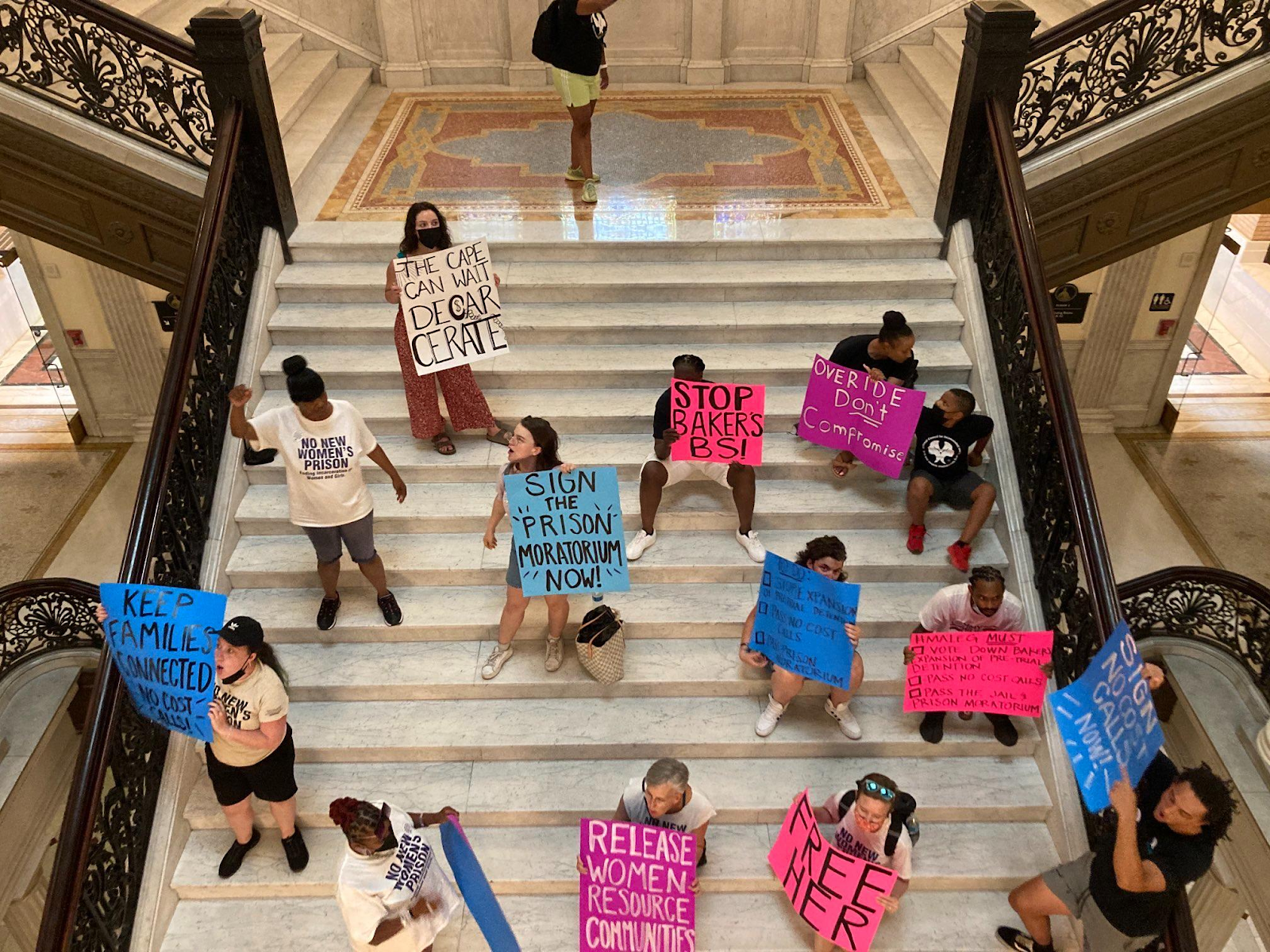
- Prison Moratorium, the five-year pause on new prison & jail construction, which was passed by both House and Senate via the infrastructure bond bill. Baker vetoed it when the Legislature already ended the session, leaving them unable to override a veto.
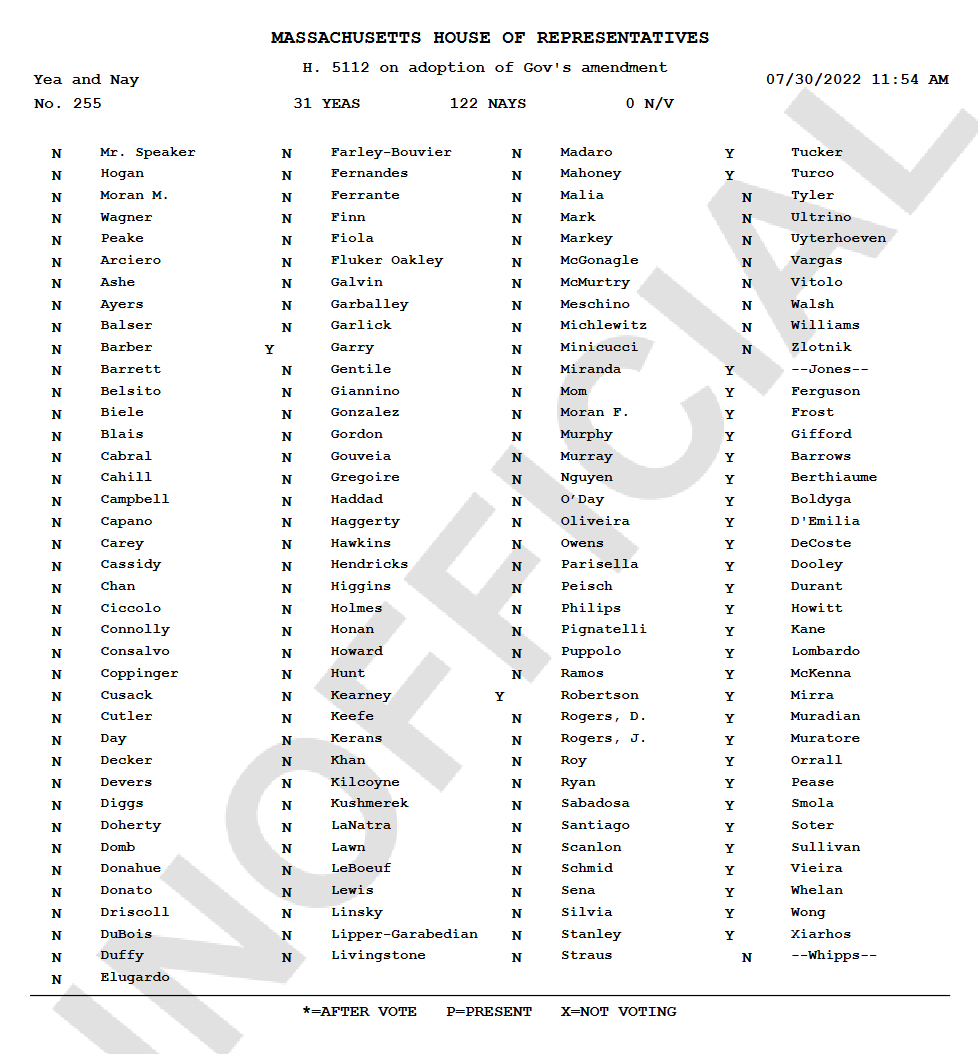
- No Cost Calls, which was passed by both chambers in the budget and was sent back with an amendment by Baker to add his “dangerousness hearing” bill (which would expand pretrial detention). The House rejected it, and the Senate passed a narrowed, but still harmful version of it, and then both chambers left
- SAPHE 2.0 Act (Statewide Accelerated Public Health for Every Community), which would create local and regional public health standards and regular state funding to health boards and was passed unanimously. Baker sent back significant amendments when the Legislature already ended the session, leaving them unable to respond.
- $30 million in funding for virtual meeting capacities in municipalities, which Baker vetoed in the general government infrastructure bill the Legislature passed.
In Limbo because of the Economic Development Bill
The Legislature had been working to finalize an economic development bill, centered on rebates (which concerningly excluded the residents of the greatest needs), some progressive tax reforms, some regressive tax reforms (a massive estate tax giveaway), and funding for important programs across the state. These negotiations got sidelined by the realization that a misguided Reaganite 1986 tax law in the state could be triggered, sending automatic (regressive) tax rebates to residents. Important policies that were included in the Senate or House version of the bill are stuck in limbo, and the Legislature should come back to finish them.
- PILOT Study (H.3083, Robinson), which would order an estimate how much municipalities are losing each year due to the tax exemption for nonprofits
- Community Immunity Act (S.1517, Rausch), which would create statewide consistent immunization policy and provide residents throughout the Commonwealth the data necessary to prevent future outbreaks of vaccine-preventable infectious disease
- HOMES Act (S.921, Edwards), which would create a process for sealing eviction records, which can currently be a permanent obstacle for people in attaining new housing even if they won in eviction court
What Passed the House, But not the Senate
- Facial Surveillance Regulations, as recommended by a commission created by the Legislature in the 2020 police reform bill (and incorporated by the House into the Judiciary IT bill: H.5076, 7/21/222)
What Passed the Senate, But Not the House
- Stronger child care infrastructure (S.2973, passed 7/7/22), which was lauded by the Common Start Coalition as a significant step forward in transforming the child care system in MA, including more affordability for families, early educator raises, and stability for child care providers
- The Healthy Youth Act (S.2541, passed 9/23/2021), which would ensure that Massachusetts schools that offer sex education use an age-appropriate, medically accurate, and LGBTQ-inclusive curriculum (Passed 9/23/2021)
- Menstrual Equity Bill (S.2730, passed 3/7/2022), which would make menstrual products available without cost in prisons, homeless shelters, and public schools.
- Civil asset forfeiture reform (S.2988, passed 6/30/2022), which would raise the legal bar that law enforcement must meet to seize and keep people’s money and property in suspected drug crimes (For more, see our write-up here.)
- Juvenile Justice Reform (S.2987, passed 6/30/2022), which would increase opportunities for judicial diversion for youth (For more, see our write-up here.)
- Gender X Bill (S.2540, passed 9/27/2021), which would allow for a non-binary option on birth certificates and drivers licenses in the state.
Reported out of Committee But Never Taken Up
One Fair Wage (S.1213 / H.1971): An Act requiring one fair wage (Jehlen – Farley-Bouvier / Fluker-Oakley), which would phase out the discriminatory subminimum wage for tipped workers
Wage Theft Enforcement (S.1179 / H.1959): An Act to prevent wage theft, promote employer accountability, and enhance public enforcement (DiDomenico-Donahue), which would provide the AG’s office with additional mechanisms for enforcing the Commonwealth’s wage and hour laws and subjects lead contractors to joint and severable civil liability if their subcontractors commit wage theft
Banning Mandatory Arbitration (S.1164 / H.1984): An Act relative to the defense against abuse waivers (Chandler – Gordon), which would ban mandatory arbitration in the workplace, a practice which affords employers one-sided protections such as selecting the arbitrator and holding arbitration at the employment site
Injured Workers Bill (S.1187 / H.2032): An Act to protect injured workers during and after the COVID-19 pandemic (Eldridge – Nguyen), which would provide for an administrative complaint and investigation mechanism for enforcement and otherwise addresses employer misconduct that prevents workers from receiving timely medical care and benefits
Equity in Public Contracting (S.2018 / H.3166) An Act Relative to Equity in Public Contracting in Honor of Bruce C. Bolling (Chang-Diaz — Holmes), which would commit the Commonwealth’s commitment to lowering unemployment rates in distressed communities and uses both transparency and competition to help ensure projects funded by taxpayer dollars are creating local jobs and promoting workforce diversity
Wage Equity Bill (S.1196 / H.2020): An Act relative to transparency in the Workplace (Feeney – Malia/Miranda), which would require employers of 100+ workers to publicly post annual wage data reports by race and gender to check compliance with the Pay Equity Law
Lift Kids Out of Deep Poverty (S.96 / H.199): An Act to lift kids out of deep poverty (DiDomenico – Decker) Sets a floor for cash assistance benefits at 50% of the federal poverty level, improving basic financial security for low-income families with children
Homeless Bill of Rights (S.142): An Act providing a bill of rights for people experiencing homelessness (Rausch), which would people experiencing homelessness from discrimination in housing, employment and voter registration; removes archaic and offensive laws about “vagabonds,” “vagrants,” and “tramps” from the General Laws
CHAPA Housing Production Bill (S.871 / H.1448: An Act relative to housing production (Crighton – Vargas/Honan), which would establish a statewide goal of producing 427,000 new units of housing in Massachusetts by 2040, with more than one quarter meeting the definition of affordable housing
Tenant Opportunity to Purchase (S.890 / H.1426): An Act to guarantee a tenant’s first right of refusal (Jehlen – Livingstone/Consalvo)l which would provide tenants of small, medium, and large multifamily properties with right of first refusal when the owner plans to put a building on the market, provided that they can make a bona fide offer to match the asking price in a reasonable period of time
Visitation Rights (S.1550 / H.2440): An Act to strengthen family and community connection with incarcerated people (Chang-Diaz – Decker), which would strengthen and secure the rights of prisoners to receive visits and maintain relationships with their friends and loved ones without unnecessary interference from the state
Safe Communities Act (S.1579 / H.2418): An Act to protect the civil rights and safety of all Massachusetts residents (Eldridge – Balser/Miranda), which would limit local and state police collaboration with federal immigration agents, bars law enforcement and court personnel from inquiring about immigration status, and ensures due process protections
Access to Medication Treatment (S.1296 / H.2067): An Act regarding consistent care for addiction rooted in evidence (Keenan – Balser), which would require prisons and jails to provide medication for opioid disorders
Media Access in Prisons (S.1638 / H.2513): An Act relative to media access and transparency in correctional facilities (Rausch – Decker/Rogers), which would require correctional facilities to guarantee access of media representatives to incarcerated individuals
We the People Act (S.2402 / H.3658): Resolutions for a United States Constitutional Amendment and a limited amendment proposing convention (Eldridge – Gentile/Vieira), which calls for an Article V convention to propose an amendment to undo Citizens United and authorize campaign finance regulation
Empowering Parents to Run (S.475 / H.769): An Act supporting parents running for public office (Jehlen – Connolly/Meschino), which would allow parents running for elected office to expense child care to their campaign accounts
Remote Access to Public Meetings (S.2082 / H.3152): An Act to modernize participation in public meetings (Lewis – Garlick), which would guarantee that remote access to public meetings outlives the pandemic by codifying Governor Baker’s March 2020 emergency order in statute (Rather than making this permanent, the Legislature extended the rules only to next March)
Regional Transportation Ballot Initiatives (S.1899 / H.2978): An Act relative to transportation ballot initiatives (Lesser – Lewis), which would allow municipalities to use ballot initiatives to raise revenue (increase a tax of their choice, sales, hotel, gas, etc.) that would be used specifically for identified regional transportation projects, something many other states already allow
Native Mascots Ban (S.294 / H.581): An Act prohibiting the use of Native American mascots by public schools in the Commonwealth (Comerford – Elugardo/Gouveia), which would prohibit the use of Native American mascots in Massachusetts public schools.
Data Equity Bill (H.3115): An Act ensuring equitable representation in the Commonwealth (Chan), which would require that government agencies that collect demographic information disaggregate by country of origin in order to better identify community needs and inequalities between communities.
Indigenous People’s Day (S.2027 / H.3191): An Act establishing an Indigenous People’s Day (Comerford – Lewis / Fluker Oakley), which would recognize the second Monday in October as Indigenous Peoples Day and recommends appropriate incorporation into school curricula
Left in Committee, Sent to Study, or Voted Down
Medicare for All (S.766 / H.1267): An Act establishing medicare for all in Massachusetts (Eldridge – Sabadosa/Garlick), which would establish a single payer system, in which the state provides health care to all residents as a right
HERO Act (S.1853 / H.2890): An Act providing for climate change adaptation infrastructure and affordable housing investments in the Commonwealth (Eldridge – Elugardo), which would double the deeds excise tax on home sales to provide a funding stream for the Global Warming Solutions Fund, the Affordable Housing Trust Fund, and the Housing Preservation and Stabilization Fund
Real Estate Transfer Fee (S.868 / H.1377): An Act empowering cities and towns to support affordable housing with a fee on certain real estate transactions (Comerford – Connolly), which would enable cities and towns to assess a fee of 0.5-2% on residential and commercial real estate transactions, with the funds allocated to affordable housing trust funds
Banning Exclusionary Zoning (S.867 / H.1373): An Act promoting fair housing by preventing discrimination against affordable housing (Chang-Diaz — Barber)
HOMES for All (S.866 / H.1799): An Act Relative to Homes for All (Chang-Diaz – Miranda), which would require that any person having the right to rent, lease, or sell properties can not discriminate against any person for sealed criminal records, misdemeanors that occurred over three years ago or that did not result in convictions
COVID Housing Equity Bill (S.891 / H.1434): An Act to prevent COVID-19 evictions and foreclosures and promote an equitable housing recovery (Jehlen – Moran/Honan), which would require landlords to cooperate with rental assistance programs before pursuing eviction; protects the most vulnerable tenants from forced removal for COVID-19 debts; pauses no-fault evictions during the state of emergency and recovery period; pauses foreclosures and requires forbearance based on federal policies; and requires the state to adopt equitable principles, flexibility, and simplification in the distribution of rental assistance funds
Tenant Protection Act (S.886 / H.1378): An Act enabling local options for tenant protections (Gomez – Connolly/Elugardo), which would enable cities and towns to pass tenant protections such as rent stabilization laws, just cause eviction, limitations on condo conversions, etc.
Right to Counsel (S.874 / H.1436): An Act promoting housing stability and homelessness prevention in Massachusetts (DiDomenico – Day / D. Rogers), which would provide legal representation for low-income tenants and owner-occupants in eviction proceedings
Paid Leave for Municipal Workers (S.1160 / H.2044): An Act to ensure paid family and medical leave benefits for municipal employees (Brady – D. Rogers), which would extend the 2018 paid family and medical leave law to cover municipal employees
Dignity At Work Act (S.1185 / H.3843): An Act addressing dignity at work without regard to protected class status / Dignity At Work Act (DiZoglio/Lewis), which would create a legal claim for bullying targets who can establish they were subjected to malicious, health-harming behavior in the workplace
Debt-free higher ed (S.829 / H.1339): An Act to guarantee debt-free public higher education (Eldridge – Higgins), which would create a higher education system where every Massachusetts resident has a right to attend any public college or university free of tuition and fees
Endowment Tax (S.836 / H.2931): An Act to support educational opportunity for all (Gomez – Higgins/Barber), which would impose an excise tax on university endowments greater than $1 billion to create a fund subsidizing the cost of higher education, early education, and child care for lower-income and middle-class residents of the commonwealth
PILOT Funding (S.1874 / H.3080): An Act relative to payments in lieu of taxation by organizations exempt from the property tax (Gomez – Uyterhoeven), which would enable cities and towns with nonprofits owning total property valued at or above $15 million to require them to make payments in lieu of taxes (PILOT) equal to 25% what they would have owed without the exemption
CHERISH Act (S.824 / H.1325): An Act committing to higher education the resources to Insure a strong and healthy public higher education system / CHERISH Act (Comerford – Garballey/Mark), which would commit the Commonwealth to funding public higher education at 2001 levels, adjusted for inflation
CARES Act (S.365 / H.584): An Act relative to anti-racism, equity and justice in education (Lewis / Elugardo – Uyterhoeven), which would create a commission to develop curriculum materials with a social justice perspective of dismantling racism and ensure that ethnic sftudies, racial justice, decolonizing history, and unlearning racism is taught at all grade levels using a critical approach and pedagogy that is age-appropriate (The bill was folded into an Educator Diversity bill, but none of the text was incorporated into the bill it was folded into…)
Safer Schools (S.286 / H.648): An Act relative to safer schools (Chandler – Khan), which would support schools that want to transition their school safety program to one that does not rely on a school police model and require greater transparency on the impact of school policing on students’ discipline and information sharing with law enforcement agencies
Decriminalizing Consensual Sex (S.1126 / H.1726): An Act relative to consensual adolescent sexual activity (Rausch – Lewis), which would decriminalize consensual activity between teenagers close in age
Curbing Solitary Confinement (S.1578 / H.2504): An Act to provide criminal justice reform protections to all prisoners in segregated confinement (Eldridge – Miranda), which would expand the rights of those in solitary confinement, including requiring treatment for those with serious mental illness and monthly reviews for eligibility to return to the general population
Ending Life without Parole (H.1797): An Act to reduce mass incarceration (Livingstone/Miranda), which would repeal mandatory sentences of life without parole, which have strong racial biases and have been deemed human rights violations by international courts
Raising the Age (S.920 / H.1826): An Act to promote public safety and better outcomes for young adults (Boncore-O’Day/Khan), which would raise the age of criminal majority to 21, allowing offending youth to have better access to treatment and educational services and thereby reducing recidivism
Justice Reinvestment Act (S.1815 / H.2008): An Act to reinvest justice and opportunity in communities affected by incarceration (Chang-Diaz — Keefe), which would establish a training and workforce fund that would reinvest the savings from lower incarceration into neighborhoods most affected by the criminal justice system
Eliminating Mandatory Minimums (S.977 / H.1910): An Act to eliminate mandatory minimum sentences related to drug offenses (Creem – Uyterhoeven), which would repeal mandatory minimum sentences for opioid-related offenses, which were left in or newly created by the 2018 criminal justice reform bill
Cannabis Expungement (S.1048 / H.1904): An Act ensuring equitable access to cannabis related expungement (Gomez – Comerford / Tyler – Lewis)w, which would permit a person eligible for expungement of a decriminalized offense for possession of marijuana to expunge the charge without a hearing and permits a person who is incarcerated due to a possession of marijuana that is now decriminalized to seek release from incarceration
COVID Decarceration (H.1868): An Act regarding decarceration and COVID-19 (Sabadosa), which would direct the Department of Corrections and Sheriffs to to release people from incarceration who pose no immediate threat to the community so that the virus does not spread quickly in our jails and prisons, and in turn, to staff, families, and our health care system
Curbing Police Militarization (S.1539 / H.2479): An Act relative to military grade controlled property (Barrett – Keefe/Lewis), which would require a vote by a local legislative body before a municipality can acquire military equipment
Banning Tear Gas (S.1637 / H.4150): An Act banning the use of tear gas by law enforcement (Rausch – Connolly/Lewis), which would ban the use of tear gas and other chemical weapons by law enforcement
Limiting Qualified Immunity (S.945): An Act to Allow Restitution for Civil Rights Violations (Chang-Diaz), which would prevent qualified immunity from being used as a shield against lawsuits for violations of a person’s civil rights
Updating the MA Civil Rights Act (S.946): An Act to Secure Civil Rights through the Courts of the Commonwealth (Chang-Diaz), which would remove a narrow limitation in the MA Civil Rights Act in order to allow people to seek recourse through the courts for any violation of their civil rights
Vote16 (S.448): An Act ensuring municipal participation of the widest eligible range (Chandler), which would enable cities and towns in Massachusetts to lower the voting age for municipal elections to 16 to encourage good voting habits early
All Resident Voting (S.465 / H.770): An Act extending voting rights in municipal elections to noncitizen voters of the commonwealth (Eldridge — Connolly/Elugardo), which would allow non-citizens to vote in municipal elections
Local Option RCV (S.485 / H.825): An Act providing a local option for ranked choice voting in municipal elections (Rausch – Pignatelli), which would enable cities and towns in Massachusetts to adopt ranked choice voting for municipal elections
Expanding Public Records Law (S.2107, S.2048, & H.3239): An Act expanding the public records law (Rausch) & An act to apply the public records law to the legislature (Eldridge – Uyterhoeven), which would remove the full exemption that the Governor and Legislature have from public records law
IPCC by 2030 (S.2170 / H.3372): An Act investing in a prosperous, clean commonwealth by 2030 (Eldridge – Uyterhoeven), which would commit MA to transitioning to 100% renewable electricity and net zero carbon emissions across all sectors by 2030
Rooftop Solar (S.2165 / H.3278): An Act Increasing Solar Rooftop Energy / An Act establishing solar neighborhoods (Eldridge – Lewis/Connolly), which would require that all new construction be built to accommodate solar energy installations
Building Justice with Jobs (S.2226 / H.3365): An Act providing for building justice with jobs (Pacheco – Robinson/LeBoeuf), which would put thousands of MA residents to work retrofitting 100,000 homes each year to improve energy efficiency and health outcomes, and reduce utility bills and carbon emissions
Environmental Justice Protections (S.996 / H.1792): An Act to create access to justice (DiDomenico — Meschino/Madaro), which would increase access to legal remedies for communities disproportionately impacted by environmental burdens, e.g., by eliminating the legal burden of proving that programs or activities with a disparate impact are motivated by discriminatory intent
Siting Reform (S.2135 / H.3336): An Act Relative to Energy Facilities Siting Reform to Address Environmental Justice, Climate, and Public Health (Boncore – Madaro), which would add environmental justice, public health, and climate to the factors that the Energy Facilities Siting Board must consider in its deliberations; requires community engagement prior to filing for environmental or Siting Board review of a petition to construct an oil, gas, or substation facility; among other steps
100% Clean Act (S.2136 / H.3288): An Act transitioning Massachusetts to clean electricity, heating and transportation (Boncore – Decker/Garballey), which would transition Massachusetts to 100 percent clean electricity by 2035 and 100 percent clean heating and transportation by 2045
State Infrastructure Bank (S.665 / H.1223): An Act establishing the Massachusetts infrastructure bank (Eldridge – Connolly/Elugardo), which would create a public bank, capitalized by the Commonwealth and offering financing at lower cost to Mass cities and towns, increasing municipal capacity for making infrastructure improvements