News Roundup — March 12, 2022

“The Police State Is Failing Officers Too,” The Nation

“As a society, we have been taught that police should respond to every issue, and as a result, their outsize budgets take away resources from basic community needs, including schools, affordable housing, and infrastructure. This one-solution-fits-all approach is backed by neither data nor common sense, and all too often leads to violence and death.”

“MBTA Looking at $230M Shortfall When Federal Aid Runs Out,” State House News Service

“In fiscal year ’24, even after using about $100 million in fiscal year ’24, we still have a gap of $236 million,” O’Hara said. “Our fiscal cliff is then in fiscal year ’24.” A great case for Fair Share

“How Air Pollution Across America Reflects Racist Policy From the 1930s,” New York Times

“Urban neighborhoods that were redlined by federal officials in the 1930s tended to have higher levels of harmful air pollution eight decades later, a new study has found, adding to a body of evidence that reveals how racist policies in the past have contributed to inequalities across the United States today.”

“Federal COVID funds offer Boston Mayor Michelle Wu a big boost with her big plans,” Boston Globe

“The biggest barrier in this city is believing that we can’t do more,” Wu said. “And so being able to show and have people see with their own eyes and live the impacts is going to be transformational for making the case for larger investments down the line.”

“How Did This Many Deaths Become Normal?,” The Atlantic

“The United States reported more deaths from COVID-19 last Friday than deaths from Hurricane Katrina, more on any two recent weekdays than deaths during the 9/11 terrorist attacks, more last month than deaths from flu in a bad season, and more in two years than deaths from HIV during the four decades of the AIDS epidemic.”

“Boston Progressives Fear Rollback of Reforms After DA’s Early Exit,” Bolts

“There’s a strong and growing body of research that shows that declining to prosecute nonviolent misdemeanor cases not only minimizes individuals’ current involvement with the criminal legal system, but also substantially reduces the probability of future involvement,” Cohn told Bolts. 

“Chang-Diaz aims for big, progressive change,” CommonWealth

“We have seen so many examples, time and time again, where people power movements have taken on and won against establishment powers in Massachusetts,” she said. “In the end, we have to remember…that it’s not money that wins elections. It’s people that win elections.”

“2 senators say proposed building code comes up short,” CommonWealth

“The straw proposal bars a city or town from mandating all-electric new construction, even after local officials allow for vigorous analysis and debate. For municipalities in Massachusetts and other progressive states, all-electric construction is the favored strategy for decarbonizing new buildings. Barring communities from employing it would be a significant setback,” the senators said. They added, “Bottom line: Despite its unequivocal support of ‘net zero emissions’ by 2050, despite the special challenges of reducing emissions in buildings, and despite having been given a full 18 months by the Legislature to do its work, the Baker administration has proposed a municipal opt-in specialized stretch energy code that comes up short.”

“‘This should not be survival of the fittest.’ For high-risk people, COVID is far from over,” Boston Globe

“In a way, it was comforting to see people indoors for a while. I thought they would understand what it’s like to not leave your house,” she said. “But when given the chance, the world went outside in a flash and left me behind. I see all my friends living their lives. When is that going to be me?”

“State Senate hires a pay consultant in wake of report that says staff pay ‘breaks with best practice’,” Boston Globe

“The conversation around staff pay was always . . . can we afford to have this conversation with the Senate president now?” Raynor said. “It’s wild when you see the policies you’re pushing for addressing poverty and the fiscal cliff, and realize it’s about you.”

“Senate passes ‘period poverty’ bill,” CommonWealth

“We don’t expect school nurses to pay for toilet paper for everyone in the school,” Jehlen said. “Why should they pay for menstrual products?”

“State Police troopers may have inflated hours they worked in hundreds of details, inspector general finds,” Boston Globe

“The change, the report notes, “appears to remove the incentive for troopers to misrepresent” their hours. But it also means troopers will likely be paid for more time than they actually work, Cunha’s office said.”

“Fewer than 10% of applicants have been granted medical parole, frustrating some Mass. lawmakers,” WBUR

“It reminded me of ‘One Flew Over the Cuckoo’s Nest,’ ” said Eldridge, a Democrat whose district includes Middlesex and Worcester. “It was incredibly outdated and cramped and just not ideal for providing health care to prisoners in their 70s and 80s.”

“‘A no-brainer’: Merrimack Valley RTA makes all buses free to ride for two years,” Boston Globe

“I’m about to say something completely radical,” Berger said. “What I’m going to say that’s radical is that we are going fare-free, and that ain’t radical, that’s mainstream.”

“Local-option COVID approach slammed,” CommonWealth

“Not only are we seeing a patchwork of different rules in different communities in this state, which is confusing for the public and also less effective for the public health protections, but it also means that the decisions are getting pushed on to the backs of local public health staff who are then the folks who are being harassed and threatened,” Pavlos said. “That’s really unacceptable.”

“Ending mask mandate won’t bring us back to normal,” CommonWealth

“The pandemic is far from over. Just a few weeks ago, our ERs were overflowing and our primary care colleagues were pulled in to cover hospital shifts. While we are relieved to see the decline in Omicron cases, more variants are sure to emerge. Just last week, the World Health Organization announced a newly detected, even more contagious Omicron subvariant.”

“Massachusetts’ roadmap bill created an environmental justice advisory council. Where is it?,” Boston Globe

“The historic climate law that Governor Charlie Baker signed last March included provisionsmeant to make sure low-income communities and people of color don’t suffer disproportionate environmental harm from new polluting projects….It required Baker’s administration to appoint a special council to weigh in on which communities should have certain environmental protections, on the grounds that they’re already overburdened by pollution from fossil fuel infrastructure…But nearly a year later, Baker hasn’t appointed anyone to the council yet. And the body’s first report is due in July.”

“Mass. residents should welcome law on licenses for undocumented immigrants” (Letter), Boston Globe

“We found that not just immigrant and US-born Latino residents in those states responded more positively to welcoming immigration policies, but also most white, non-Latino residents did as well. Like immigrant and US-born Latinos, white residents displayed a more positive emotional response and felt like they belonged in their state more when immigration policies were more welcoming.”

“14 Takeaways From The Latest U.N. Study On Climate Change’s Deadly Toll,” HuffPost

“But the report emphasizes what millions of people can already intuit from dramatic shifts in weather patterns: Ways of life that sustained generations are coming to an abrupt and chaotic end, causing great suffering that world governments’ responses so far have proven woefully inadequate to ease, much less reverse.”

192nd Senate Scorecard: 2021-2022 Session

192nd Senate Scorecard: 2021-2022 Session

About the Scorecard:

A scorecard serves its purpose if it tells a story and informs advocacy.

As such, we prioritize votes that are contentious over those that are unanimous: unanimous votes neither tell a story nor inform advocacy. We prioritize bills and amendments that relate to our Progressive Platform and Legislative Agenda over those that do not, and we make a point of including bills and amendments for which our members lobbied their legislators.

Since legislators’ jobs are to vote, we count absences as the same as votes against the progressive position when calculating scores. HOWEVER, when legislators submit letters to the Clerk detailing how they would have voted had they been present, we will count these intentions, so long as their vote would not have alone decided the outcome of a bill or amendment. This helps us better achieve one of our main goals — informing advocacy — and acknowledges that there are extenuating circumstances behind some absences.

192nd Senate Scores *

"Who's my legislator?" Find out here.

Key/Descriptions

* What you see in our Scorecards and accompanying materials and analysis are the result of many, many hours of hard work by dedicated volunteers. Research, interviews, coding, data input, reviewing, designing, coordinating, investigating, editing, and intensive consideration and deliberation. Our scorecards are unique and are having the impact we seek: giving voters access to obscure info that is necessary to keep legislators accountable.

Please support this work with your contribution. With more resources, we can make improvements on many fronts, including design and interactivity. You can also support our work by sharing it, with attribution to Progressive Mass: progressivemass.com/scorecard

Want to look at other scorecards?

Don’t know your legislators?  Find out at scorecard.progressivemass.com

192nd House Scorecard: 2021-2022 Session

192nd House Scorecard: 2021-2022 Session

About the Scorecard:

A scorecard serves its purpose if it tells a story and informs advocacy.

As such, we prioritize votes that are contentious over those that are unanimous: unanimous votes neither tell a story nor inform advocacy. We prioritize bills and amendments that relate to our Progressive Platform and Legislative Agenda over those that do not, and we make a point of including bills and amendments for which our members lobbied their legislators.

Since legislators’ jobs are to vote, we count absences as the same as votes against the progressive position when calculating scores. HOWEVER, when legislators submit letters to the Clerk detailing how they would have voted had they been present, we will count these intentions, so long as their vote would not have alone decided the outcome of a bill or amendment. This helps us better achieve one of our main goals — informing advocacy — and acknowledges that there are extenuating circumstances behind some absences.

* What you see in our Scorecards and accompanying materials and analysis are the result of many, many hours of hard work by dedicated volunteers. Research, interviews, coding, data input, reviewing, designing, coordinating, investigating, editing, and intensive consideration and deliberation. Our scorecards are unique and are having the impact we seek: giving voters access to obscure info that is necessary to keep legislators accountable.

Please support this work with your contribution. With more resources, we can make improvements on many fronts, including design and interactivity. You can also support our work by sharing it, with attribution to Progressive Mass: progressivemass.com/scorecard

Want to look at other scorecards?

Don’t know your legislators?  Find out at scorecard.progressivemass.com

“Boston Progressives Fear Rollback of Reforms After DA’s Early Exit,” Bolts

Eoin Higgins, “Boston Progressives Fear Rollback of Reforms After DA’s Early Exit,” Bolts Mag, March 8, 2022, https://boltsmag.org/boston-declination/.

Jonathan Cohn, the political director of Progressive Massachusetts, a state group that supports criminal justice reforms, says Hayden’s backtracking is a major mistake. 

“There’s a strong and growing body of research that shows that declining to prosecute nonviolent misdemeanor cases not only minimizes individuals’ current involvement with the criminal legal system, but also substantially reduces the probability of future involvement,” Cohn told Bolts. 

MA Voters Deserve Election Day Registration for This Year’s Elections

Election Day is exactly 8 months away: November 8, 2022.

In Maine, New Hampshire, Connecticut, and Vermont, prospective voters will be able to register or update their registration at the polls. But in Massachusetts, they won’t be able to because of our arbitrary, exclusionary, and outdated voter registration cutoff.

Late last month, the Massachusetts House of Representatives voted in favor of the VOTES Act, pledging their support for making permanent critical electoral reforms like mail-in and early in-person voting. However, the House chose to leave out the heart of the VOTES Act: Election Day Registration (EDR). Now, because the House and Senate versions of the VOTES Act differ, a small group of legislators are finalizing the bill in conference committee.

EDR has been proven to make elections more equitable and efficient in 20 states. By reducing voter registration barriers, EDR boosts voter turnout for all, especially BIPOC, low-income, immigrant, and young voters. It also decreases administrative burdens of running elections by allowing election workers to update registration information on the spot.

Contact your state representative NOW and urge them to include EDR in the final version of the VOTES Act.


But Before November….

Before November will be the primaries on September 6 to determine who advances. And before that will be the party conventions in June that determine who even makes the ballot in the first place.

Over the past month, Democratic ward and town committees have been holding caucuses to elect delegates to the state party convention. If you want to take part, check out the caucus calendar here to see if your caucus has happened yet or is still to come.

And if you didn’t get elected or can’t make your caucus, you might still be able to become a delegate. You can find additional opportunities here.


Know What’s on the Ballot

Do you know what an Attorney General, an Auditor, or a Secretary of the Commonwealth does?

Do you want to know?

And do you want to find out more about what the candidates vying for these important statewide positions plan to do with these offices?

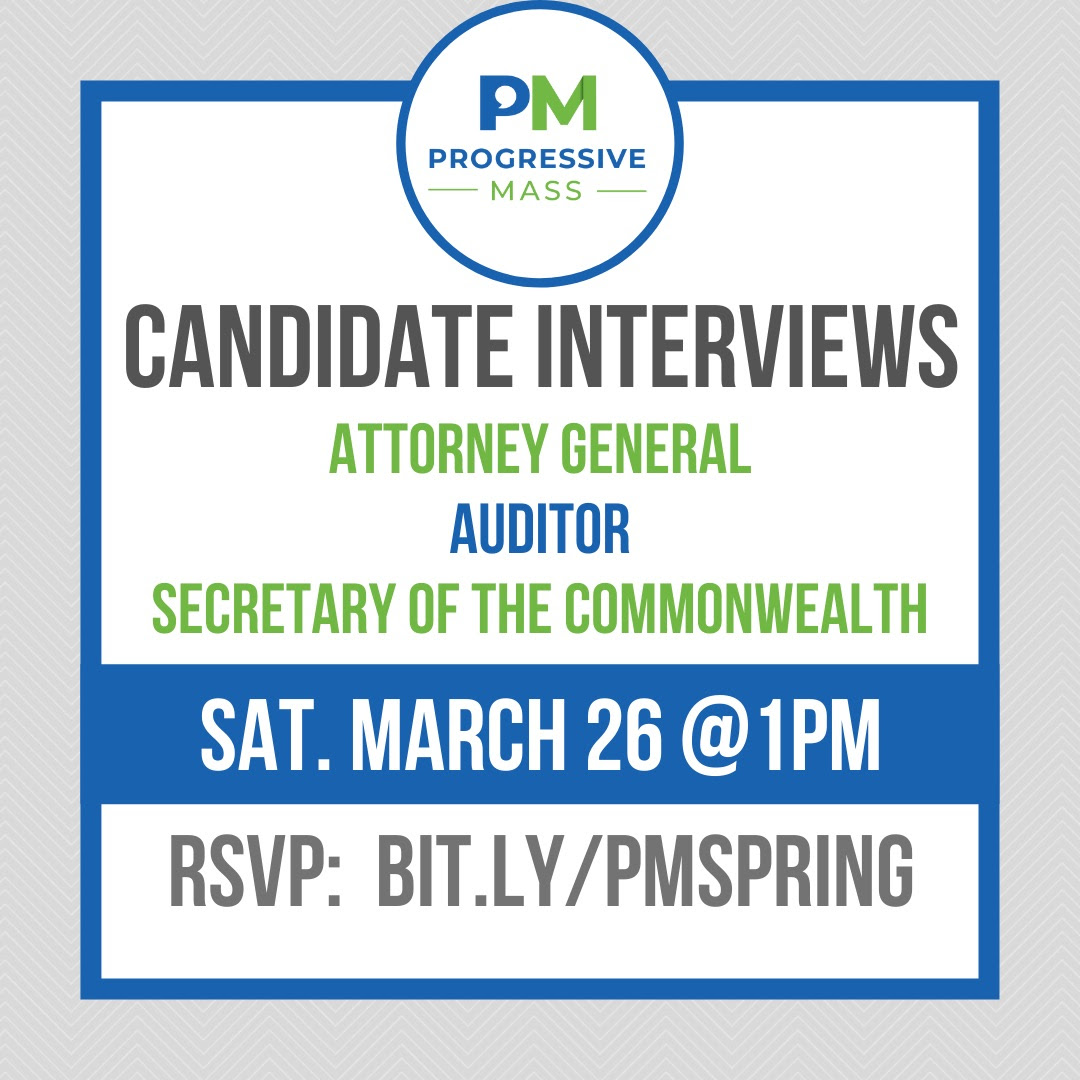
Then join us on Saturday, March 26, at 1 pm for our Spring Candidate Interviews.

All are welcome! Just RSVP here.

In solidarity,
Jonathan Cohn

Let’s Talk about Upcoming Votes

Tomorrow, the MA House is voting on a bill to generate revenue for an offshore wind investment fund and establish a slate of tax credits and incentives to promote offshore wind.

Massachusetts is well-positioned to be a leader in the renewable energy economy, but as we grow that sector, it is important that we make sure that all communities, especially the underserved, can benefit from the new opportunities provided.

Urge your state rep to support Amendment #10: Environmental Justice and Economic Opportunity, which would strengthen the diversity and inclusion provisions in the bill.


The Work & Family Mobility Act: What’s Next?

Last month, the MA House voted 120 to 36 to pass the Work & Family Mobility Act (often referred to as the “Driver’s License Bill”), which would enable all qualified state residents to apply for a standard Massachusetts driver’s license or identification card regardless of immigrant status.

The case for the bill is clear. Many MA residents depend on a car to get to work, to school, to the hospital, etc., and immigration status shouldn’t be a barrier to getting a license. If all drivers have passed the same test and know the same rules of the road, and are properly insured, we all benefit from the safer roads that result.

Despite this, the bill had been stalled in the Legislature session after session. But the years of hard work done by advocates, especially those from immigrant-led organizations, paid off.

But the work isn’t done.

The bill now goes to the State Senate. Email your state senator to vote YES and to urge Senate Leadership to take up the bill as soon as possible!

Also, don’t forget: positive reinforcement is important too. So thank your state rep if they voted for the bill.


Know What’s on the Ballot

Do you know what an Attorney General, an Auditor, and a Secretary of the Commonwealth does?

Do you want to know?

And do you want to find out more about what the candidates vying for these important statewide positions plan to do with these offices?

Then join us on Saturday, March 26, at 1 pm for our Spring Candidate Interviews.

All are welcome! Just RSVP here.

Our Endorsements for Governor and Lt. Governor

2022 Gov & LG

Progressive Massachusetts reached out in late December to gubernatorial and lieutenant gubernatorial candidates with our comprehensive policy questionnaire. In mid-February, we polled our statewide membership on whom and whether to endorse, and the results were clear: Sonia Chang-Díaz for Governor and Tami Gouveia for Lt. Governor.

Each received a commanding 78% of the vote in our member poll, far clearing the 60% threshold required for endorsement.

Each has consistently and persistently demonstrated a commitment to our fundamental mantra that “We all do better when we all do better.” They each bring a deep commitment to equity and justice and a proven track record.  

Why Sonia Chang-Díaz for Governor

When we think of the big achievements of our Legislature from the past five years, the bills that were far-reaching and agenda-setting, they have one thing in common: Sonia Chang-Díaz. She has been a leader in the fights to ensure that members of the trans community are able to exist in public life with full respect and access, to reform our criminal legal system, to update our decades-old education funding formula to help close deep inequities, and to strengthen police accountability. And we know Sonia doesn’t only fight: she wins. And she does so by building coalitions both inside and outside the Legislature and by listening to the voices of those most impacted. But she has been more than just a legislator. She brings the experience of a former teacher and a working parent, ready to roll up her sleeves to invest in our commonwealth to make it a better place for current and future generations.

Here is what some of our members had to say about why they support Sonia Chang-Díaz for Governor.

“I have been impressed with Sonia Chang-Díaz since she has been a state senator. I think her focus on education and social justice will bring fresh air to the Governor’s office.”

“Sonia has fought and won in the Senate for so many of our progressive values, like education funding and criminal justice reform. Sonia has proven that she not only shares these values, but can deliver results.”

“Sonia is smart, driven, empathetic, inclusive, and creative. Whereas many politicians take credit for things, Sonia leads and gets things done. I don’t think anybody in state government has more impressive progressive wins in the last decade than Sonia.”

“Sonia is that rare combination of principled and pragmatic. She is clear about where she stands, she sticks to her guns, and knows when to push and stand firm and when to move forward.”

“Sonia Chang-Díaz has a track record of accomplishing big, progressive goals in our Commonwealth. She led on education funding reform and criminal justice reform by highlighting the stories of real stakeholders, and was able to bring reluctant legislators around on these crucial issues.”

“Sonia has a proven record of progressive leadership and getting impossible things done on Beacon Hill. She’s the reformer we need with the vision and principles to make our Commonwealth more equitable and just.”

“Sonia is the only candidate who supports single-payer healthcare. She’s got an extensive track record of progressive stances AND of work done to promote them. The Student Opportunity Act alone was the achievement of a legislator’s lifetime and she was the driving force behind it.”

“Sonia leads with equity in everything she does, and she has demonstrated her commitment to bold progressive change by building large collaborative coalitions to get that change passed.”

Learn more about Sonia’s campaign at https://www.soniachangdiaz.com/.  

Why Tami Gouveia for Lt. Governor

Tami Gouveia brings a powerful combination of deeply progressive values and policy expertise, rooted in an understanding that a focus on public health is essential if we want a Commonwealth in which all can thrive. She fought for this goal in her decades as a social worker, leading efforts to protect children from exposure to environmental toxins and to develop a holistic regional approach to the opioid crisis. And she’s done so as a state representative, fighting for both critical community investments and bold, equitable policy solutions. The Lt. Governor can have a powerful role as an advocate and convener, and we are convinced that she will excel in such a role.

Here is what some of our members had to say about why they support Tami Gouveia for Lt. Governor.

“As a public health and social work professional along with being a current elected Rep., she will bring focus to ‘soft infrastructure’ needs like quality and affordable daycare, increasing pay and benefits for caregivers, health and mental health needs, and so much more.”

“Dr. Gouveia has a very consistent track record of fighting for what’s right and what’s good for her constituents without regard to how those votes may affect her ‘career.’ She is a true public servant who can be trusted to always vote her values and not her pocketbook.”

“I have seen the things that Dr. Gouveia has done for her district and what she advocates for in the State House. She listens. She is not afraid to speak up for progressive policies. She pushed early for a strong response to COVID-19 and is in it for the long game – to make things better for all of us. She also advocates for those of us that don’t always get invited to the table. When my district was without a rep, she made herself available to us.”

“Tami Gouveia is a progressive fighter and has not shied away from standing up for her beliefs while a state Senator. I have been impressed with her focus on public health and equity during the pandemic.”

“This moment calls out for a leader with Tami’s unique expertise and experience in public health, social work and building progressive coalitions on Beacon Hill. No one will work harder on behalf of every resident of the Commonwealth.”

“We’ve seen what happens during a pandemic when politicians listen to public health experts and then do whatever they wanted anyway. As a public health expert herself, Tami can help us navigate the end of this pandemic and prepare as best we can for the next one.”

Learn more about Tami’s campaign at https://www.tamigouveia.com/.

What about the Other Statewide Races?

Earlier this week, we sent office-specific, comprehensive policy questionnaires to the candidates for Attorney General, Auditor, and Secretary of the Commonwealth. Stay tuned.

But if you want to mark your calendars now, do so and sign up for our public candidate interviews on Saturday, March 26, from 1 pm to 4 pm.

News Roundup — February 24, 2022

“Glasnost on Beacon Hill,” Boston Globe

“For the first time in nearly two decades since the question of whether to allow unauthorized immigrants to apply for a driver’s license first came up on Beacon Hill, House Speaker Ron Mariano plans to — wait for it — bring the issue up for debate and a floor vote Wednesday, and force lawmakers to go on record for or against it. Shocking, indeed, given that one longstanding tradition on Beacon Hill is a tendency to hammer out policy behind closed doors and then hold pro forma, unanimous votes to approve it, something that makes it impossible to know what an individual legislator really said or did. Former speaker Robert DeLeo perfected the art form, making House votes about as suspenseful as Russian elections.”

“Privacy advocates speak out against proposal to expand state wiretapping law,” WGBH

“Opponents included Kade Crockford, speaking on behalf of the ACLU of Massachusetts, who said the measure could have “far-reaching negative effects and open up a Pandora’s box of potential unintended consequences, including political harassment and intimidation.””

“Protesters call for 5-year halt on prison construction in Massachusetts,” WGBH

“Over the last three years, there’s been a decrease in women incarcerated, which shows that we can really be a model and an example to what different looks like,” James said. “The prison and jail moratorium bill is just kind of us planting the seed to say that we don’t need — not just a women’s prison — but we don’t need any more prisons and jails, period, in Massachusetts.”

“Compassionate response to 911 calls with social workers makes sense,” CommonWealth

“Law enforcement officers have become the default first responders in situations involving those in crisis who do not have access to adequate mental and behavioral health care. These are often those suffering from addiction, mental illness, and a lack of housing. This police-as-default response mechanism disproportionally affects communities of color. These types of crises most often do not require a response by armed law enforcement officers and the presence of the police can in many situations exacerbate an already tenuous situation and actually cause harm to those needing help. “

“The Gig Economy Is Coming for Millions of American Jobs,” Bloomberg

“Our work is like everybody else’s work,” she said. “If we compromise employment rights, we’re going to have a whole lot of people, including ourselves, who are second-class.”

“Should there be a separate 911 system for mental health crises?,” WGBH News

“The ACES Act calls for something a little bit different,” said Rebekah Gewirtz, executive director at the Massachusetts chapter of the National Association of Social Workers, which spearheaded the bill. “The community-based organizations and municipalities working closely together to create a program versus community-based organizations and police departments creating a program. So, it’s an important distinction.”

“For the surtax: Fair Share will fund education, transportation over the long-term,” Boston Business Journal

“Strong economic growth requires robust and accessible transportation and an educated, well trained workforce. Right now, Massachusetts’ transportation infrastructure is teetering and its education system is expensive and inequitable. The Fair Share Amendment, through a modest tax on those who can most afford it, will provide long-term funding to revitalize those essential building blocks of a prosperous Commonwealth.”

“Compassionate response to 911 calls with social workers makes sense,” CommonWealth

“Law enforcement officers have become the default first responders in situations involving those in crisis who do not have access to adequate mental and behavioral health care. These are often those suffering from addiction, mental illness, and a lack of housing. This police-as-default response mechanism disproportionally affects communities of color. These types of crises most often do not require a response by armed law enforcement officers and the presence of the police can in many situations exacerbate an already tenuous situation and actually cause harm to those needing help.”

“What’s better for T: No fares or low-income fare?,” CommonWealth

“Jim Aloisi, the former state transportation secretary and current TransitMatters board member, is a big fan of Wu’s embrace of doing away with fares on buses. He believes eliminating fares on the bus network would attract more passengers and allow them to board buses quickly, which will speed up service. Better service, in turn, will attract even more riders, he says.”

“Ending mask mandate won’t bring us back to normal,” CommonWealth

“These children understand what Gov. Charlie Baker and Massachusetts Education Commissioner Riley do not. Ending the mask mandate in schools on Monday will not bring us back to normal. Rather, it will lead to more preventable infections and outbreaks, at the expense of our society’s most vulnerable. As primary care physicians who care for children and adults, and a parent of two children under 3, we are appalled to see the Baker administration once again prematurely lift data-driven policies that are needed to keep our children and communities safe.”

2022 Statewide Elections

2022 Statewide Elections

Governor and Lt. Governor

The Governor and Lt. Governor’s races offer Massachusetts an opportunity to shift course from the complacency and conservatism of the Baker-Polito administration. We must make sure that our recovery from the COVID-19 pandemic puts our commonwealth on a more equitable foundation, one that does right by workers, local businesses, and historically disenfranchised communities; one that provides our teachers and students the resources they need to thrive; and one that is rooted in an understanding of the importance of investing in our future, from child care to public education to public transit and beyond. Massachusetts also must address long-standing crises of medical debt, student loan debt, housing instability, runaway climate change, and systemic racism. We have a lot to do, and we need proactive leaders, backed by an engaged public, to do it. 

Progressive Massachusetts reached out to all announced and likely-to-announce candidates in December 2021, inviting them to fill out our comprehensive questionnaire about their policies, priorities, and leadership style. We view these questionnaires as a vital opportunity to educate candidates about issues that matter to progressive voters, get candidates on record, and create a more informed and engaged electorate.

If a candidate declined to fill out the questionnaire or submitted a questionnaire after others were publicly posted, they are not included below.

Watch candidate interviews here.

Attorney General, Auditor, & Secretary of the Commonwealth

This year, Massachusetts will have open races for Attorney General and Auditor, as well as a contested race for Secretary of the Commonwealth.

These offices, although often overlooked compared to Governor, can and will have a major impact on the future of the Commonwealth and our ability to advance an agenda of equity, justice, democracy, and sustainability.

Progressive Massachusetts reached out to all candidates, inviting them to fill out our comprehensive questionnaire about their policies, priorities, and leadership style. We view these questionnaires as a vital opportunity to educate candidates about issues that matter to progressive voters, get candidates on record, and create a more informed and engaged electorate.

Watch candidate interviews here.

Want to see more questionnaires?

MA House Passes Work & Family Mobility Act 120-36!

DFF logo

Earlier today, the MA House passed the Work & Family Mobility Act, which would allow any qualified driver—regardless of immigration status—to obtain a driver’s license, by an overwhelming, veto-proof margin of 120 to 36.

The success was the testament to the hard work of the Driving Families Forward coalition, led by SEIU 32BJ and the Brazilian Workers Center, as well as bill sponsors Rep. Tricia Farley-Bouvier (D-Pittsfield) and Christine Barber (D-Somerville).

Sixteen states, the District of Columbia, and Puerto Rico already allow residents the right to apply for driver’s licenses regardless of immigration status, including our neighbors New York, Vermont, and Connecticut. And Massachusetts is poised to be next.

The bill is a win-win all around. It recognizes the essential contributions of our immigrant brothers and sisters, who often depend on a car to get to work, to school, to the hospital, etc. Immigration status shouldn’t be a barrier to getting a license. The bill would help make the roads safer for all, lower insurance rates, bring in more revenue for the state (through license fees), and strengthen our economy.

Despite the clear case for the bill and the proven results in other states, every Republican voted against it, and they were joined by Democrats Mark Cusack (D-Braintree), Colleen Garry (D-Dracut), Patrick Kearney (D-Scituate), Christopher Markey (D-Dartmouth), Brian Murray (D-Milford), Dave Robertson (D-Tewksbury), Jeff Turco (D-Winthrop), and Thomas Walsh (D-Peabody).

During the floor debate, the House rejected two amendments from Republican Minority Leader Brad Jones (R-North Reading): one (#5) that sought to fear-monger around the idea of undocumented immigrants voting because of being able to obtain a driver’s license (a dishonest misinterpretation of the Automatic Voter Registration policy and the Senate’s proposed Same Day Registration language) and a second (#6) that sought to give law enforcement unfettered access to RMV documents. Both failed on identical 31-125 votes, with Garry, Kearney, and Robertson joining Republicans in voting for them.

If your state rep voted yes, thank them for doing so! Positive reinforcement is critical.

If your state rep voted no, express your disappointment with their vote.

So what comes next?

The bill now goes to the State Senate. Email your state senator to vote YES and to urge the bill to be taken up as soon as possible!