Mark Your Calendars: Safe Communities Act Town Hall + Common Start Week of Action

Although the MA Legislature will soon go on recess for the end-of-year holiday season, this time of year is critical for building momentum for key legislative priorities.

Mark your calendar with some great opportunities to deepen your knowledge about and show support for the Safe Communities Act and the Common Start bill.

Safe Communities Act Town Hall

SCA Town Hall

We’re 18 months into the COVID-19 pandemic and 9 months into a new federal administration and the passage of the Massachusetts Safe Communities Act ( S.1579 and H.2418) is more important than ever. Ending police and court involvement in deportations remains an urgent public health and public safety priority in Massachusetts. Join allies in the Safe Communities Act Coalition for a virtual town hall on November 18th to hear from immigrant workers, immigrant survivors of domestic violence, and advocates about why the passage of the Safe Communities Act is essential and what you can do to take action.

Interpretation will be available.

Zoom link available upon RSVP.

Common Start Coalition Week of Action

In advance of the hearing later this month on the Common Start bill, there will be rallies across the state.

The Common Start bill would establish a system of affordable, high-quality early education and child care for all Massachusetts families.

Cape & Islands: This Sunday @ 11:30 AM, Hyannis Village Green (367 Main Street)

RSVP at https://bit.ly/capeislands11-14

Location: Hyannis Village Green, 367 Main Street

Cape & Islands Common Start Rally

Merrimack Valley & North Shore: This Sunday @ 11:30 am, Lowell City Hall (375 Merrimack St)

RSVP at https://bit.ly/northeastma11-14

Merrimack Valley Common Start Rally

Southeast MA: Next Saturday at noon, Buttonwood Park, New Bedford

RSVP at https://bit.ly/southeastma11-20

New Bedford Common Start Rally

Greater Boston: Next Saturday at 10:30 AM, Tadpole Playground, Boston Common

RSVP at https://bit.ly/greaterboston11-20

Greater Boston Common Start Rally

Sunday, 11/7: Our Democracy Under Siege: How do we rebuild a better and more just Democracy?

Our Democracy Under Siege: How do we rebuild a better and more just Democracy?

As we recover from the carnage that Trump has inflicted on our democracy, it is time for reflection in order to understand what damage has been done, what threats are still facing us, and how we can effectively address the fallout from Trump’s Presidency. We will explore issues such as what work still needs to be done to address low voter turnout, how to create enthusiasm for our government, and how to effectively fight the cynicism that many Americans feel towards our democracy. As we look to the future, how do we create a sense of “We the People” as racism, xenophobia, and numerous inequities and injustices result in pessimism in the American populace.

Join Progressive Watertown on Sunday, November 7, at 2 pm for a discussion. RSVP here!

Upcoming Hearings on Medicare for All and Universal Child Care: Share Your Story

The reason why we support progressive policies is the tangible, positive impact that they will have in bettering the lives of people across the Commonwealth.

When health insurance costs too much and provides too little, and when families struggle to make ends meet in order to afford child care, people end up with undue stress, growing debt, and foreclosed opportunities.

The good thing? We can change that.

There will be upcoming hearings in the MA Legislature on Medicare for All and universal child care / early education, and they will be an opportunity to share why how such policies would have a tangible, positive impact on you and the people you care about.

Next Tuesday: Medicare for All Hearing

Next Tuesday (10/26) at 11 am, the Joint Committee on Health Care Financing will be hearing testimony on Medicare for All (S.766/H.1267).

These bills would make health care at last a truly enjoyed human right with a non-profit health care system that puts patients before profits, is comprehensive, covers every one, and is affordable.

If you would like to speak at the hearing, you must sign up by 4 pm today!

If you aren’t able to attend but still want to share why Medicare for All is so important to you, don’t fret!

Coming Soon: Hearing on the Common Start Bill

The Common Start coalition is collecting testimony for their bill’s hearing next month. The Common Start bill would establish a system of affordable, high-quality early education and child care for all Massachusetts families, over a 5-year timeline. This system would cover early education and care for children from birth through age 5, as well as after- and out-of-school time for children ages 5-12, and for children with special needs through age 15.

The hearing is on November 23, but the coalition is asking for testimony by Thursday, October 28 to put together a curated “recipe book” (Common Start, A Recipe for Affordable, Accessible, High-Quality Education and Care).

Check out the coalition’s guide to writing testimony here, and send testimony (or stories you’d like to include) to james@field-first.com.

Ending the Inhumanity of Our Carceral System

Prison

Curbing Solitary Confinement (H.2504)

No Cost Calls (S.1559)

Visitation Rights (H.2440)

Thursday, October 21st, 2021

Testimony to the Joint Committee on Public Safety

My name is Caroline Bays. I am board president of Progressive Massachusetts, Thank you to the chairs, Sen. Timilty and Rep. Gonzalez and the other members of this committee for hearing my testimony. As I said I am testifying as board President of PM for these three bills we are supporting (H.2504 on solitary confinement, S.1559 no cost calls, and H.2440 on visitation rights), but more importantly, I am also testifying as a person who has a dear friend currently experiencing the horrors of our prison system as it is currently run. 

I have been visiting my friend since November of 2016 when I received a call from a mutual friend asking me to go visit this…well…kid who was suicidal and had been put in 10 Block. That has led me on a journey that was impossible to imagine prior to meeting him.  I have listened to him cry about being tortured himself and cry even harder about witnessing the torture of others over the four years he spent in solitary confinement. I have watched the DOC get around the solitary provisions of the CJRA by changing names of units and allowing fifteen extra minutes out of cell time so they don’t have to follow the law. I have been a victim of the DOC’s  concerted efforts to limit visitations – to the point now that after visiting him on a weekly basis, I have only been able to visit him three times since October of 2020 when he was moved from DDU to Souza-Baranowski. I have received the frantic emails asking for money so he can call family – and phones are the only link to us he has left to him since Souza has reduced the visiting schedule to virtually non-existent. But the most horrific thing I have witnessed over the last five ½ years has been the torture that he experienced while in solitary confinement. And if you think I am using the term torture flippantly or I’m exagerating – then please, please, please read the DOJ report which found the DOC guilty of torture and in violation of the 8th amendment. I read the report and as graphic and horrific as the stories were to me – they could have been taken from any of the letters from my friend. I beg you to address the egregious and inexcusable overuse of solitary confinement in the DOC. In fact – to give you an exampleof it’s overuse – My friend was recently put back in solitary confinement. What did he do wrong? He received mail that tested positive for drugs – from his lawyers. 

In summation – these three bills are all necessary to address the concerted effort DOC has made to limit contact between people inside and their loved ones, despite everything we know about how important maintaining relationships to loved ones is for successful re-entry.  I have witnessed first hand how the DOC has tried to get around the solitary confinement provisions in the CJRA of 2018. I have watched loved ones sent away because they weren’t on the approved visitation list. And I have experienced the frantic emails begging for money just so he can call a loved one who was in crisis.

As board President of PM I ask you to report these three bills out favorably – but as a citizen of Massachusetts who has someone I care about inside, I beg you – – please – please help those of us who are suffering by passing these important bills enabling us to keep in contact with our loved ones. Thank you for hearing my testimony. 

Caroline Bays

Take Action: MA Deserves Fair Maps

Drawing Democracy
The Drawing Democracy Coalition, which consists of civil rights, democracy, and community groups across the Commonwealth, has been fighting to achieve fair districts that equitably represent communities of color, low-income people, and immigrants through a transparent process and maximum community engagement. After reviewing the maps proposed by the Joint Committee on Redistricting, the coalition has important recommendations that would improve representation in the MA Legislature.

Read the Coalition’s Senate recommendations — and contact your legislator here.

Read the coalition’s House recommendations — and contact your legislators here.

You can also submit public comment here by tomorrow (Monday) at 5 pm.

Mass Incarceration Is Bad for MA. These Bills Can Make a Difference.

Prison

October 5, 2021

Chairman Eldridge, Chairman Day, and Members of the Joint Committee on the Judiciary:

I am submitting testimony in my capacity as Chair of the Issues Committee of Progressive Massachusetts. We urge a favorable report for the following bills:

  • H.1868: An Act regarding decarceration and COVID-19 (Sabadosa)
  • H.1900: An Act relative to telephone service for inmates in all correctional and other penal institutions in the Commonwealth (Tyler)
  • H.1905: An Act establishing a jail and prison construction moratorium (Tyler)
  • H.1797: An Act to reduce mass incarceration (Miranda/Livingstone)
  • H.1910/S.977: An Act to eliminate mandatory minimum sentences related to drug offenses (Uyterhoeven – Creem)

H.1868: An Act Regarding Decarceration and COVID-19

Incarceration is always harmful, but during a deadly pandemic—and at a time when many correctional officers have resisted vaccination, it is truly a matter of life or death.

Those who are not fed appropriately or allowed appropriate exercise, are more likely than most to have comorbidities, a fact which increases the likelihood that they will die from this disease. Whatever reason they might be in prison for, nobody was sentenced to illness or death. When the state incarcerates someone, the state becomes responsible for ensuring their well-being.  That means releasing as many people as possible in order to ensure that these tragic deaths do not continue and spiral out of control.

H.1900: An Act relative to telephone service for inmates in all correctional and other penal institutions in the Commonwealth

Families across Massachusetts are charged exorbitant fees to maintain vital connections with incarcerated loved ones. This is a regressive tax on the most vulnerable populations, and the MA Legislature can end it.

As communities already struggle with the high cost of housing, health care, and transportation, no one should be forced to choose between paying rent or buying groceries and maintaining contact with loved ones. Moreover, punitive policies targeted at the families of incarcerated individuals leave us all worse off: numerous studies have shown that contact with loved ones promotes public safety by supporting successful reentry.

H.1905: An Act establishing a jail and prison construction moratorium

Massachusetts has one of the lowest rates of incarceration in the country, yet we spend more on jails and prisons than most other states. Indeed, while the incarcerated population in MA decreased 21% from 2011-19, spending on incarceration has increased 25% over the same period. According to the Department of Corrections, the cost of keeping one woman incarcerated at MCI-Framingham is $162,260 — money that could be better spent on social supports that help women get back on their feet.

Conditions inside many MA prisons and jails are toxic and inhumane, despite the millions of dollars already poured into them. We cannot put more money in them and expect a different outcome than the one we see today, one that exacerbates racial inequity and trauma.

A five-year moratorium on new prison construction and the expansion of existing prisons and jails will give the Commonwealth the chance to shift spending priorities, especially as we recover from COVID, and the inequalities COVID revealed. We need to give communities the opportunity to create and sustain solutions that address the root causes of incarceration.

Sentencing Reforms: H.1797: An Act to reduce mass incarceration & H.1910/S.977: An Act to eliminate mandatory minimum sentences related to drug offenses

In 2018, the Massachusetts Legislature passed a sweeping criminal justice reform bill. Recognizing that mandatory minimum sentences were a part of a failed “tough on crime” model that fueled mass incarceration, the Legislature eliminated many of them. However, the bill also created new mandatory minimums, continuing this problematic legacy of tying the hands of judges and failing to either deter or address the root causes of offenses.

Similarly ineffective is the sentence of life without parole. Studies have shown that severe sentences are not a deterrent to crime, and the sentence of life without parole forecloses on any possibility of rehabilitation, increases the size of our prison population, and saddles the prison system with the burden of elder care it is not equipped to provide. Enabling individuals who have served for twenty-five years to have a parole hearing is a common-sense reform.

We urge you to give these bills a favorable report and to contribute to our state’s re-evaluation of public safety in line with public health and racial equity.

Sincerely,

Jonathan Cohn

Chair, Issues Committee

Progressive Massachusetts

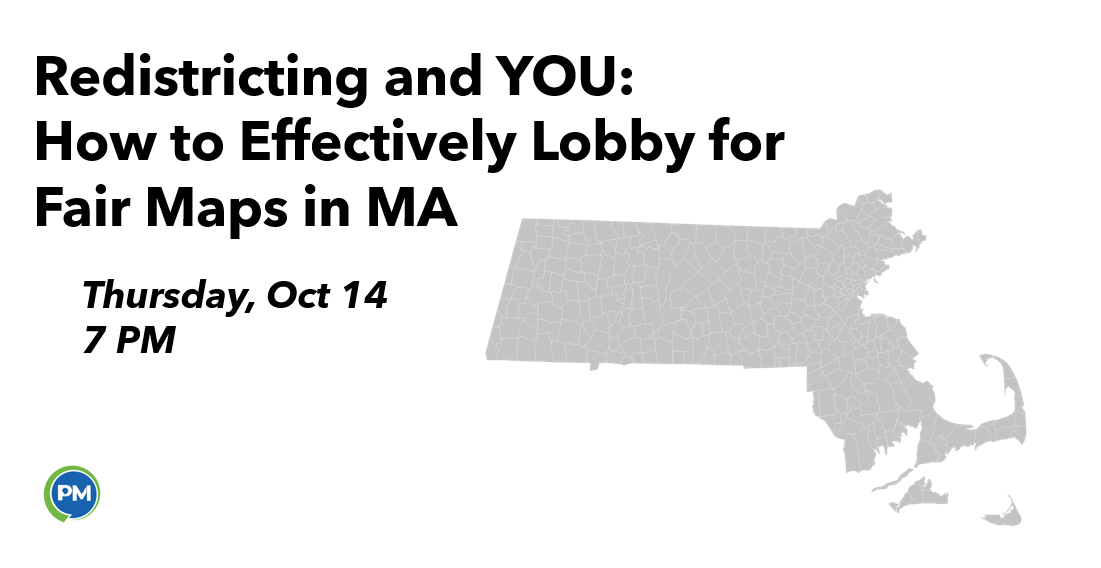
Redistricting and YOU: How to Effectively Lobby for Fair Maps in MA

Redistricting 2021 Event

This year — likely this MONTH, the Massachusetts Legislature will be drawing the legislative and Congressional districts for the next decade. The Drawing Democracy Coalition recently released a Unity Map informed by community groups across the state. What are the key features of this map? How does one set priorities in redistricting? What makes a map fair? And how can we be effective advocates?

We’ll have a discussion with Jordan Berg Powers of Mass Alliance, Beth Huang of the Massachusetts Voter Table, and Roberto Jiménez Rivera of the Boston Teachers Union. (Additional speakers may be announced.)

Missed the event? Watch it here.

Missed

The VOTES Act Is Good. Here’s How It Could Be Better.

Tomorrow, the MA Senate will be taking up the VOTES Act, which contains a number of important pro-democracy reforms such as making expanded early voting and vote-by-mail permanent and enacting Same Day Registration so that voters can register or update their registration at the polls.

The MA Senate deserves credit for advancing a strong and comprehensive bill with popular, time-tested, and effective reforms. But the Senate can also make the bill even stronger by including the following amendments:

Amendment #1 (Hinds): Protecting ballot access for eligible incarcerated people, which would require correctional officials to send incarcerated individuals information about their rights, distribute registration forms and absentee ballots to all eligible voters, and ensure that the votes are collected and transferred to election officials, among other reforms to the jail-based voting language.

Amendment #4 (Rausch): Paid time off for voting, which would guarantee workers 2 hours of paid time off to vote, making sure that long hours are not a barrier to participation.

Amendment #111 (Chang-Diaz): Providing Access for Transliterated Ballots, which provides for transliteration of ballots in languages that do not use the Roman alphabet, thereby ensuring that language is not a barrier to full participation.

Amendment #17 (Rausch): Ensuring Access to Ballot Drop Boxes, which requires municipalities to have at least one secure and accessible drop box location with a requirement that larger ones have at least one secured municipal ballot drop box for each twenty-five thousand registered voters.

Amendments #18 & 19 (Rausch): Ensuring Election Day Registration in All Elections / Ensuring Vote By Mail Access in Municipal Elections, which ensure that the reforms in the bill apply to preliminary and general municipal elections. Amendment #28 (Rausch): Permitting Vote By Mail Ballots to be Returned to Regular Polling Places, which would allow voters to drop off mail ballots at their regular polling locations.

Can you email your state senator in support of these important amendments?


Take Action in Support of #NoCostCalls

Right now, families are charged exorbitant fees to maintain vital connections with incarcerated loved ones. This is a regressive tax on the most vulnerable populations of the Commonwealth that also harms public safety by limiting communication and weakening community bonds .

While only 21 percent of the state’s population is Black or Latinx, more than 54 percent of the people imprisoned by the Department of Corrections are. Black and Latinx children are, respectively, nine and three times more likely than White children to have a parent in prison. As communities already struggle with the high cost of housing, health care, and transportation, no one should be forced to choose between paying rent or buying groceries and maintaining contact with loved ones.

Today, the Judiciary Committee will be hearing testimony on important legislation to eliminate such fees.

Can you submit testimony to the Judiciary Committee in support of the #NoCostCalls bill?


Redistricting and YOU: How to Effectively Lobby for Fair Maps in MA

This year — likely this MONTH, the Massachusetts Legislature will be drawing the legislative and Congressional districts for the next decade. The Drawing Democracy Coalition recently released a Unity Map informed by community groups across the state. What are the key features of this map? How does one set priorities in redistricting? What makes a map fair? And how can we be effective advocates?

Next Thursday at 7 pm, we’ll have a discussion with Jordan Berg Powers of Mass Alliance, Beth Huang of the Massachusetts Voter Table, and Roberto Jiménez Rivera of the Boston Teachers Union.

RSVP HERE.

Rally to Defend Abortion: In Boston & Across MA

Today, just days before the U.S. Supreme Court begins a new session that will include a direct challenge to Roe v. Wade, organizations dedicated to reproductive health, rights, and justice are joining together to demonstrate clearly and unequivocally that we will not allow abortion to be outlawed — and that we are ready to fight to protect, defend, and expand access to abortion for everyone, no matter what.

The biggest rally today will be the one in Boston at 12:00 PM in Franklin Park. RSVP: bit.ly/bostonrallytodefendabortion.

But there are also rallies and standouts in every corner of the Commonwealth. Find the closest one to you here.

In solidarity,

Meg Wheeler

Board, Progressive Mass

Time to Press Pause on Prison Construction

The Massachusetts Legislature is currently considering a proposal to spend $50 million to build a new women’s prison to replace MCI-Framingham.

Backers of the project often tout that the new facility for the approximately 125 women still incarcerated there will be a “trauma-informed” prison. But here’s the problem: there’s no such thing as a trauma-informed prison. Despite the statistics which have proven that incarceration increases the likelihood that a person will reoffend once released, the state continues to pour money into a carceral system that we know does not keep our communities safe and, instead, increases recidivism.

Alternatives to the carceral status quo are necessary and possible, and the first step is to press pause on the construction of new prisons and jails that lock in the current system. That is why we’re supporting S.2030/H.1905, which would impose a five-year moratorium on prison and jail construction

Starting tomorrow (or, if you’re reading this in the morning, “today”), human rights advocates across the state will begin a week-long walk from Springfield to Boston to bring awareness to the need to create such alternatives to incarceration by directly addressing root causes, such as the inability to access housing, food, and jobs.

If you can join for all or part of the walk, RSVP here!

If you can’t join, you can still make a difference by contacting your state legislators in support of S.2030/H.1905. Send them an email here.