Earlier today, our friends at the Massachusetts Immigrant and Refugee Advocacy (MIRA) Coalition held their annual Immigrants’ Day at the State House. The event celebrated victories such as the transformative Driving Families Forward campaign and House vote, a successful and inclusive Redistricting campaign, our Commonwealth’s growing number of immigrant and BIPOC officeholders and candidates, and the promise that these developments hold for creating a more welcoming, safe, and just Commonwealth for immigrants and refugees.
But the work isn’t done yet. And here’s how you can play your part.
Get the Work & Family Mobility Act Over the Finish Line!
The Work & Family Mobility Act would extend eligibility for Massachusetts standard driver’s licenses to all qualified state residents, regardless of immigration status. The bill ensures that all drivers are trained, licensed, and insured, and removes unlicensed driving as a key entry point to the deportation pipeline.
After a House supermajority vote for passage on February 16, the bill is poised for passage by the Senate. Let’s make Massachusetts the 19th jurisdiction (17 states plus Washington, D.C. and Puerto Rico) to issue licenses to all qualified drivers.
Are they already a supporter? That’s awesome! You can still thank them for their support and ask them to urge Senate Leadership to bring the bill to the floor as soon as possible.
Pass the Safe Communities Act!
The COVID-19 pandemic revealed the impact of decades of state and local involvement in deportations—undermining testing, treatment and contract tracing efforts in immigrant communities and impeding access to court and police protection for immigrant victims of exploitation and crime.
The Safe Communities Act would restore trust in local institutions by ending the use of our public safety resources for federal immigration enforcement. Given the Biden Administration’s failure to end local entanglement with ICE, this bill is as important as ever. The Committee on Public Safety and Homeland Security has until May 4th to recommend the bill for passage.
Email your legislatorsand ask them to weigh in with the Joint Committee on Public Safety and Homeland Security before May 4th!
Election Day is exactly 8 months away: November 8, 2022.
In Maine, New Hampshire, Connecticut, and Vermont, prospective voters will be able to register or update their registration at the polls. But in Massachusetts, they won’t be able to because of our arbitrary, exclusionary, and outdated voter registration cutoff.
Late last month, the Massachusetts House of Representatives voted in favor of the VOTES Act, pledging their support for making permanent critical electoral reforms like mail-in and early in-person voting. However, the House chose to leave out the heart of the VOTES Act: Election Day Registration (EDR). Now, because the House and Senate versions of the VOTES Act differ, a small group of legislators are finalizing the bill in conference committee.
EDR has been proven to make elections more equitable and efficient in 20 states. By reducing voter registration barriers, EDR boosts voter turnout for all, especially BIPOC, low-income, immigrant, and young voters. It also decreases administrative burdens of running elections by allowing election workers to update registration information on the spot.
Before November will be the primaries on September 6 to determine who advances. And before that will be the party conventions in June that determine who even makes the ballot in the first place.
Over the past month, Democratic ward and town committees have been holding caucuses to elect delegates to the state party convention. If you want to take part, check out the caucus calendar here to see if your caucus has happened yet or is still to come.
And if you didn’t get elected or can’t make your caucus, you might still be able to become a delegate. You can find additional opportunities here.
Know What’s on the Ballot
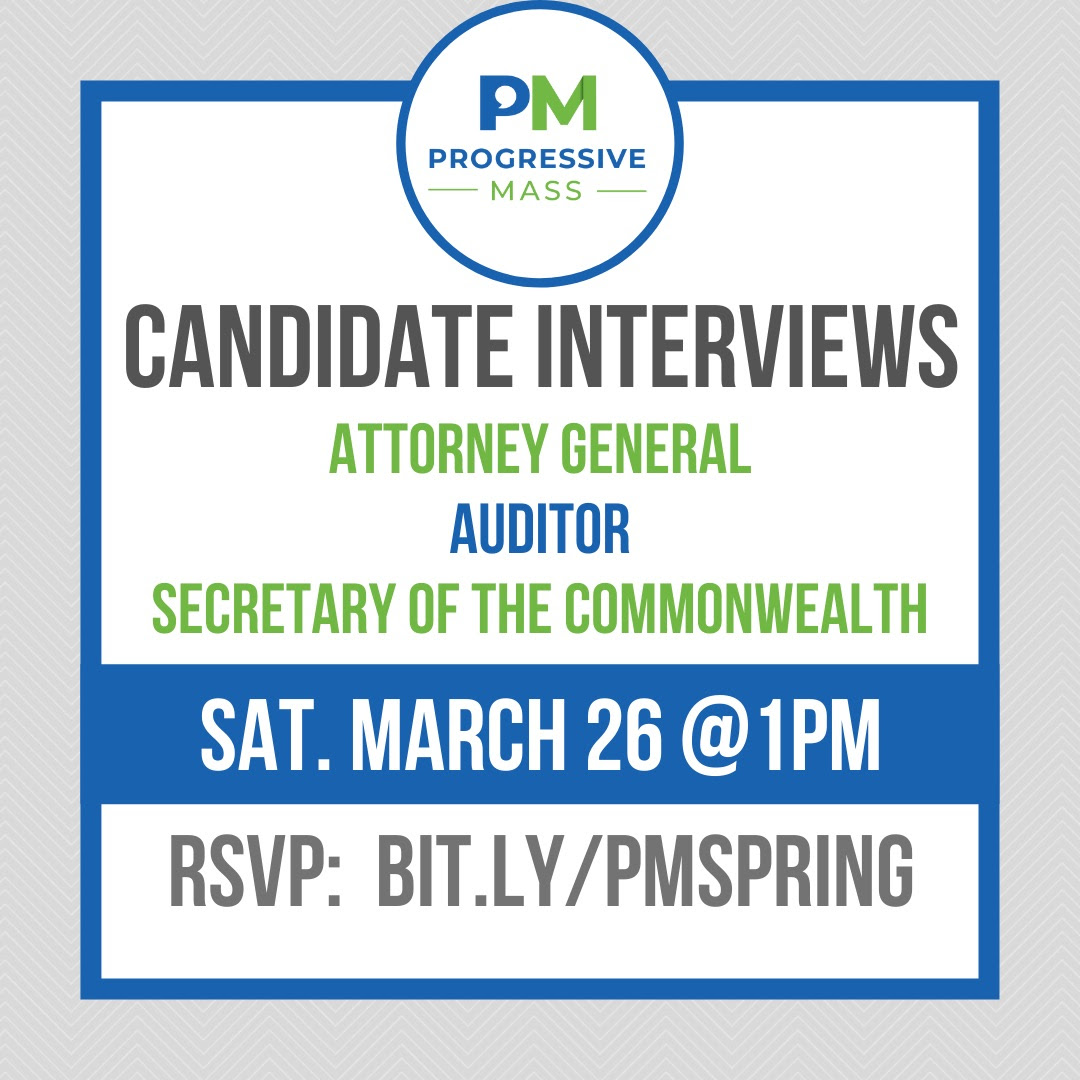
Do you know what an Attorney General, an Auditor, or a Secretary of the Commonwealth does?
Do you want to know?
And do you want to find out more about what the candidates vying for these important statewide positions plan to do with these offices?
Tomorrow, the MA House is voting on a bill to generate revenue for an offshore wind investment fund and establish a slate of tax credits and incentives to promote offshore wind.
Massachusetts is well-positioned to be a leader in the renewable energy economy, but as we grow that sector, it is important that we make sure that all communities, especially the underserved, can benefit from the new opportunities provided.
Last month, the MA House voted 120 to 36 to pass the Work & Family Mobility Act (often referred to as the “Driver’s License Bill”), which would enable all qualified state residents to apply for a standard Massachusetts driver’s license or identification card regardless of immigrant status.
The case for the bill is clear. Many MA residents depend on a car to get to work, to school, to the hospital, etc., and immigration status shouldn’t be a barrier to getting a license. If all drivers have passed the same test and know the same rules of the road, and are properly insured, we all benefit from the safer roads that result.
Despite this, the bill had been stalled in the Legislature session after session. But the years of hard work done by advocates, especially those from immigrant-led organizations, paid off.
“Policy is my love language.” This is a quote that Congresswoman Ayanna Pressley often uses, and it rings so true. If we want to build a society where people truly love, care for, and respect each other, then we need policies that reflect that, rather than policies that dehumanize and marginalize.
Tell Your State Rep to Vote YES on the Work & Family Mobility Act!
Last Friday, the Work & Family Mobility Act was reported out of the Joint Transportation Committee.
This bill would enable all qualified state residents to apply for a standard Massachusetts driver’s license or identification card regardless of immigrant status.
Many MA residents depend on a car to get to work, to school, to the hospital, etc., and immigration status shouldn’t be a barrier to getting a license.
Moreover, the Work & Family Mobility Act would make us all safer. If all drivers have passed the same test and know the same rules of the road, and are properly insured, we all benefit.
The House is expected to vote on the bill soon—possibly as early as this week.
Valentine’s Day Rally to Pass the Jail and Prison Construction Moratorium Bill!
Let’s show love to incarcerated women and love for our communities! Come to the State House with Families for Justice as Healing on Monday from 12-1pm to push the Legislature to pass the Moratorium Bill and free women from Framingham and invest money in what communities really need to thrive! Please wear masks to keep each other safe. Feel free to bring signs with messages like FREE HER, STOP THE NEW WOMEN’S PRISON, or PASS S2030/H1905. RSVP HERE.
Hearts Broken on Slow Solutions, Love is Strong for our Movement
Every day that passes without action breaks our hearts, knowing that Black, Indigenous, People of Color, Immigrant, and all oppressed people are harmed by the status quo. Our frontline movements have worked for years for urgent social change, with some priority bills delayed by our legislature for over a decade. It is with our broken hearts and fierce love for each other that we will gather at the statehouse, united in calling for action.
We will be joining allied organizations in gathering at 3pm on Monday in front of the State House (and on Zoom) to lift up our priorities together. Will we have another year of immigrants in MA denied access to a driver’s license? Will tens of thousands more face needless COVID-19 evictions and foreclosures?
Healthy Youth Act Lobby Day
For over 10 years, the Healthy Youth Act has been our Commonwealth’s opportunity to ensure that public schools that choose to offer sex education provide lessons that are inclusive, comprehensive, and medically accurate.
This Monday, February 14, from 12 pm to 2 pm, the Healthy Youth Act Coalition will be hosting a virtual lobby day to urge the Legislature to pass the bill. RSVP here (and you can email your state rep here if you can’t make it.)
Fighting for a Fair Share from Our Wealthiest Institutional Neighbors
Tuesday, February 15, 6pm – 7:30 pm
Across the Commonwealth, towns and cities are wrestling with the challenges and fiscal burden of expanding nonprofit property tax expansion from some of the wealthiest education and medical institutions in our country. Without a framework for institutional contributions, critical services for residents are threatened. From Western Mass to Greater Boston, from North Shore to South Shore—this issue demands state action. Join us for a discussion on necessary state legislation on payment in lieu of taxes (PILOT) programs and how advocacy organizations and state and local legislators are fighting to win it.
The PILOT Action Group is hosting a discussion with Davarian L. Baldwin, college professor and author of In the Shadow of the Ivory Tower and How Universities Are Plundering Our Cities. Baldwin’s book provides an excellent analysis of the role of large nonprofit institutions in our communities, and presents a vision of a more equitable relationship between communities and these institutions. Register here.
Common Start Coalition Roundtables
The Common Start Coalition is a statewide partnership of organizations, providers, parents, early educators, and advocates working together to make high-quality early education and child care affordable and accessible to all Massachusetts families.
Over the next few weeks, the Common Start Coalition will be hosting a series of roundtable discussions about why long-term investment in child care and early education infrastructure is so critical. Sign up today!
Wednesday, Feb 16, from 6:30pm – 7:30pm: Roundtable discussion on racial justice and Common Start, hosted by Neighborhood Villages and Coalition for Social Justice
Thursday, Feb 17, from 4pm – 5pm: Common Start Roundtable discussion on wraparound services, hosted by Horizons for Homeless Children
Thursday, February 24, from 6:30 pm to 7:30 pm: Common Start Roundtable discussion with religious leaders on affordable childcare
Tuesday, March 1, from 6:30 pm to 7:30 pm: Common Start Roundtable discussion on Building Blocks for a Healthy Future
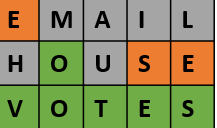
I don’t know what tomorrow’s Wordle will be, but the most important five-letter word in the MA House tomorrow is VOTES.
Why? Because the MA House will finally be taking up the VOTES Act, a voting rights package that makes pandemic-era voting reforms like mail-in voting and early voting permanent.
But there’s a problem. Whereas the Senate’s bill, passed last fall, included Same Day Registration and strong Jail-Based Voting language, the House bill doesn’t.
Maine, Vermont, New Hampshire, and Connecticut all have Same Day Registration, and Massachusetts should too. It’s one of the most proven ways to increase voter turnout. Every single Democratic member of the US Congress supports Same Day Registration, so why doesn’t our Democratic supermajority?
And individuals incarcerated with non-felony convictions maintain the right to vote under the law, but that right often doesn’t exist in practice. We are all worse off when anyone’s right to vote is denied.
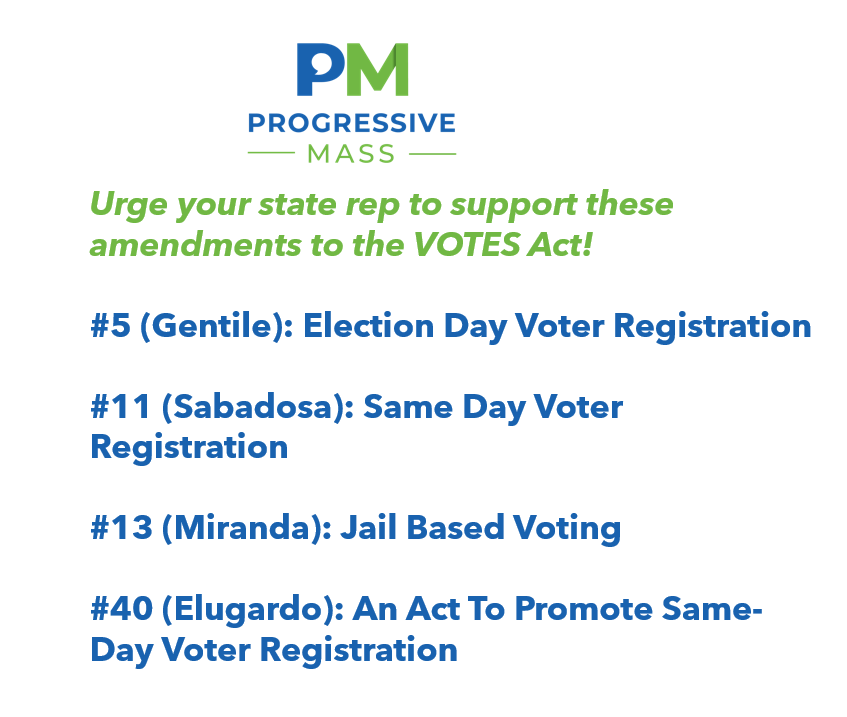
State representatives have already filed amendments to fix this, but your rep needs to hear from you.
Amendments #5, 11, and 40 (Same Day Registration) would enable voters to register to vote or update their registration on Election Day.
Amendment #13 (Jail Based Voting) strengthens reporting requirements for houses of corrections and builds voter registration into the re-entry process.
Last week was a bad week for voting rights in the US Senate, as Senators Joe Manchin and Kyrsten Sinema refused to support rules changes that would allow for important voting rights packages to pass amidst Republican opposition.
But this week—with your help—might be a good week for voting rights in Massachusetts. Last October, the MA Senate passed the VOTES Act, which not only makes vote-by-mail and expanded early voting permanent but also goes further by eliminating our arbitrary, exclusionary voter registration cutoff and strengthening protections for jail-based voting.
The MA House is expected to take up this bill this week: on Thursday, January 27.
It’s important that the House pass the VOTES Act in full, especially the provisions on Same Day Registration and strengthening Jail-Based Voting.
Driving Families Forward Virtual Briefing Series Continues
Join the Driving Families Forward Coalition for part II of the Driving Families Forward Coalition Virtual Briefing series! Over the last year, the Driving Families Forward Coalition has worked tirelessly gaining the support of more than 270 endorsing organizations, including community, health, faith, labor, business, and law enforcement for the Work and Family Mobility Act, which would ensure that immigration status is not a barrier to obtaining a driver’s license.
Tune in on Facebook Live at the Driving Families Forward page Tuesday, January, 25th to hear from law enforcement leaders supporting our legislation across the state.
Common Start Roundtable: Tuesday @ 6:30 pm
Tomorrow at 6:30 pm, the Common Start Coalition will be hosting a virtual roundtable–featuring Congresswoman Katherine Clark–about the child care crisis and the solutions for it, especially the Common Start bill.
Massachusetts Power Forward Day of Action
Climate Justice can’t wait! Massachusetts needs decision-makers to act fast and move more climate justice policy now!
Join the Massachusetts Power Forward coalition this Thursday for a day of action. 9AM – 10AM : Action Hour, call your legislators https://fb.me/e/1i7OF5oNc 12pm- 1pm: Action hour, take a selfie photo petition and post on twitter to push our legislators https://fb.me/e/3lr4Lo33T
Yesterday, on Martin Luther King, Jr. Day, politicians across the Commonwealth (and the country) honored Martin Luther King, Jr., for his commitment to racial equity and social justice.
It was a reminder of how much work we still have to do here in Massachusetts to deliver on his vision, and how we need to demand that elected officials follow through with their rhetoric from yesterday all 365 days of the year.
Three Quick Actions You Can Take Today
(1) Write to Your State Rep in Support of the VOTES Act
While Congress remains stalemated on voting rights action due to Republican and conservative Democratic (we’re looking at you, Joe Manchin and Kyrsten Sinema) opposition, we have important action to take here in MA.
Last fall, the MA Senate passed the VOTES Act, which would make pandemic voting reforms like expanded mail-in voting and expanded early voting permanent as well as enact Same Day Voter Registration and stronger protections for jail-based voting. But the House needs to take action too. Write to your state representative today — and if you already have recently, follow up with them.
(2) Write to the Public Safety Committee in support of the Safe Communities Act.
Immigrant justice and racial justice are deeply intertwined. Longstanding state and local involvement in deportations discourages immigrants from seeking medical care, and prevents immigrant victims and witnesses from seeking police and court protection. Many immigrants—and their children—fear that seeking help from local authorities will result in deportation and family separation.
(3) Pledge to be a Fair Share Voter: For years, Massachusetts’ communities of color have been harmed by inequitable and inadequate access to transportation and public education. Now, the pandemic has heightened these economic and racial inequities that prevent shared prosperity.
The Fair Share Amendment is a transformative opportunity to raise revenue to build a more equitable commonwealth by investing in public education and transportation. Pledge your support for Fair Share today!
Wednesday, Jan 19, 4 pm: Legislative Briefing on No Cost Calls
This Wednesday, the MA Legislature’s Criminal Justice Reform Caucus is hosting a “NO COST CALLS” legislative briefing, open to the public. RSVP here.
They are partnering with the No Cost Calls Coalition and Prisoners’ Legal Services to explain how this legislation will remove barriers to communication between incarcerated people and their loved ones as Connecticut, New York City, Los Angeles, San Francisco, and San Diego Counties have already done. Join this briefing to hear firsthand accounts of the hardships that phone charges impose and the benefits of facilitating family contact. Worth Rises, based on its experience in jurisdictions that have already eliminated charges, will present a fiscal analysis showing how cost-effective this legislation would be.
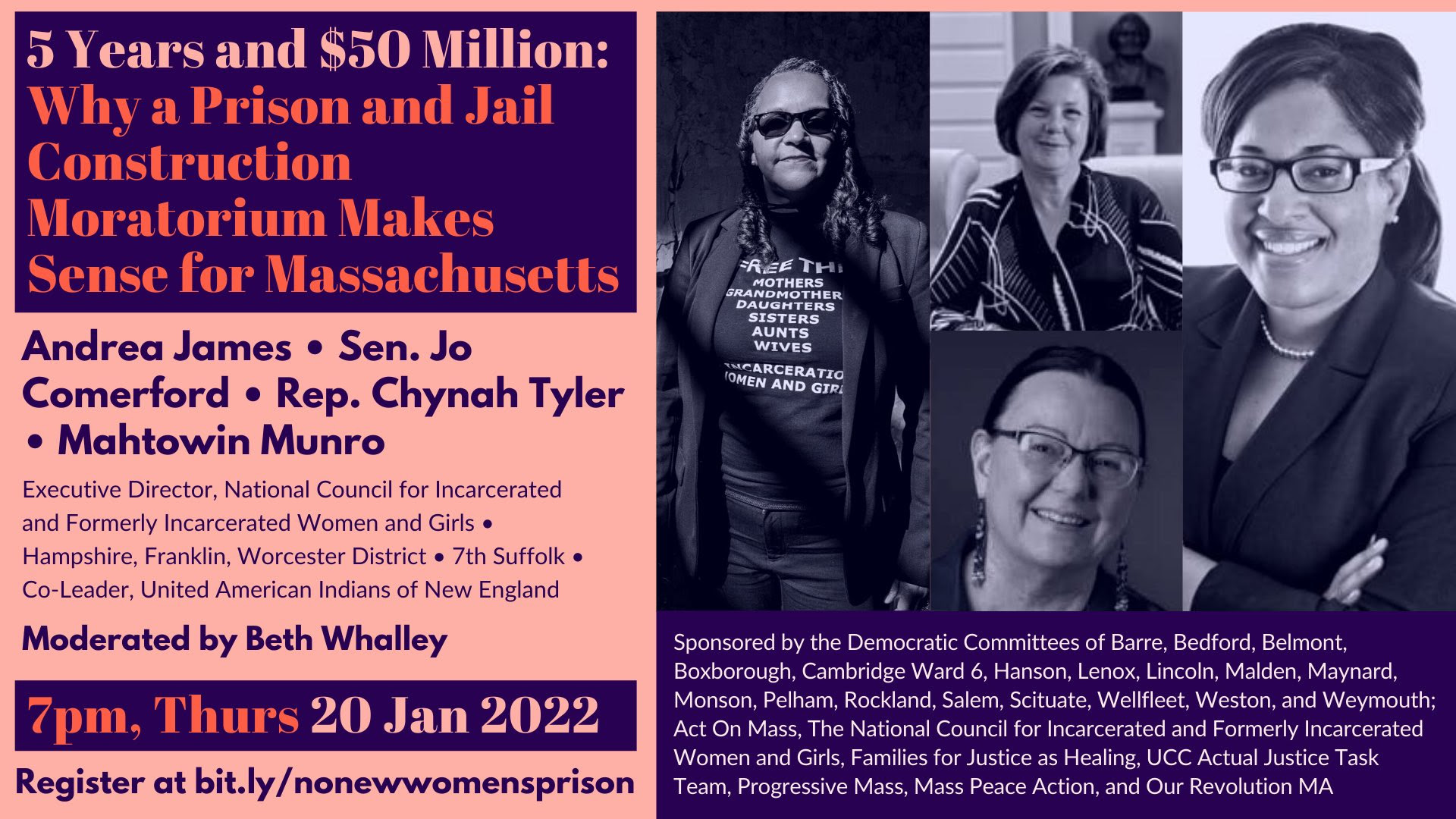
Thursday, Jan 20, 7 pm: #NoNewWomensPrison Virtual Forum
Join this Thursday to learn more about S.2030/H.1905, An Act Establishing A [5-year] Jail and Prison Construction Moratorium, and how to take action to support it. The forum will discuss what this bill does and doesn’t do, how it would be implemented, and what it would mean for Massachusetts to invest $50 million into communities, instead of incarceration.
Featured speakers include bill sponsors Sen. Jo Comerford and Rep. Chynah Tyler along with Mahtowin Munro of the United American Indians of New England, and Andrea James of Families for Justice as Healing and The National Council for Incarcerated and Formerly Incarcerated Women and Girls.
Today, most Massachusetts residents will be experiencing subzero temperatures due to wind chill.
And too many working-class people will have to decide whether they can afford sufficient heating (or sufficient winter clothing) and still afford next month’s rent, a decision no one should have to make.
At the same time, we’re in the midst of a pandemic that has made clear that quarantining at home is impossible if you don’t have a home to go back to, and that too many workers are faced with the dire choice of going into work while sick or not having enough money to pay rent.
What both show is that we need to be doing far more for housing stability in our state amidst escalating rents and the displacement that results.
This morning, the MA Legislature will hear testimony on the Tenant Protection Act (S.886/H.1378), a bill from Sen. Adam Gomez and Reps. Mike Connolly and Nika Elugardo that would lift the statewide ban on rent control and enable municipalities to take action to support housing stability in line with the needs and conditions of each community.
No one policy is a silver bullet, but local leaders need to have every tool in the toolbox to address our housing crisis.
Here are ways that you can show support for the bill:
Submit written testimony: Send in your comments and ask others to do the same. You can use the form here.
2022 is going to be an eventful year. We’re kicking it off with our annual member meeting on Saturday, January 22, from 1 pm to 4 pm. We’ll have an update on our work from the past year as well as what’s in store for 2022. We’ll also be featuring interviews with 2022 Gubernatorial and Lt. Gubernatorial candidates.
The first segment of the Annual Member Meeting will offer members updates on our organization, plans, and a chance to meet nominees for the Board (to be voted on after). The remainder, the bulk of the meeting, is open to all for the candidate interviews.
Next Tuesday: Hearing on the Tenant Protection Act
Next Tuesday, the MA Legislature will hear testimony on the Tenant Protection Act (S.886/H.1378), a bill from Sen. Adam Gomez and Reps. Mike Connolly and Nika Elugardo that would lift the statewide ban on rent control and enable municipalities to take action to support housing stability in line with the needs and conditions of each community.
Here are ways that you can show support for the bill:
ways that you can show support for the bill:
Submit written testimony: Send in your comments and ask others to do the same. You can use the form here.
Testify at the hearing. You need to sign up by 5 pm today.


.jpg)


.png "Common Start Roundtable")