Progressive Newton Joins Educators to Urge a YES Vote on Upcoming Overrides

Activists urging a YES vote for an upcoming override

By Andrew Steinberg, Progressive Newton

On February 14th and 15th, Progressive Newton co-organized standouts with the “Yes for Newton” campaign and Newton Teachers Association to support the three Override votes on Tuesday, March 14th. During the standouts, hundreds of volunteers at 21 schools showed solidarity with Newton educators and community members who recognized the importance of “Yes” votes for the special election. 

The first “operating override” would raise $9.175 million, approximately half of which would go to the Newton Public Schools to help cover staffing and operating costs. The other half would go towards street and sidewalk improvements, park/playground maintenance, programming for senior residents, and climate resiliency projects such as electrifying school buildings and bolstering the city’s tree canopy. The second and third “debt exclusion overrides” would raise $3.5 million and $2.3 million to replace the Countryside Elementary School and the Franklin Elementary School respectively. Both of these schools are overdue for changes. For example, the Countryside School is infamously built so low on wetlands that a learning area in the basement chronically floods and smells like sewage. The state government has recognized the facility as one of the worst in the Commonwealth, and has promised to pay for 25-30% of the costs if Newton funds the rest. 

The Override votes are happening during a special election because a Massachusetts law enacted in 1980 strictly limits the amount of property tax revenue a community can raise. Under state law, the maximum amount a community can levy in any given year is called the “levy limit.” Currently, a community’s levy limit increases automatically by an incremental amount of 2.5% of the prior year’s levy limit. However, by passing an Override, a community can assess taxes in excess of the automatic annual 2.5% increase. Voters must approve this increase above 2.5%.

Historically, cities like Newton have relied on Overrides to raise money for large capital projects. In 2013, the city passed its last Override to rebuild the Angier, Cabot, and Zervas Elementary Schools. Over the last decade, costs for the city have increased due to rising prices of construction materials, equipment, healthcare, transportation, and labor. These prices have shot up even more over the last two years due to inflation. Additionally, new municipal services such as full-day kindergarten, increased mental health supports in schools, and necessary technological infrastructure for students have increased costs. Given that these expenditures would be continuous and the city does not merely want to force the bill on future generations through taking on debt, an Override is the best way to ensure that the funding is both adequate and consistent. 

While the benefits of the Override votes are clear (such as better educational facilities with robust services, and a more sustainable city with greater amenities), the costs of not supporting them are also. According to the Mayor, “without the override, [Newton Public Schools (NPS)] is looking at a potential shortfall of $6 to $8 million which will require extensive reductions to educational services and infrastructure” (“Mayor’s Update,” Jan. 24, 2023). NPS leadership asserts that if the three questions did not pass, the city would have to eliminate 40 to 50 educator positions, resulting in larger class sizes from kindergarten through 12th grade. Elective options would also decrease, and many academic/social/emotional support roles for students and athletic/music/theater programs would be cut. 

Progressive Newton believes that now is not the time for holding back on education funding and reducing school services. The pandemic showed us that the previous system was not enough, and the disparities that the crisis exacerbated will have major consequences for years to come. For this reason, we are proud to support the Newton Teachers Association to advocate for the excellence that our students deserve. Until the 14th, we will be informing our neighbors about the importance of the Override votes and the opportunity to build a better Newton than the one we had before. 

Flyer for the "Show Love for our Schools!" standouts
Activists holding signs for Yes for Newton
Pictures from the Oak Hill/Brown Middle School standout, organized by Progressive Newton volunteers

Less Than Six Weeks Before the End of the Session. But This Happens Before.

The Legislative session will be over in just under six weeks, but there’s one key deadline that’s earlier than that: the state budget deadline, which is just around the corner on June 30.

The Legislature doesn’t always meet that deadline (pushing things into July), but it still exists. And that means action has to happen quick.

Here are three key areas to contact your legislators on:

*Equitable Approaches in Public Safety: The Senate budget included language to increase funding to $3.5M for the Equitable Approaches to Public Safety (EAPS) program (line item 4512-2020). This language and funding will allow municipalities to create community-based alternative crisis response models centered around social and emotional health professionals like social workers and peer support specialists.

*Early Education and Child Care: The House and Senate both included new funding for early education and child care in their budgets. They increased funding in different ways, but, as the Common Start Coalition has argued, if the priorities of both chambers make it into the final budget, it would represent a substantial step toward implementing the coalition’s full vision of a high-quality early education and childcare system that is affordable and accessible for all families.

*No Cost Calls: Both the House and Senate budgets included language to provide persons who are incarcerated with access to free phone calls or similar forms of communication. It is unconscionable that prisons and jails have been price-gouging incarcerated individuals and their families for years, and it’s important that this provision is a part of the final budget.

Can you contact your state legislators in support of these three budget priorities?

TONIGHT: Community Forum on Suffolk & Plymouth County DA Races

We’ll be joining community partners from the Justice for Massachusetts coalition for a forum with the Suffolk and Plymouth County DA candidates TONIGHT from 6 pm to 9 pm.

6:00 pm – 7:00 pm: Kevin Hayden (Suffolk County)

7:00 pm – 8:00 pm: Rahsaan Hall (Plymouth County)

8:00 pm – 9:00 pm: Ricardo Arroyo (Suffolk County)

RSVP here.


TOMORROW: The ‘Segrenomics’ of Education

Many of the educational issues and controversies we face today — state takeovers, standardized testing, charter schools, many more — have interconnected historical roots and mutually reinforcing current impacts that result in huge gaps in school quality and huge gaps in student opportunity. Understanding that history is crucial for finding solutions.

Tomorrow at 7:00 pm, join the important discussion with Dr. Rooks about her research on segrenomics, connecting the dots between economics with segregated schooling and community organizers from across the state on their work.

RSVP here.


WEDNESDAY: Education Budget Briefing

On Wednesday at 4 pm, join the Massachusetts Education Justice Alliance, MassBudget, and the Massachusetts Teachers Association for a briefing on the education budget, including discussions of the state budget, budget supplemental, the American Rescue Plan (ARPA), and the Fair Share Amendment.

RSVP here.

Education Budget Briefing

In solidarity,

What’s in the MA House Budget….And What Could Be.

First of all, happy Earth Day! This Earth Day, I’m thinking about how the investments from the Fair Share Amendment will help us improve our public transit systems, a vital part of our response to climate change (as well as reducing air pollution and expanding economic opportunity). The Fair Share campaign recently launched new social media accounts, so if you haven’t followed them yet, make sure to do so on Facebook, Twitter, and Instagram.

A Budget Is a Moral Document

Last week, the MA House Ways & Means Committee released its budget for the next fiscal year.

The Good: The budget avoids the regressive tax cuts for the rich proposed by Republican Governor Charlie Baker, includes the new investments in public schools required by the Student Opportunity Act, and ends the exploitative practice of charging incarcerated individuals for phone calls to loved ones.

The Bad: At the same time, the budget continues our chronic underfunding of public transit and fails to deliver on the investments in child care necessary for true affordability and accessibility.

How the Budget Could Be Better: The House will be considering various amendments next week to improve the budget and better deliver on the promise of shared prosperity and justice for all.

Can you contact your state rep in support of these amendments?

Voting Access for All

Amendment #47 (New American Voters Fund), filed by Reps. Ultrino & Donato: Would allocate $4 million to municipalities and community organizations to hire bilingual election workers, pay for professional translators and interpreters, and train elections departments.

Justice for All

Amendment #902 (ACES), filed by Rep. Sabadosa: Would ensure that every call to 911 gets the best response by providing funding to communities that want to develop alternatives to police response for calls better handled by mental and community health providers, like social workers and peer specialists.

Amendment #936 (Community Empowerment and Reinvestment Grant), filed by Rep. Mary Keefe: Would provide $15 Million for the Community Empowerment Reinvestment Grant Program, which funds reentry and intervention programs.

Amendment #1346 (Youth Bail Fees), filed by Rep. Fluker Oakley: Would (1) eliminate the statutorily-required $40 administrative bail fees charged to juveniles when they are arrested overnight and (2) shift the decision to release a child to their parent or to impose cash bail decisions from the police officer on call to the Bail Magistrate, a neutral 3rd party.

The House budget remains poised to earmark millions of dollars for the incarceration of men civilly committed for treatment of substance use disorder under the statute known as “Section 35” (M.G.L. c.123 s.35).

  • Amendment #332 (Section 35), filed by Rep. Balser: Would eliminate the Governor’s proposed funding for correctional section 35 facilities.  
  • Amendment #333 (Access to Addiction Services), filed by Rep. Balser: Would ensure sufficient bed space in DPH or DMH facilities for men committed under section 35.

Economic Security for All

Amendment #181 (Lift Kids Out of Deep Poverty FY23), filed by Rep. Decker: Would raise cash assistance grants for very low-income families with children, elders, and persons with disabilities by 20% for FY 23.

Amendment #640 (Excluding Temporary COVID Relief Income from FY23 Means Testing), filed by Rep. Elugardo: Would ensure that economic assistance from the CARES Act does not count against anyone’s eligibility for means-tested public assistance programs.

Amendment #802 (Including underemployed and unstably housed youth in “at-risk”), filed by Rep. Elugardo: Would add a focus of creating economic opportunity for youth experiencing homelessness to the YouthWorks Youth Jobs program.

Amendment #881 (Massachusetts Rental Voucher Program), filed by Rep. Madaro: Would cap tenant rent share to 30% income instead of 40% and expand mobile vouchers to cover tenant-paid utilities, among other measures.

Amendments #1068 (RTA Funding) & #1070 (RTA Funding Distribution), filed by Representative Sarah Peake: Would make $101 million in base funding available to the RTAs (an increase from $94 million).

Amendment #1268 (Housing Protections), filed by Rep. Moran: Would extend Chapter 257 eviction protections to cases where landlords seek to recover arrears for non-payment of rent – effectively closing the non-payment loophole – and require landlords to participate in the rental assistance process in good faith before being permitted to file an eviction case in court.

Amendment #1371 (Rental Assistance for Families in Transition), filed by Rep. Decker: Would expand eligibility for RAFT to households with incomes from 50% of the area median income (AMI) up to 60% AMI.

Safe & Welcoming Schools for All

Amendment #1133 (Targeted Intervention to Enhance the Learning of Students in Early Grades), filed by Rep. Uyterhoeven: Would provide funding for student specific supports and interventions that enhance learning during preschool through the third grade and that support the elimination of disciplinary sanctions for this population of students

Amendment #1138 (Student Wellness School Support), filed by Rep. Uyterhoeven: Would provide funding to reduce school exclusion for students in prekindergarten through the third grade by utilizing best practices, increased parent engagement and community-based services to support teachers and school staff to employ alternatives to suspensions and expulsions to address student misbehavior in the early grades

Amendment #1321 (Holistic School Health and Safety Practices Grant Program), filed by Rep. Khan: Would create a grant program, administered by the state’s Department of Elementary and Secondary Education, to support public schools and school districts in transitioning to safety models that do not rely on stationing police in schools.

Can you contact your state rep in support of these amendments?

Common Start Rally on Saturday + State House Staff Union

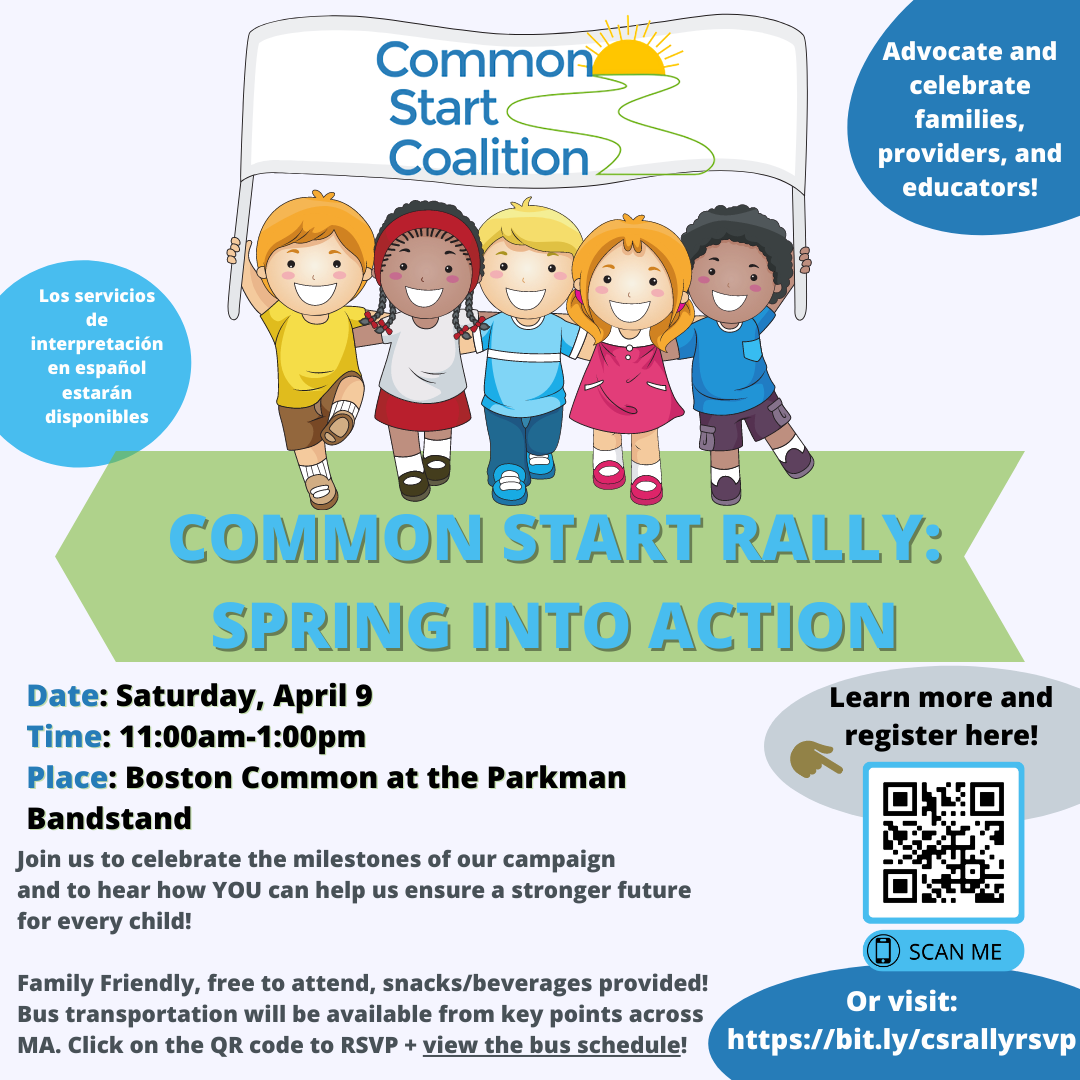
This Saturday, parents, families, child care providers and workers, and activists across the state will be joining the Common Start Coalition for a rally on the Boston Common to highlight the need for robust child care and early education infrastructure.
Date: Saturday, April 9
Time: 11:00am – 1:00pm

Place: Boston Common at the Parkman Bandstand

RSVP at https://bit.ly/csrallyrsvp

The rally is family-friendly and free to attend. Bus transportation with snacks and beverages will be provided from key locations across Massachusetts.

Can’t make the rally? Send your state legislators an email in support of the bill!

Common Start Rally

Show Your Support for MA Senate Staff

Earlier this week, members of the MA State Senate staff announced that after years of staff organizing, they achieved the number of authorization cards necessary to form a MA Senate staff union. On Thursday, March 31, representatives of the International Brotherhood of Electrical Workers Local 2222 (IBEW) notified Senate President Karen Spilka of the successful majority and requested voluntary recognition of the Massachusetts State House Employee Union, which will become the 2nd state legislative staff union in United States history.

Show your support for the MA State House Employee Union here.

Our Students Deserve an Inclusive Curriculum

Classroom

Monday, September 13, 2021

Chairman Lewis, Chairwoman Peisch, and Members of the Joint Committee on Education:

My name is Jonathan Cohn, and I am the chair of the Issues Committee at Progressive Massachusetts, a statewide grassroots advocacy group committed to a more equitable, just, democratic, and sustainable vision for Massachusetts.

We urge you to give a favorable report to S.365/H.584: An Act relative to anti-racism, equity and justice in education (Lewis – Elugardo / Uyterhoeven).

The events of the past year and a half have put a spotlight on the racial inequities in US society: the COVID-19 pandemic, the growing attention to police brutality since the George Floyd murder, and the rise of anti-Asian racism—not to mention how the January 6th attack on the US Capitol manifested the dark legacy of racism and white supremacy in our country’s past and present.

Our schools need to be equipping students with the tools and knowledge to understand the totality of our country’s history, to critically engage with current events, and to be agents of change in their communities. And we need to ensure that all students can see the contributions that people who look like them made to our nation’s history by teaching history in its fullest.

These bills would do so by creating a Commission for Anti-Racism and Equity in Education, with members chosen from advocacy groups, teacher and superintendent unions and associations, and parent groups, to develop curriculum materials with a social justice perspective and to ensure that ethnic studies and racial justice are taught at all grade levels using an analytical and age-appropriate approach. The Commission would also be tasked with advising the Department of Elementary and Secondary Education on how best to support and retain teachers and school counselors of color and with ensuring that teachers and counselors have access to professional development that fosters an equitable and inclusive pedagogy.

Thank you for your work on this important legislation.

Sincerely,

Jonathan Cohn

Chair, Issues Committee

Progressive Mass

“It is far past time for us to stop shortchanging our students.” (Redux)

Graduation cap on a stack of books

The following testimony was originally submitted to the Joint Committee on Higher Education on April 30, 2019. Since neither bill passed the Legislature in the 2019-2020 session, the testimony was updated for new bill numbers and resubmitted on May 18, 2021.

Tuesday, May 18, 2021

Chairwoman Gobi, Chairman Rogers, and Members of the Joint Committee on Higher Education,

My name is Jonathan Cohn, and I am the chair of the Issues Committee of Progressive Massachusetts, a statewide multi-issue grassroots organization committed to fighting for social justice and progressive policy. Since our founding, treating education as a public good and funding it as such has been central to our mission.

As such, we strongly support S.829 / H.1339, An Act to guarantee debt-free public higher education, and S.824 / H.1325, An Act committing to higher education the resources to Insure a strong and healthy public higher education system (or CHERISH), and urge you to report them out favorably.

Since 2001, Massachusetts has cut funding for public higher education by 14 percent. However, at the same time that our state was retrenching from investing in our future, enrollment was going up. As a result, per student funding has fallen by 32 percent, almost a third.

When the state pulls back, the cost burden falls onto students. Massachusetts saw some of the highest tuition and fee increases in the country from 2001 to 2016, particularly during the recession. The share of costs borne by students and their families doubled, putting a degree out of reach for more and more students, especially those of disadvantaged backgrounds.

Today, the average graduate from our state universities and the UMass system leaves with over $30,000 in student debt—the tenth highest in the country. The average debt for graduates of public, four-year postsecondary schools grew faster in Massachusetts than in all but one other state from 2004 to 2016.

A postsecondary degree provides a proven premium in lifetime wages for graduates and countless other opportunities. Cost should not be a barrier. By preventing young people from living independently, buying a home, or pursuing their career of choice, college debt is a drag on our economy. Even when students drop out due to cost, they can be saddled with debt for years after.

It is far past time for us to stop shortchanging our students. Investing more in public higher education, as the CHERISH Act would require, and making public higher education debt-free would benefit not only students. When financial concerns are no longer a hindrance for people seeking to realize their full potential, we all benefit.

Sincerely,

Jonathan Cohn

Chair, Issues Committee

Progressive Massachusetts

MassLive: MA’s Struggling Higher Ed Sector

PM Issues Committee chair Jonathan Cohn was quoted in MassLive‘s Shira Schoenberg’s write-up of a bill passed by Beacon Hill to keep a closer eye on the financial conditions of the state’s colleges and universities in light of a spate of recent closures:

While the bill passed unanimously with no debate, the liberal advocacy group Progressive Massachusetts criticized lawmakers for not going far enough. Jonathan Cohn, chair of the issues committee for Progressive Massachusetts, said in a statement, “Making sure that students and the state are aware of a college’s imminent closure or tenuous financial status is great, but it doesn’t do anything to make higher education more affordable for Massachusetts families.”

The Student Opportunity Act is a Win. Let’s Make it Better.

Four years ago this very month, the Foundation Budget Review Commission highlighted how the state has been shortchanging public schools due to an outdated funding formula.

Because of the advocacy of teachers, students, parents, community members, and YOU, that formula will finally get fixed.

The Student Opportunity Act will provide $1.5 billion per year in new school funding to help the students who need it the most.

Tomorrow, when the MA Senate votes on the bill, we have an opportunity to strengthen it so that this once-in-a-generation bill is as strong as possible.

For that to happen, your senator needs to hear from you–to hear that you support the bill’s passage and support the following amendments:

  • #17 (Targeted Improvement Plans), which increases community and educator involvement in school districts’ plans to reduce disparities — and requires charter schools to create such plans as well
  • #19 (Charter Cap Reimbursement), which caps the number of charter schools and charter school seats for any year in which the state fails to fully fund the charter school mitigation account.
  • #27 (Analyze Impact of Proposition 2 1/2), which requires a study of the impact on this regressive tax law on municipalities’ ability to provide a high-quality education to all students
  • #53 (Ensuring Proportional Phase-In), which makes sure that all of the updates get phased in at the same pace so that low-income students don’t get left behind
  • #61 (Charter School Reimbursement Accountability), which requires the Commonwealth to draw funding from charter schools to ensure full reimbursement to public schools
  • #63 (Following Through On Our Commitments), which makes sure that the Legislature fully funds charter reimbursements.

Find your senator’s email and phone number here. And then tell them to support the Student Opportunity Act as well as amendments #17, #19, #27, #53, #61, and #63 so that we can deliver on our promise to all students.

Can we count on you to make that call or send that email?

Are Your Legislators Keeping It 💯 for Our Students?

In the 1980s, steep cuts in property taxes strained school budgets across the state, creating gaping inequalities between the richest and poorest communities.

In response to that, parents from Brockton sued the state, claiming that it was failing to meet its constitutional obligation to “cherish” education for all students. This language written goes all the way back to John Adams.

In June of 1993, the Legislature responded to this lawsuit — and the underlying funding crisis — by passing the Education Reform Act, which has shaped the course of public education in Massachusetts since.

One core part of ensuring that every student got a quality public education was the Chapter 70 formula.

Here’s how it worked:

(1) Calculate a “foundation budget“: A district ‘s foundation budget is determined by multiplying the number of students at each grade level and demographic group (e.g., low-income students and English Language Learners) by a set of education spending categories (e.g., teacher compensation, building maintenance) and totaling those numbers up.

(2) Calculate a required local contribution: This is done by looking at incomes and property values. In other words, how much can a city or town contribute based on the resources that it has?

(3) Fill the gap with state aid. And if districts can and want to, they can choose to spend more than their required contribution.

And this worked! Well, at first.

Some things from 1993 last forever.

I Will Always Love You gif

But most haven’t. And the assumptions built into this formula are now out of date.

The Legislature knows this, too.

In 2015, a commission created by the Legislature (the Foundation Budget Review Commission) found that we are underfunding state aid to public school districts by up to $2 billion a year due to outdated assumptions about the cost of health care, special education, English Language Learner education, and closing income-based achievement gaps.

That’s a lot of money!

And as a result, we have one of the most unequal public education systems in the country. All students lose out due to our outdated funding formula, especially the students who need extra help the most.

Wow, we really need to see action on this. What can I do?

The Legislature has been debating various proposals this year. Some, like the PROMISE Act (part of our Legislative Agenda), provide a comprehensive solution. Others are less far-reaching or have some provisions that could make inequities even worse.

It’s important that when legislators take action this fall, they get it right. 

That means providing 100% additional funding for the poorest students so that all students, regardless of income, have the opportunity to succeed.

For that to happen, your legislators need to hear from YOU, their constituents. They have to vote well for you to continue to vote for them to represent you. It’s that simple.

Are we a state that believes in high-quality public education for all students, or are we not?

Keep it 100

So here’s what you can do:

(1) Look up your legislators’ phone numbers and email addresses here. (Put the numbers in speed dial!)

(2) Explain that you need them to commit to 100% additional funding for the poorest students. They need to be communicating this to House Leadership. (If they send a letter, ask them to send you a copy).

Here’s a sample script:

Hello, my name is [YOUR NAME], and I am a constituent from [YOUR NEIGHBORHOOD/CITY/TOWN].

It’s been almost four years since a commission created by the legislature showed that we are underfunding our public schools by up to $2 billion a year due to an outdated funding formula from 1993. It’s far past time for the Legislature to update this formula, and we have to do it right.

A good bill will do right by all our students, especially the most vulnerable. And that means providing 100% additional funding for the poorest students.

I urge you to only support a bill that delivers on this promise of quality public education for all and to communicate this to Speaker Bob DeLeo and Education Chairwoman Alice Peisch.

Can I count on you to send a letter to them outlining your demands for an education funding bill?

[If time, personalize the issue by referencing the needs of your own school district or speak about your own experience as a student/teacher/parent/community member.]

(3) Let us know how the call went.

(4) Set yourself a calendar reminder for one week to call again.

(5) Ask five of your friends to do the same.