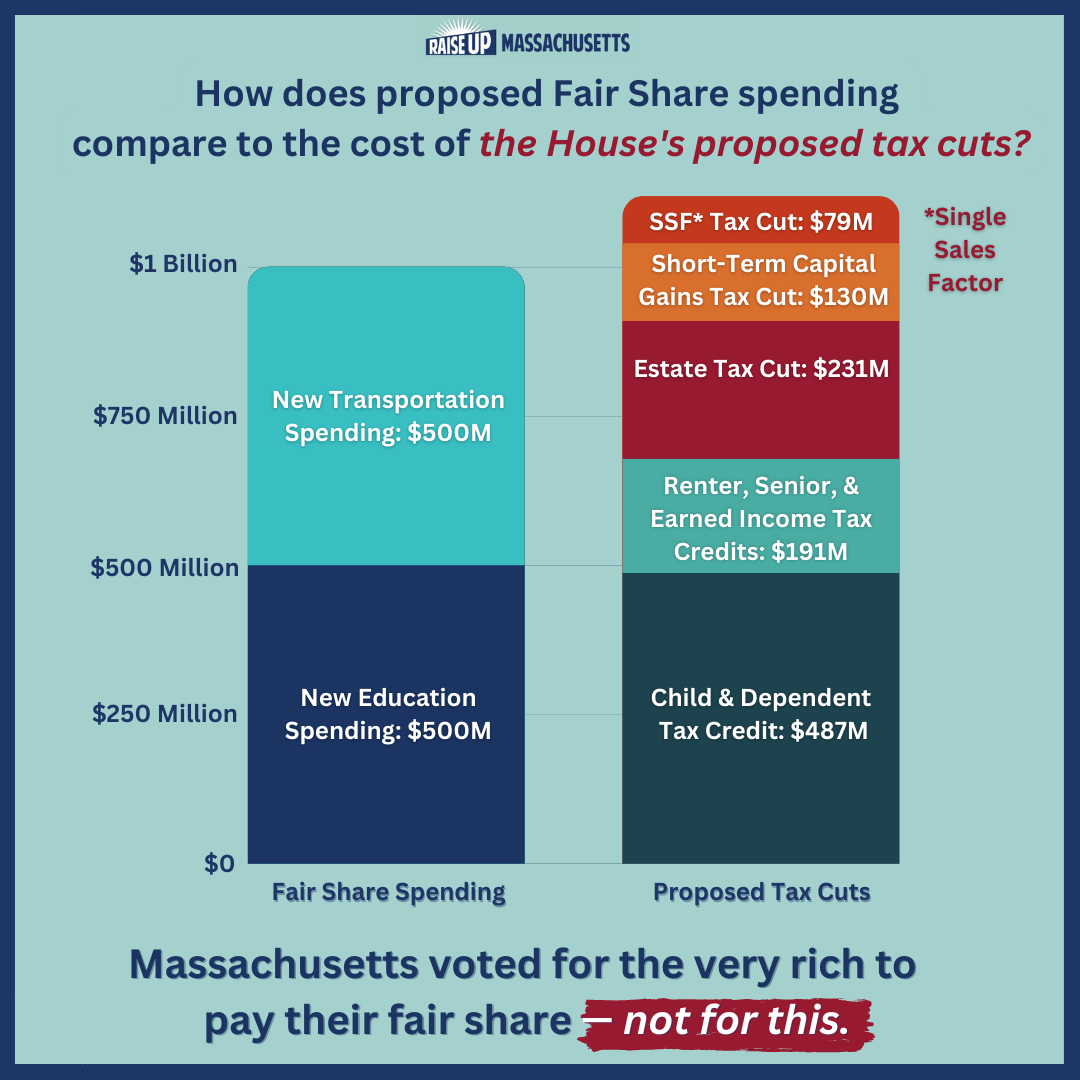
Last year, voters like you showed up in November to vote for the Fair Share Amendment because you understood the importance of a fairer tax code and greater investment in public education and transportation. And you didn’t just show up to vote — you canvassed, phone-banked, text-banked, tabled, spoke to neighbors, and much more.
Now that Governor Maura Healey has signed the FY 2024 budget, we can see how much the Fair Share Amendment has delivered in its first year. Let’s take a look.
$229 million for public colleges and universities
$224 million for K-12 public schools
$70.5 million for early education and care
$175 million for roads and bridges
$95.7 million for regional public transit
$205.8 million for the MBTA
For early education and K-12 public education, that means….
For public higher education, that means….
For roads, bridges, and regional transit, that means….
The new revenue raised by the Fair Share Amendment could be at risk this fall if the Legislature passes major tax giveaways for the ultra-rich and large corporations.
Massachusetts needs to prioritize spending on what will make our state truly affordable, equitable, and competitive: programs that support working people and ensure a labor force adequate to our economy’s needs. That, in turn, requires that families have affordable housing, childcare, educational opportunities, and reliable transportation to make it possible for them to work, gain skills, and earn a good living.
We need to act NOW to protect the Fair Share Amendment from tax avoidance, and ensure that Massachusetts can invest more in our schools, colleges, roads, bridges, and public transit systems. At the same time, we need to make sure our legislators don’t give away billions of dollars to the ultra-rich.
At a time when the state’s economic outlook is uncertain, and working families are struggling to get ahead, Massachusetts needs to prioritize spending on what will make our state truly affordable, equitable, and competitive: programs that ensure a labor force adequate to our economy’s needs, not tax cuts for the ultra-rich.
That group of six negotiators, called a “Conference Committee,” consists of Senate Ways & Means Chair Michael Rodrigues (D-Westport), Senate Revenue Chair Susan Moran (D-Falmouth), Senate Revenue Ranking Minority Ryan Fattman (R-Sutton), House Ways & Means Chair Aaron Michlewitz (D-North End), House Revenue Chair Mark Cusack (D-Braintree), and House Revenue Ranking Minority Michael Soter (R-Bellingham). And they need to hear from your legislators.
We’re joining Raise Up Massachusetts in support of five key demands for the Conference Committee.
Reject the proposed cut to the short-term capital gains tax, which would overwhelmingly benefit wealthy investors who are engaged in complex hedged investment strategies.
Reject the expansion of the corporate tax policy called ‘single sales factor apportionment,’ which gives a massive tax break to large, profitable multinational corporations that already don’t pay their fair share.
Minimize the budgetary cost of estate tax reform by limiting the benefits that are extended to estates above $2 million
Protect the revenue from the Fair Share Amendment by closing the “Single Filing Loophole,’ which could prevent Massachusetts from losing between $200 and $600 million in Fair Share revenue each year.
Make the outdated 62F tax giveaway system more fair by ensuring an even distribution of any future 62F rebates, rather than maintaining the current system that overwhelmingly benefits the ultra-rich, out of proportion with their contribution to overall state taxes.
Chair Moran, Chair Cusack, and Members of the Joint Committee on Revenue:
My name is Jonathan Cohn, and I am the Policy Director of Progressive Massachusetts, a statewide grassroots advocacy group committed to fighting for an equitable, just, democratic, and sustainable Commonwealth.
We urge a favorable report for H.2963 and S.1836: An Act relative to payments in lieu of taxation by organizations exempt from the property tax (Rep. Uyterhoeven & Sen. Gomez).
Massachusetts is lucky to be home to many world-class hospitals and universities. But these large institutions, despite often operating indistinguishably from for-profit institutions, do not have to pay taxes. Given their large footprint, that is a fiscal drain for many communities across the Commonwealth, especially as communities are looking to find much-needed funds for investments in schools, housing, and infrastructure.
This bill would address this discrepancy by requiring large hospitals and universities to pay 25% of commercial property taxes to municipalities, based on the Payment in Lieu of Taxes (PILOT) agreement in Boston. Under this bill, municipalities could opt in to requiring a mandatory PILOT rather than having to engage in drawn-out negotiations or chasing down institutions one by one.
Why 25%? This number reflects the costs posed by such large institutions to municipal services like police, fire departments, and departments of public works. It is still a good deal for the institutions, who are still paying far less in property taxes than an individual would have to pay. And, by applying only to institutions with property worth over $15 million, the bill would avoid risking any adverse impact on smaller institutions.
We need to be empowering municipalities to take action to address the many crises before us, but they need the funds to do so. Our cities and towns are severely limited in how they can raise funds, as municipal budgets are disproportionately based on property taxes—and we are stuck living in the misguided Reagan-era holdover of a “Prop 2 ½” regime. If our cities and towns have wealthy institutional neighbors, they shouldn’t be forced to be stuck in struggling fiscal straits.
Earlier tonight, the MA Senate passed a $586 million tax reform package. As I noted earlier today, the MA Senate’s tax reform package was a much better proposal than the House’s:
The Senate bill rejects the proposed $117 million tax cut for day traders and speculators proposed by Gov. Healey and passed by the MA House in April. Notably, both chambers rejected this idea last year when Governor Baker proposed it.
The Senate bill rejected a $79 million corporate tax giveaway that the House back in April with no public debate.
The Senate bill offers a less expensive and less regressive cut to the estate tax than either Governor Healey or the MA House. Unfortunately, every estate tax proposal includes tax cuts for the largest estates rather than limiting them to more modest estates subject to the tax.
During the debate, the Senate voted to protect the Fair Share victory from last year by closing tax loopholes and defeating attempts to give more tax cuts to the rich; however, the Senate unfortunately also rejected an attempt to improve our state’s response to the affordable housing crisis.
THE GOOD
The Senate voted 33 to 5 for an amendment from Sen. Jason Lewis to close a joint filing loophole that could have led to the loss of $200 million of Fair Share revenue each year. It would have required couples that jointly file their federal taxes to do so in Massachusetts as well. Without this technical change, Massachusetts would remain the only state with an additional tax code for higher incomes without either an incentive for couples to file jointly or a prohibition against their filing separately. Such a loophole would encourage tax avoidance through the illegal misattribution of income.
Two Democrats–Sen. Barry Finegold of Andover and Sen. Michael Moore of Millbury–joined the 3 Republicans in voting no.
The Senate defeated, by a vote of 32 to 5, a proposed Republican tax giveaway to day traders and speculators. Only Barry Finegold (D-Andover), Walter Timilty (D-Milton), and the three Republicans voted for it.
The Senate defeated, by a vote of 33 to 5, a regressive and fiscally irresponsible Republican attempt to raise the estate tax threshold to $5 million, which would have given hundreds of thousands of dollars to such multi-million-dollar estates. Only Nick Collins (D-South Boston) and Walter Timilty (D-Milton), and the three Republicans voted for it.
The Senate defeated, by a vote of 32 to 6, a second Republican effort to erode the revenue raised by the estate tax. Only Nick Collins (D-South Boston), Walter Timilty (D-Milton), John Velis (D-Westfield), and the three Republicans voted for it.
THE BAD
The Senate’s tax package expands the Housing Development Incentive Program, which provides millions in state tax credits and local tax breaks for developers of market-rate housing in Gateway cities. However, the units built through these incentives can be shockingly expensive, and incentives often go to areas that are already attractive to developers.
According to an analysis from the Mass Law Reform Institute, more than half of HDIP funds go to only five of the 26 Gateway cities, only 2% of HDIP units are affordable, and rents routinely exceed prevailing wages and prices. We need to build more housing, but our public dollars should be going toward affordable housing if we want to meaningfully address our housing crisis.
In response, Sen. Jamie Eldridge (D-Acton) offered an amendment to create basic affordability standards for HDIP projects: a requirement that at least 20% of the units created in any HDIP-funded project be permanently affordable.
Despite our large Democratic supermajority, the commonsense amendment was defeated 30 to 9.
If your senator was one of the 9 who stood up to Senate Leadership to vote yes, make sure to thank them.
Since last year’s Fair Share victory, our state’s super-rich and their allies in the media have been pushing a myth that we need to cut taxes on the rich to prevent people from leaving Massachusetts. Even though this has been widely debunked, Governor Healey heeded such demands by proposing a tax reform package skewed toward the very rich. The House, back in April, followed suit.
Saying No to Tax Cuts for the Super-Rich and Large Corporations
Let’s start with some good news:
The Senate bill rejects the proposed $117 million tax cut for day traders and speculators proposed by Gov. Healey and passed by the MA House in April. Notably, both chambers rejected this idea last year when Governor Baker proposed it.
The Senate bill rejected a $79 million corporate tax giveaway that the House back in April with no public debate.
The Senate bill offers a less expensive and less regressive cut to the estate tax than either Governor Healey or the MA House. Unfortunately, every estate tax proposal includes tax cuts for the largest estates rather than limiting them to more modest estates subject to the tax.
Voters last year were clear that they wanted the super-rich to pay more so that we can invest in our schools and infrastructure, so it’s important that senators hold the line here in today’s vote and in negotiations to come.
Housing: The Real Reason Why People Are Moving out of MA
High-ranking senators have rightly noted that the reason people are moving out of MA is not taxes–it’s the high cost of housing. However, the Senate’s proposals on housing are mixed. Although the expansion of the low-income housing tax credit can help our state address a growing housing crisis, increasing the Housing Development Incentive Program (HDIP) without accountability or affordability measures is a false solution.
The HDIP program provides millions in state tax credits and local tax breaks for developers of market-rate housing in Gateway cities. However, the units built through these incentives can be shockingly expensive, and incentives often go to areas that are already attractive to developers. Moreover, the program lacks basic monitoring and oversight to ensure that it is achieving desired ends. Only with affordability and accountability requirements can the program be part of the solution to our housing crisis.
How Your Senator Can Make the Bill Better
Your senator can better protect Fair Share and better respond to our housing crisis by supporting these three amendments:
Amendment #16 (Sen. Eldridge): Improve HDIP to create affordable housing, which would ensure that HDIP funds support badly needed mixed income housing by requiring developments funded under the program to have at least 20% permanently affordable housing.
Amendment #19 (Sen. Eldridge): Improve transparency of HDIP program, which would establish regular reporting on the awarding of such tax incentives
Amendment #26 (Sen. Lewis): Reducing high income tax avoidance, which would protect the revenue raised by the Fair Share Amendment by ensuring that couples who file jointly on their federal taxes do so in Massachusetts as well.
Chair Moran, Chair Cusack, and Members of the Joint Committee on Revenue:
My name is Jonathan Cohn, and I am the policy director at Progressive Massachusetts. We are a statewide, multi-issue, grassroots membership organization focused on fighting for policy that would make our Commonwealth more equitable, just, sustainable, and democratic.
This year so far, the Legislature’s discussion about “tax reform” has centered on how to roll back taxes. The framing of “tax relief” has unfortunately warped discussion of the major issues facing our Commonwealth. “Tax relief” implies that taxes are a burden harming our Commonwealth rather than our collective investments in our collective well-being. And the framing of “tax relief” displaces discussion from the real burdens faced by residents of the Commonwealth: the high cost of housing, the high cost of health care, the high cost of child care, the high cost of higher education, long hours in traffic, a malfunctioning transit system—the list goes on.
Addressing those true burdens that Commonwealth residents face requires many disparate policy solutions, but they share one thing in common: they all require money. If we want to ensure that our students get the best education possible from pre-K to postsecondary, that everyone has the best health care possible, that everyone has a safe roof over their head, that everyone can get to where they need to go efficiently, cleanly, and safely, that everyone has clean air to breathe, then we need to raise the revenue to do it. Our new Governor has outlined proposals to move us closer to such goals, but they will exist only on paper if not backed by funding.
As such, we urge you to broaden the discussion of “tax reform” to think about how the Commonwealth can make a more progressive tax code that enables us to do right by all our residents.
Please give a favorable report to the following bills:
H.2708/S.1925: An Act to close corporate tax loopholes and create progressive revenue (Barber & Uyterhoeven / Rausch)
H.2743 / S.1835: An Act establishing a tiered corporate minimum tax (Connolly / Gomez)
H.2967 / S.1858: An Act establishing a tax on excessive executive compensation (Uyterhoeven / Lewis)
H.2856 / S.1788: An Act relative to restoring corporate tax rates (Keefe / DiDomenico)
H.2725/S.1875: An Act requiring public disclosures by publicly-traded corporate taxpayers (Capano / Miranda)
To provide a quick note on each of these bills:
H.2708 and S.1925 would increase the share of GILTI income (“Global Intangible Low-Taxed Income,” or offshored income made in Massachusetts) that the state taxes from 5% to 50%. This could raise up to $450 million in additional revenue each year and would bring us in line with Maine, New Hampshire, and Rhode Island.
The corporate minimum tax—namely, the tax that corporations pay if they are able to wipe away all tax obligations through accounting tricks—is $456 and hasn’t budged since 1989 (the year after I was born, I might add). H.2743 and S.1835 would create a tiered structure for this minimum tax so that large corporations are paying their fair share.
By imposing additional taxes on corporations with excessive imbalances in how much they pay their C-suite executives versus their median employees, H.2967 / S.1858 would both raise revenue and reduce the Commonwealth’s sky-high income inequality.
A decade ago, Massachusetts lowered the tax rate on corporate profits from 9.5% to 8.0%. H.2856 and S.1788 would reverse that change to, again, make sure corporations are paying their fair share. According to MassBudget, each 1 percentage point increase in the rate could generate between $200 -$300 million in additional annual tax revenue.
Large corporations pay teams of lawyers to help them avoid paying taxes. We know that this problem exists, but without disclosure, we cannot understand the totality of the problem and best calibrate our response. The disclosure requirements required in H.2725/S.1875 would help us do that.
Our Commonwealth has the resources to ensure the best for all our residents, but we need to commit to realizing such a vision through our policy.
Earlier this week, Massachusetts reported April state tax revenues $1.6 billion short of what officials originally projected.
As Raise Up Massachusetts said in a statement, “Senators should treat this report as a red light. Rather than cutting taxes for the wealthy, they should focus on making sustainable investments in affordability for working families.”
In the face of a possible economic downturn and a debt-ceiling showdown (and possible looming government shutdown) on the federal level, continuing to move forward with tax cuts for the ultra-rich and large corporations isn’t just inequitable — it’s reckless, setting our state up for deep cuts to necessary programs and services.
Here are three quick actions that you can take this weekend.
Ask of Gov. Healey: Pause New Gas Infrastructure
Happy Earth Day! The science has long been clear: we need to rapidly transition away from fossil fuels and toward renewable energy. If we know that there can be no long-term future for fossil fuel infrastructure, then we need to stop expanding it and creating a lock-in effect for decades to come, with negative health and environmental impacts on surrounding communities.
Governor Healey has spoken of climate as a top priority, so she should show that commitment by pledging to halt new gas system expansions until the state has a concrete plan for a just transition to a clean — and green — energy future.
Can you join Mass Power Forward in calling on her to do so?
Ask of Your State Senator: Protect Fair Share
The tax plans proposed by the Governor and the House include hundreds of millions of dollars in unnecessary giveaways to the ultra-rich and large corporations.
But the Senate can take a different path.
Call your State Senator and ask them to:
REJECT the proposed cut to the short-term capital gains tax that would overwhelmingly benefit wealthy investors; REJECT expanding the ‘single sales factor apportionment’ that would give a massive tax break to large, profitable multi-state corporations; TARGET any estate tax reform exclusively to moderate estates, with no tax breaks to large multi-million-dollar estates; AND USE THOSE SAVINGS to invest in affordable housing, childcare, and reliable transportation.
Don’t know your State Senator’s phone number? Find it here, and then save it in your phone for next time.
And then after you make that call, can you follow up with an email?
And if you’re free this upcoming week, sign up for a phone bank with Raise Up Mass so that we can drive more calls to legislators.
Tuesday, April 25, 4 pm to 7 pm
Wednesday, April 26, 4 pm to 7 pm
Thursday, April 27, 4 pm to 7 pm
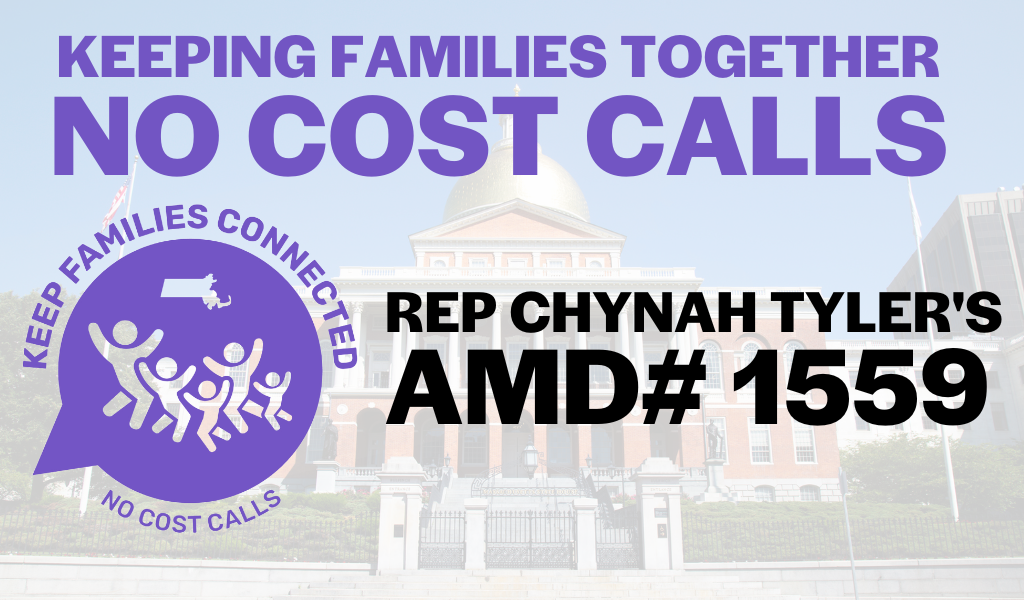
Ask of Your State Rep: Support No Cost Calls
The good news is that the MA House included No Cost Calls language — that is, ending the predatory practice of prisons and jails charging incarcerated individuals for phone calls to loved ones — in its FY2024 budget proposal.
However, there are additional steps necessary to strengthen the guarantee of access to such free phone calls. Rep. Chynah Tyler filed an amendment to the budget (Amendment #1559) to do just that, ensuring a stronger baseline of access (i.e., including access to tablets and setting a minimum guarantee for call time).
Can you call your state rep to ask them to support Amendment #1559 to the House budget?
I am both puzzled and disappointed by the current budget talks on Beacon Hill. Much of the analysis pits the benefits of those who are struggling to meet their basic needs against those of our wealthiest residents (“House’s tax plan echoes Healey’s ‘competitiveness’ goals,” Metro, April 12). Why is it assumed that the only way to retain the wealthy is to give them a tax break?
Don’t these citizens already live in comfortable homes, send their children to good schools, and enjoy nice vacations? Wouldn’t their lives, like those of the rest of us, be enhanced by providing secure housing and great educational opportunities to all of the Commonwealth’s children? Like the rest of us, don’t they wantreliable transportation, environmentally sustainable infrastructure, public art, and glorious parks? Until we can fully fund all these priorities, shouldn’t we hold off on talking about refunds to the most fortunate?
Last November, voters sent a message by voting for the Fair Share Amendment: the rich should pay their fair share so that we can invest in public education and infrastructure. For years, the Legislature has used the line “We don’t have the money” to justify inaction and underinvestment. We got them the money.
But on Thursday, the MA House made clear that they plan to give money right back to the rich and large corporations by passing a tax cut package filled with giveaways to the richest residents of the Commonwealth. And that’s not okay.
The House vote was 150 to 3, with only Rep. Mike Connolly (D-Cambridge), Rep. Dan Sena (D-Acton), and Rep. Erika Uyterhoeven (D-Somerville) voting no. If they are your representatives, you should reach out and thank them. With the exception of a few absent representatives, all others voted yes, and if your representative voted to undermine Fair Share like that, they need to hear about your disappointment. Read more about the vote here.
But the fight isn’t it over.
Here’s how you can act.📣
The tax plans proposed by the Governor and the House include hundreds of millions of dollars in unecessary giveaways to the ultra-rich and large corporations. But the Senate can take a different path.
Call your State Senator TODAY and ask them to:
✅ REJECT the proposed cut to the short-term capital gains tax that would overwhelmingly benefit wealthy investors; ✅REJECT expanding the ‘single sales factor apportionment’ that would give a massive tax break to large, profitable multi-state corporations; ✅TARGET any estate tax reform exclusively to moderate estates, with no tax breaks to large multi-million-dollar estates; AND ✅USE THOSE SAVINGS to invest in affordable housing, childcare, and reliable transportation.
Don’t know your State Senator’s phone number? Find it here, and then save it in your phone for next time.