Tomorrow is an important deadline at the State House

Tomorrow is an important deadline at the State House: Joint Rule 10 Day.

According to this State House rule, every joint committee (i.e., committee of both the House and Senate) must take action on the bills before them by the first Wednesday in February.

That action can be to give the bill a favorable report (It advances!), to give the bill an adverse report (It’s done for the session), to send the bill to study (It’s effectively done for the session), or to give the bill an extension (It has more time).

The State House relies on deadlines to spur action, so expect to see a flurry of action on bills later this week.

That also means it’s a great time to contact the committees in support of critical bills.

Can you commit to sending at least one email by tomorrow? See below for some action tools.


Keep Up the Momentum for Criminal Justice Reform

If we want to continue to move past the failed model of mass incarceration – a model that costs outrageous sums, breaks apart communities, and does not increase public safety – then we need more policy action this year.

Urge the Judiciary Committee to advance key bills before a critical February 7 deadline.

  • Raise the Age (H.1710 and S.942: An Act to promote public safety and better outcomes for young adults): When young adults (18, 19, 20) are kept in the juvenile system, they are able to have better access to school and rehabilitative programming.
  • Prison Moratorium (H.1795: An Act establishing a jail and prison construction moratorium): Massachusetts does not need to build new prisons and jails. We need to be investing in programming, re-entry services, and community supports.
  • Clean Slate Bills (H.1598/S.979: An Act providing easier and greater access to sealing & H.1493/S.998: An Act to remove collateral consequences and protect the presumption of innocence): Too many people are trapped in poverty and deprived of jobs, housing and other chances for success because of their criminal and juvenile records. We need to allow for automatic record sealing in certain cases, rather than relying only on burdensome case-by-case petitions.

Can you write to the Judiciary Committee today in support of these key bills?

Let’s Set up all Students and Families for Success

Every student deserves the support and resources to thrive. That’s why we’ve been such strong supporters of the Common Start bills and the Thrive Act.

Common Start (H.489 and S.301): While Massachusetts is a nationwide leader on early education and child care and we’ve made important progress in recent years, the current system remains broken and access to quality early education and care remains out of reach for too many families. The Common Start framework would provide the specific structure that is needed to deliver affordable care options for families; significantly better pay and benefits for early educators; a new, stable source of funding for providers; high-quality programs and services for children; and substantial relief for businesses and our economy.

Thrive Act (H.495 / S.246): Massachusetts’ state takeover law and the state’s misuse of the MCAS as a graduation requirement are failing our students and disrupting their education. The Thrive Act would end the failed system of state takeovers of school districts, and replace it with a comprehensive support and improvement system that focuses on giving students and educators the tools and resources they need to succeed. The legislation would also support students by establishing a modified high school graduation requirement in which coursework would replace the MCAS test as the basis for showing student mastery of state standards. And, the legislation would create a commission to give our communities a voice in building a better assessment and accountability system.

Can you email the Joint Committee on Education in support of these bills?


It’s Time to Make Polluters Pay

Massachusetts communities are already experiencing the devastating and costly effects of climate change even without considering the HUGE cost of building the climate resilient infrastructure recommended by Climate Chief Hoffer in her 2023 report.

Unless action is taken, our communities will continue to bear the financial and emotional costs of climate change while the fossil fuel companies responsible for climate-related damages make record profits. These companies must bear the cost.

The Make Polluters Pay Bill (S.481/H.872) is a pathway to making that happen.

It would require top polluters to contribute to a superfund used to pay for climate-related damages in Massachusetts. It would create the Climate Change Adaptation Cost Recovery Program, generating $75 billion over the next 25 years for climate adaptation and resilience projects. These funds will then be dispensed through the Climate Change Adaptation Fund, with at least 40% of the funds going to projects directly benefiting environmental justice communities.

Can you write to the Joint Environment and Natural Resources Committee in support of these bills?

MA Needs to Lead on Democracy

In the late 1990s, after incarcerated individuals in MCI-Norfolk started political organizing, Republican Governor Paul Cellucci and the Massachusetts Legislature responded with retaliation and a multi-step process of disenfranchisement. Our commonwealth did something rare in recent history: it took away the right to vote from a category of people who were formerly enfranchised.

According to a new fact sheet from The Sentencing Project, over 7,700 otherwise eligible citizens in Massachusetts are disenfranchised due to a felony conviction. The report further underscores the racial disparities in the Massachusetts criminal legal system that leads to Black and Latinx residents being disproportionately denied their right to vote.

On April 26, 2023, the Joint Committee on Election Laws gave a favorable report to S.8/H.26, constitutional amendments filed by Sen. Liz Miranda and Adam Gomez and Rep. Erika Uyterhoeven that would ensure that incarceration never leads to a loss of voting rights.

Now, the Election Laws Committee must advance S.428/H.724 before the Feb. 7 deadline. This legislation would make relevant changes in state law, and is needed to accompany the constitutional amendments. Passing the constitutional amendments this year would be historic — we need to make sure these bills that change the law for local elections are moving at the same pace.

Can you write to the Joint Election Laws Committee in support of these bills?

Op-Ed: MA Takes Steps to Put Gas in the Past

Jonathan Cohn, “MA Takes Steps to Put Gas in the Past,” Fenway News, February 1, 2024.

“Although the docket raised the bar for when the DPU would approve new gas pipelines, it did not call for a ban on expanding gas infrastructure, a vital step to avoid the lock-in effect of unsustainable fossil fuels. Before the Legislature are a set of bills (S.2135 / H.3237) to put a two-year moratorium on gas infrastructure expansion to give the state time to develop a clear and equitable plan for transitioning to renewable energy. We still need that (and for more than just two years), and the Governor can also do that herself by executive action. You should let her know that you think she should.”

News Roundup – January 5, 2024

Walter Wuthmann, “$1.5 billion in estimated revenue: A look at the Mass. ‘millionaire’s tax’ first year,” WBUR, December 28, 2023.

“The money is going where it was promised,” said Raise Up MA Coalition spokesperson Andrew Farnitano in an interview. He said such investments are “only possible because the voters passed this constitutional amendment and we created this new tax.”

Zeninjor Enwemeka, “Mass.’ minimum wage will stay at $15 this year. There’s a new push to raise it to $20,” WBUR, December 27, 2023.

“After they take out my health insurance, after they take out my taxes, I’m making $5 an hour,” Stevens, 41, said. He lives in Peabody with his wife and two kids.””After they take out my health insurance, after they take out my taxes, I’m making $5 an hour,” Stevens, 41, said. He lives in Peabody with his wife and two kids.”

Macie Parker, “Communities at climate risk need help, but state dollars are hard to come by,” Boston Globe, December 25, 2023.

“There are proven solutions to climate impacts….We just need the funding and technical assistance to implement those solutions.”

Rebecca Ostriker and Mark Arsenault, “A Boston Building, Scattered Souls, and Rent Control Revisited,” Boston Globe, December 17, 2023.

“The story of the Hotel Hemenway is the story of acity transformed, and also of the state’s on-again, off-again history with rent control. And that story continues, with intensity, today. Twenty-nine years after Massachusetts voters ended rent control in a ballot initiative, there’s an escalating political battle over resurrecting government controls, a response to the region’s unprecedented housing crisis that has pushed costs out of reach for many working people.”

John Micke, “Healey: Mass. cities, towns in line for $100M in infrastructure aid through millionaires’ tax,” MassLive, December 15, 2023.

“Days before Christmas, Massachusetts’ 351 cities and towns are in line for $100 million in state aid to help them cover local infrastructure costs, according to Gov. Maura Healey’s office.”

Editorial Board, “Give supervised consumption sites a chance to reduce drug-related deaths,” Boston Globe, December 15, 2023.

“On Wednesday, Governor Maura Healey’s Department of Public Health released two reports that provide a rationale for opening supervised consumption sites and a practical blueprint for doing so. The state Legislature should take the next step and create a legal framework that would let public health professionals oversee these efforts without fear of state-level professional or legal liability.”

Phyllis Keenan, “My Turn: Restoring the promise of Massachusetts’ community colleges,” The Greenfield Recorder, December 12, 2023.

“By addressing the needs of adjunct faculty, relieving students of crippling debt, and improving campus infrastructure, lawmakers can make good on the promise of our public higher education system. It’s time for Massachusetts to prioritize the education of its citizens. Passing the CHERISH Act is a crucial step in the right direction.”

Annette Duke and Trevor Samios, “Tenants facing eviction need lawyers,” CommonWealth, December 7, 2023.

“Landlords and tenants, organizations fighting homelessness, healthcare leaders, faith-based organizations, and mayors all agree it is time Massachusetts stepped in with legal help for those facing the trauma of eviction.”

MA Senate Passes Gun Safety Bill 37 to 3. Here’s What’s in It.

thoughts and prayers sign

In October, the MA House passed a comprehensive gun bill 120 to 38 (read about it here). 

The Senate debated and passed its own gun safety bill, named the SAFER Act, yesterday. 

Among the key provisions of the bill were: 

  • Cracking down on ghost guns by bringing MA’s laws in line with national standards of  what counts as a firearm, prohibiting the 3D-printing of weapons unless the person owns a license to manufacture firearms, and requiring any kit-assembled guns by a licensed gun owner to be registered  
  • Codifying the state’s assault weapons ban as it is currently being interpreted by the Attorney General, thereby modernizing outdated language referring to the since-expired federal ban
    • NOT in the SENATE BILL: expanding the AWB to cover more firearms 
  • Prohibits machine gun conversion devices or devices that increase the rate of fire of firearms
  • Creates manufacturer accountability by banning the marketing of unlawful firearm sales to minors and allowing industry actors to be held civilly liable if such marketing practices lead to an individual being harmed. [SENATE ONLY]
  • Ensures that gun dealers are inspected annually and allows the Massachusetts State Police to conduct those inspections if a local licensing agency does not or cannot do so. 
  • Prohibits the carry of firearms in government administrative buildings, with exceptions for law enforcement officers and municipalities that choose to opt out.
    • NOT in SENATE Bill: Extension to polling places, educational institutions (including higher education); ban on carry on private property without express permission or signage
  • Expands the list of individuals eligible to file an extreme risk protection order (ERPO) to include licensed healthcare professionals
    • NOT in SENATE bill: Extension to include school administrators and employers
    • SENATE ONLY: Ability to file a pre-emptive ERPO, prohibiting someone who does not yet have a license for applying for one for a certain period of time
  • Protects survivors of harassment by requiring courts to compel the surrender of firearms by individuals who are subject to harassment protection orders who pose an immediate threat. 
  • Ensures that firearm licensing authorities have access to certain information about an applicant’s history of involuntary mental health hospitalizations due to posing a serious harm—with appropriate safeguards to guarantee privacy and due process [SENATE ONLY]
  • Establishes commissions to study the funding structure for community-based violence prevention services and to study emerging firearm technology 
  • Strengthens data collection on firearms and firearm crimes 

The final vote was 37 to 3. The only NO votes were Republicans Peter Durant (R-Spencer), Ryan Fattman (R-Sutton), and Patrick O’Connor (R-Weymouth).

During the debate on the bill, Senator Patrick O’Connor (R-Weymouth) tried to replace the bill with a narrower substitute bill. It received only 6 votes, the 3 NO votes plus Marc Pacheco (D-Taunton), Bruce Tarr (R-Gloucester), and Walter Timilty (R-Milton).

State House News Service: “City Council backs idea of debt-free college bill”

Chris Lisinski, City Council backs idea of debt-free college bill,State House News Service, January 31, 2024.

“Councillors posed for a photo with Higher Ed for All advocates and turned over the microphone to Jonathan Cohn, policy director of the Progressive Massachusetts group that’s part of the coalition pushing for higher education reforms.

“The bill that we’re fighting for this session, in particular the CHERISH Act, is something that builds on that vision with debt-free higher education so that students aren’t graduating with thousands and thousands of dollars in debt that makes it hard for them when they start out and is damaging for the economy of Massachusetts as a whole,” Cohn said in the council chambers.”

Let’s Build on Recent Progress for Criminal Legal Reform

Earlier this month, MassInc published a study on MA’s 2018 criminal legal reform omnibus bill.

Takeaway #1: The bill led to significant reductions in incarceration without undermining public safety.

Takeaway #2: The work isn’t over.

If we want to continue to move past the failed model of mass incarceration – a model that costs outrageous sums, breaks apart communities, and does not increase public safety – then we need more policy action this year.

Urge the Judiciary Committee to advance key bills before a critical February 7 deadline.

  • Raise the Age (H.1710 and S.942: An Act to promote public safety and better outcomes for young adults): When young adults (18, 19, 20) are kept in the juvenile system, they are able to have better access to school and rehabilitative programming.
  • Prison Moratorium (H.1795: An Act establishing a jail and prison construction moratorium): Massachusetts does not need to build new prisons and jails. We need to be investing in programming, re-entry services, and community supports.
  • Clean Slate Bills (H.1598/S.979: An Act providing easier and greater access to sealing & H.1493/S.998: An Act to remove collateral consequences and protect the presumption of innocence): Too many people are trapped in poverty and deprived of jobs, housing and other chances for success because of their criminal and juvenile records. We need to allow for automatic record sealing in certain cases, rather than relying only on burdensome case-by-case petitions.

Can you write to the Judiciary Committee today in support of these key bills?

Tell Gov. Healey to Stop the Cuts

Earlier this month, Governor Healey responded to a revenue shortfall by making $375 million in unilateral 9C cuts to the budget, including cuts to cash assistance to the lowest-income families in the Commonwealth.Please help keep up the pressure on the Governor to rescind the cash assistance cuts that eliminated the 10% grant increases slated to take effect in April. We should not be balancing the budget on the backs of our lowest-income children and families, elders, and people with disabilities.

Call and/or e-mail Governor Healey to urge her to reverse the cuts to cash assistance:

Call (888) 870-7770

Suggested script:  “This is [name] from [city/town].  I’m calling to urge the Governor to rescind the 9C cuts to the TAFDC and EAEDC cash assistance programs.  The grant amounts are still far below even half of the federal poverty level.  It is unconscionable for Massachusetts to fill gaps in the budget by cutting cash assistance for our lowest income families with children, elders, and people with disabilities.”

Click here to send an e-mail.

Your Senator Needs to Hear from You on Gun Safety

Back in October, the MA House passed a comprehensive gun safety bill aimed to build upon and continue MA’s leadership in gun violence prevention. The bill included a more robust assault weapons ban; measures to crack down on ghost guns; prohibitions on firearms in government buildings, polling places, and educational institutions; and more comprehensive data collection — among other key measures.

The action now turns to the Senate.   The Senate is expected to release its own bill later this month. It’s time to contact your state senator and let them know that you want to see bold and comprehensive legislation.  Join the Massachusetts Coalition to Prevent Gun Violence in calling for a comprehensive bill that includes, among other key provisions: Industry accountability: Victims and survivors of gun violence are rarely able to hold those who have harmed them accountable due to a federal law that provides unique protections for the firearms industry. MA has the opportunity to create an avenue for victims and survivors to seek justice in the civil court system by creating a code of conduct that the firearms industry must adhere to, ensuring that their products don’t end up in the wrong hands and ultimately preventing harm.

Regulating ghost guns: Ghost guns are untraceable, unserialized firearms that can be assembled at home from a kit purchased online without a background check. MA must update our definitions of a firearm and require that all ghost gun kits and parts can only be sold to those with a license to carry firearms.

Gun violence data analysis: MA has been collecting data on guns recovered in connection with a crime for years, and we must use that data to better understand how guns are ending up in our communities. Looking more deeply at data on guns recovered in MA will allow us to close any loopholes in our laws and prevent future violence.

Email your state senator.

Testimony on the Affordable Homes Act

Green affordable housing

Thursday, January 18, 2024

Chair Edwards, Chair Arciero, and Members of the Joint Committee on Housing:

My name is Jonathan Cohn, and I am the policy director at Progressive Massachusetts. We are a statewide, multi-issue, grassroots membership organization focused on fighting for policy that would make our Commonwealth more equitable, just, sustainable, and democratic. 

Massachusetts faces a growing affordable housing crisis. To rent the average 2-bedroom apartment in Massachusetts requires an income equal to $37.97 per hour, more than twice the minimum wage. Home ownership has become increasingly out of reach, as the state’s median home price has passed $600,000. The high cost of housing has led to displacement, and in a growing number of municipalities, the local workforce can no longer afford to live there.

We are glad to see that Governor Healey recognizes the need to use a variety of tools to address our housing crisis and strongly support the comprehensive approach in the Affordable Homes Act, H.4138.

We were delighted to see the inclusion of key provisions like the following:

  • Creating a five-year housing plan (which should focus not only on supply but also on affordability to different income levels)
  • Enabling cities and towns to pass inclusionary zoning ordinances by simple majority—a vital tool for increasing affordable housing supply and diversifying communities
  • Making it easier to use public land for housing development
  • Establishing an Office of Fair Housing
  • Launching a Social Housing pilot program
  • Authorizing $150M for public housing decarbonization and $115 million for sustainable and climate-resilient affordable housing
  • Permitting Accessory Dwelling Units (ADUs) of <900 SF to be built by-right in single-family zoning districts in all communities and prohibiting the parking mandates and owner-occupancy requirements many municipalities use to make ADUs harder to build
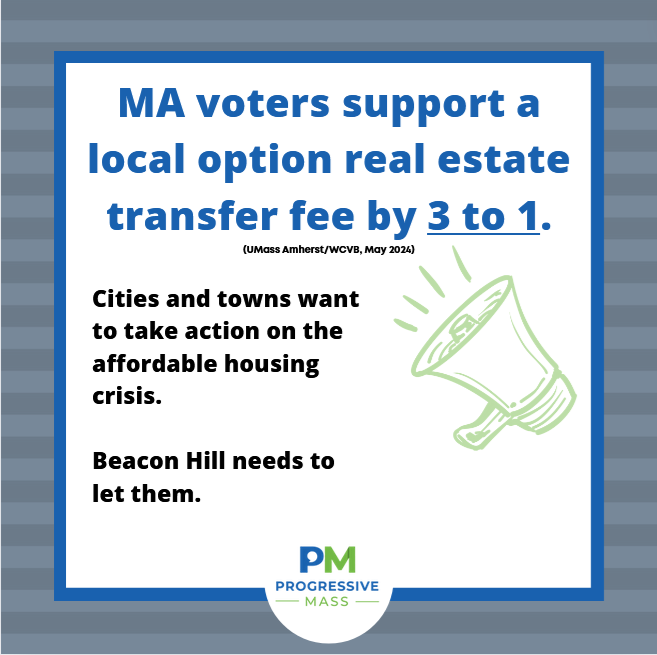
  • Enabling cities and towns to pass real estate transfer fees as a tool to raise money for affordable housing production and preservation
  • Creating a process to enable individuals to seal eviction records

All of these are essential to a three-pronged approach to the housing crisis: protecting tenants, increasing housing production, and investing more in affordable housing. We can do all three, and this bill does.

However, we would like to outline how to make some of these provisions more accessible and effective as well as some additional measures to consider including.

Real Estate Transfer Fee Local Option

Cities and towns across Massachusetts want to take action to address the housing crisis, but they are often unable to do so without state approval. Seventeen communities have now requested the ability to use this tool, beginning with Provincetown in 2010. In the years since this initial request, circumstances have only become more dire, and more cities and towns have passed such home rule petitions or are actively considering doing so.

Our housing crisis is simply too great to leave funding and financing tools on the table. All communities must be able to use this tool that will allow us to generate additional resources for desperately needed local affordable housing.

To ensure that the transfer fee language in the bill can best meet the needs of diverse cities and towns, we urge the following:

  • Setting the Right Threshold: Home sale prices vary greatly across Massachusetts, with rural communities and Gateway cities often having property values well below $1 million. They should still be able to benefit from this tool. Similarly, communities should be able to set higher thresholds if that is best for local needs and market conditions.
  • Maintaining Flexibility: Communities should be able to determine whether buyers or sellers of a property bear fees and should be able to create local exemptions that best apply to their community.
  • Applying Fees to the Full Transaction: Allowing municipalities to apply fees to the full amount of transactions, rather than only the amount in excess of a threshold, will allow communities with higher needs and sales prices to generate more desperately needed revenue.

Sealing Eviction Records

Having an eviction record is creating a devastating barrier for tenants looking for housing. Records are created as soon as a case is filed and are publicly available forever–– regardless of the outcome. These records impact people’s ability to obtain housing, credit, and employment, harming many and disproportionately impacting women and people of color.

Regardless of whether one does anything wrong or is actually evicted, being party to an eviction or housing case is being unfairly held against tenants when they try to rent a new place. Even winning in court hurts tenants.

We are delighted to see eviction sealing language in this bill, but we would recommend several steps to ensure that tenants can best be protected:

  1. Ensuring that dismissals, cases that tenants win, and no-fault evictions be automatically sealed by the court as opposed to a petition process which involves extra steps for the court and all parties.

  2. Ensuring that in non-payment cases, tenants can seal after 14 days of paying a judgment and after 4 years if they were unable to pay because of an economic hardship or other good cause reasons.
  1. Ensuring that in a fault eviction, where one must wait 7 years to seal, that an intervening eviction which prevents one from sealing can only be a fault eviction and not just any type of eviction case, such as a no-fault eviction.

  2. Clarifying that the court has the direction to consider disability and domestic violence issues in fault cases and to adjust the sealing process accordingly.

Additional Measures to Include

We join with over 240 organizations to call for the inclusion of Access to Counsel in the Affordable Homes Act. 9 out of 10 tenants are unrepresented in eviction court, leading to higher rates of displacement and community instability. Evictions negatively affect people’s physical and mental health, and result in job loss and decreased school attainment for children. Guaranteeing legal representation to all tenants facing evictions would have a major positive impact.

We also urge you to use this opportunity to repeal the ban on rent control and enable municipalities to enact local rent control ordinances to stabilize housing costs and prevent no-cause evictions. We have been seeing a growing interest in rent control across the Commonwealth, with multiple municipalities filing home rule petitions to be able to take action. Rent control is an essential tool to combat displacement, and cities and towns should be able to pass such policies as fit their local housing situation.

Cities and towns that want to take action should be able to do so, and we urge you to include a Tenant Opportunity to Purchase local option (along the lines of S.880/H.1350), which would enable cities and towns to pass laws allowing tenants to join together to match a third-party offer when their homes are being sold.

We also urge you to use this bill to establish a statewide Foreclosure Prevention Program to require servicers to participate in pre-foreclosure mediation with homeowners to explore alternatives to foreclosures, an idea put forth in S.653 and H.942.

We also urge you to take additional steps to increase our supply of affordable housing, such as by funding and writing into statute the Small Properties State Acquisition Fund, which would provide subsidies for nonprofit acquisition of homes from the market, and by including funding for the production of affordable homeownership units that can be kept affordable in perpetuity. We also urge you to add an affordability requirement to the Housing Development Incentive Program (HDIP) so that public subsidies to development address the need for affordable housing stock.

Lastly, A Technical Correction

We stand with the Massachusetts AFL-CIO in asking you to address a major concern about Section 35 of the bill. As written, this section would remove the application of prevailing wage laws to certain private development projects on public land. We hope that this was a drafting error and such language can be removed. The state should be using public land to both advance housing goals and create good-paying jobs, and these are not in conflict.

Thank you for all your work on this important bill and vital topic.

Sincerely,

Jonathan Cohn

Policy Director

Progressive Massachusetts

Book Ban Attempts Are Happening in Massachusetts Too

Chair Lewis, Chair Garlick, and Members of the Joint Committee on Education:

My name is Jonathan Cohn, and I am the policy director at Progressive Massachusetts. We are a statewide, multi-issue, grassroots membership organization focused on fighting for policy that would make our Commonwealth more equitable, just, sustainable, and democratic. 

We urge you to give a favorable report to S.2528/H.4229: An Act Regarding Free Expression, filed by Senator Julian Cyr and Representative John Moran.

Over the past few years, we have seen attacks on schools and libraries across the country aimed at removing books by and about LGBTQ people, communities of color, and other marginalized groups.

Many people would like to think that Massachusetts is different, but we are not. According to the American Library Association, in 2022 there were at least 45 attempts to restrict access to books in Massachusetts school and public libraries, with 57 titles challenged. This puts us among the top 5 states with the highest book ban attempts.

Students learn best when they see themselves and the issues that impact them reflected in their education. Education should be about opening up students to the world and to themselves, and that requires a focus on inclusivity and equity. And it means not seeking to exclude parts of history or identity.

Beyond being simply a moral issue, this is a constitutional issue. The First Amendment protects the right to share ideas, including educators’ and students’ right to receive and exchange information and knowledge. These bills would ensure that selection of age-appropriate library materials is based on the professional expertise of librarians and educators, and would establish a process and standards for handling book challenges so that books are not taken off the shelves based on political or personal views.

Thank you for all your work on the hearing, and, again, we urge you to swiftly advance these important bills.

Sincerely,

Jonathan Cohn

Policy Director

Progressive Massachusetts