A “Yes in My Backyard” Call from Newton

Dense neighborhood

From Bill Humphrey, Progressive Newton

Thank you to Chairman Arciero, Chairwoman Edwards, and other esteemed members of the Committee for hosting a hearing and collecting written testimony. I am submitting testimony on behalf of Progressive Newton (which I chair) and in my individual capacity as a Newton City Councilor in support of The Yes in My Backyard Bill (HB1379/SB858). Progressive Newton supports affordable, high-quality housing in safe, walkable, and vibrant neighborhoods and supports affirmatively furthering fair housing to ensure everyone has equal access to housing.

Specifically I wish to offer insights into two provisions of this legislation that have already essentially been adopted in Newton. The first concerns Accessory Dwelling Units and the second concerns Inclusionary Zoning.

The City of Newton in 2022 adopted local zoning changes to make it much easier to build Accessory Dwelling Units, and this new system is similar to that proposed statewide by The Yes in My Backyard Bill (HB1379/SB858). These smaller, separated units of housing on existing lots, usually primarily occupied by a Single-Family Home, not only add to our overall housing stock without much wider impact, but they also specifically help families find proximate housing for elder relatives and adult children (including those with disabilities) or help “big house” elder owner-occupants find a bit of extra rental income to be able to stay in their homes longer or to be able to afford historic preservation (especially if the unit is a traditional carriage house). These ADUs have not always been easy to build or set up under local rules, and this has discouraged them from being created. This legislation will help correct this on a consistent basis across the Commonwealth. It will allow more multi-generational families to live together, enable new incomes for owner-occupants of older homes, and facilitate additional units of new housing across Massachusetts with a smaller effect on existing neighborhoods than some larger development projects that sometimes generate more controversy.

The City of Newton has also already adopted ambitious but fair and rational Inclusionary Zoning targets, which promote the creation of more affordable units than ever before in market-rate projects but without economically discouraging overall production of housing in a substantial way. The Yes in My Backyard Bill (HB1379/SB858) establishes a reasonable compromise at a state level, by proposing that “The Department of Housing and Community Development shall be responsible for developing guidelines to ensure that municipalities do not adopt inclusionary zoning ordinances or bylaws that [unduly] constrain the production of housing in that community.”

Many other provisions in the legislation are also things presently being explored as potential local changes in Newton, but these two points are steps Newton has already taken, and they have been widely supported.

City Councilor Bill Humphrey

Newton MA 02468

We Need More Housing, and We Need More Affordable Housing.

Dense neighborhood

Wednesday, July 26, 2023

Chair Edwards, Chair Arciero, and Members of the Joint Committee on Housing

My name is Jonathan Cohn, and I am the Policy Director of Progressive Massachusetts, a statewide grassroots advocacy group with chapters across the state committed to fighting for an equitable, just, democratic, and sustainable Commonwealth.

We urge you to give a favorable report to H.1379/S.858: An Act relative to yes in my backyard and S.870: An Act to improve the housing development incentive program.

Massachusetts faces a growing affordable housing crisis. To rent the average 2-bedroom apartment in Massachusetts requires an income equal to $41.64 per hour. [1] Home ownership has become increasingly out of reach, as median housing sale price in Metro Boston nears $1 million. [2] We need action, and we need to be using every tool in the toolbox to make our state more affordable for all.

If we want to see more homes, and more affordable homes, being built, then we need to reform our zoning laws. According to a recent analysis by the Eviction Lab, Massachusetts metro areas accounted for 3 of the top 10 metro areas with the most restrictive zoning laws. Such restrictive zoning laws push up costs and reinforce residential segregation: indeed, according to census data, more than 60 percent of Massachusetts’s Black population lives in just ten cities. 

The MBTA Communities law, recently passed and currently being implemented by cities and towns, can make a dent, but we need more ambitious and comprehensive policy. H.1379/S.858 would require multifamily zoning and remove costly parking mandates around public transportation, encouraging dense, transit-oriented development that is good for climate and good for communities. It would also expedite the process of converting unused state-owned land into affordable housing or vacant commercial properties into multifamily housing, among many other steps. 

We also need to make sure that we are building more affordable housing, and S.870 would reform the Housing Development Incentive Program to ensure that it actually does so. Currently, the HDIP program subsidizes units with shockingly high rents in hot markets in little need of the “carrot” of tax incentives. [3] The program needs to be refocused to where it can have clear benefits for surrounding communities and to design mixed-income housing that addresses the full range of housing needs in our gateway cities.

Sincerely,

Jonathan Cohn

Policy Director

Progressive Massachusetts

[1] National Low Income Housing Coalition. “Massachusetts.” Accessed July 25, 2023. https://nlihc.org/oor/state/ma.

[2] Kohli, Diti. “The Typical House in Greater Boston Now Costs $900,000. Here’s What That’ll Buy You in the Rest of America.” Boston Globe. July 20, 2022.  https://www.bostonglobe.com/2022/07/20/business/typical-house-greater-boston-now-costs-900000-heres-what-thatll-buy-you-rest-america/.

[3] https://www.masslegalservices.org/content/MLRI_HDIP_Report_12_15_22.

Build Housing, Not Pipelines

Next week, the MA Legislature will be holding hearings on key bills to put a moratorium on new gas infrastructure and encourage walkable, transit-oriented communities. Both are essential to combating climate change and creating a green, healthy, and affordable state for all.

Put Gas in the Past

This summer has been an ongoing series of warning signs of the need to take bold and comprehensive action on climate change. Earlier this month, from July 3 to July 6, we experienced the four hottest days on record globally. We have seen extreme flooding hit neighboring states as well as our own, and the same for the dystopian impacts of raging wildfires in Canada.

This should serve as a wake-up call that our response to climate change, despite recent progress, is not enough. We have known for many years now that the majority of fossil fuels must be left in the ground if we are to have even a chance of staying within safe boundaries of global warming.

Next Wednesday and Thursday, the Legislature will be hearing bills to put gas in the past by establishing a moratorium on new gas system expansion. This will help us meet our state’s climate goals, protect human and environmental health, and provide time for us to create a plan for a just transition.

Sign up to testify (in person or virtually) at the Senate hearing on Wednesday, 7/26, at 1pm.

Sign up to testify (in person or virtually) at the House hearing on Thursday, 7/27, at 10am.

Want to submit written testimony? Check out the Put Gas in the Past toolkit here, or use this template.

Put Gas in the Past

Tackling Our Housing Crisis

Massachusetts faces a growing affordable housing crisis. We can tout our great quality of life on index after index, but if people can’t afford to live here, it doesn’t mean much.

To rent the average 2-bedroom apartment in Massachusetts requires an income equal to $37.97 per hour. Home ownership has become increasingly out of reach, as the state’s median home price has passed $600,000.

The unaffordability of housing in Massachusetts isn’t inevitable. It’s a result of a long legacy of exclusionary zoning that has disproportionately harmed working-class and BIPOC residents.

The Yes in My Backyard Bill (H.1379) would require multifamily zoning and remove costly parking mandates around public transportation, encouraging dense, transit-oriented development that is good for climate and good for communities. It would also expedite the process of converting unused state-owned land into affordable housing or vacant commercial properties into multifamily housing, among many other steps.

Sign up to testify (in person or virtually) at the hearing on Wednesday, 7/26, at 2 pm.

Want to submit written testimony? Check out the Abundant Housing toolkit here, or use this template.

Evictions Are Rapidly Rising. The Legislature Needs to Act.

eviction notice

Monday, June 26, 2023

Chair Edwards, Chair Arciero, and Members of the Joint Committee on Housing:

My name is Jonathan Cohn, and I am the Policy Director of Progressive Massachusetts, a statewide grassroots advocacy group committed to fighting for an equitable, just, democratic, and sustainable Commonwealth.

We urge you to give a favorable report to S.856 and H.1312: The Upstream RAFT Act, sponsored by Sen. Brendan Crighton and Rep. Marjorie Decker. This bill would improve access to the Residential Assistance for Families in Transition program (RAFT), restore COVID-era protections, and codify the RAFT program into state statute.

We often hear rhetoric about the housing crisis in Massachusetts. According to the National Low-Income Housing Coalition, it would take more than 90 hours working at minimum wage to afford a modest 1-bedroom rental home in Massachusetts at Fair Market Rent. With the cost of housing so high, housing insecurity abounds. According to data from the Eviction Lab, the number of evictions in Boston jumped significantly over the past year and is now higher than pre-COVID levels, disproportionately affecting Black and Brown families.

Addressing our housing crisis requires a vast array of policy reforms, but at the most basic level, we must take swift action in the near term to curb the growth of displacement. The RAFT program is a lifeline for low-income families, providing emergency, short-term financial assistance for low-income tenants who are at risk of eviction—regardless of immigration status. During the pandemic, this emergency assistance saved many families from homelessness.

But the program has also failed to reach its full potential because of barriers to access, and the Upstream RAFT bill seeks to address them. This bill eliminates the requirement of a “notice to quit” so that tenants can access assistance before a housing emergency becomes an eviction. Many tenants mistake a “notice to quit” for an eviction, losing out not only on their home but also on the supports the state can provide them.

It eliminates the arbitrary $10,000 annual cap on assistance and adopts a 12-month limit instead: tenants are not the ones to blame for rising rents, and they should not be punished for it.

It further reduces obstacles by providing workarounds to enable tenants with uncooperative landlords to receive assistance. No tenant should have to depend on their landlord to receive essential assistance for housing security.

And lastly, the bill would codify the RAFT program into statute in order to add long-term stability to a vital program.

We urge you to act swiftly and advance S.856 and H.312 to improve housing stability in the Commonwealth.

Sincerely,

Jonathan Cohn

Policy Director

Progressive Massachusetts

Take Action: How to Support a Progressive Budget

In the FY 2024 budget, both the House and the Senate embraced the opportunity to include forward-thinking proposals that strengthen our commitment to equity, but, with differences between them, the work is not done.

In the coming weeks, a Conference Committee of three senators and three representatives will be finalizing the details for next year’s budget, and they need to hear from you in support of key provisions:

  • Tuition equity language, which would ensure that all MA high school graduates have access to in-state tuition at our Commonwealth’s public colleges and universities, regardless of immigration status, as 23 other states and DC provide
  • Permanent School Meals for All, which would ensure healthy nutrition for all students, increase educational performance, and support working families
  • No Cost Calls language, as outlined in the Keeping Families Connected/No Cost Calls Coalition’s letter, namely, making all communication services free in 2023, including a strong guarantee of access to calls, and laying out clear language to ensure successful implementation

Can you write to your senator and representative to ask them to fight for the inclusion of all three in the final FY2024 budget?


Mark Your Calendars🗓

State House Hearings This Week

If you are interested in testifying (written, in-person, or virtual) and have questions, just reach out!

Thursday, 6/22: Gun Violence Awareness Month Action at the Massachusetts State House @ 10am in front of the State House

The Mass Coalition to Prevent Gun Violence will be gathering on the steps of the State house with local and national partners including Stop Handgun Violence, Moms Demand Action, Giffords, and Brady, to honor June as Gun Violence Awareness month and to mark the anniversary of the Supreme Court’s Bruen decision. Join for a press conference featuring survivors, violence prevention workers, and others impacted by gun violence to address the impact of gun violence in the Commonwealth and call for continued action.

Sunday, 6/25: Progressive Mass Activist Afternoons Continues @ 3:30 PM

Join Progressive Mass for an Activist Afternoons series! We’ll be reaching out to members across the state to reach out to their legislators about key issues at the State House. On 6/25, we’ll be focusing on the Transfer Fee bill. RSVP here!

Tuesday, 6/27: Hearing at the State House for the Prison Moratorium Bill @ 11 am, Rally @ 10 am

Massachusetts does not need new prisons and jails: we need to be investing in communities, not in expanding the carceral system. So make sure that the Legislature hears loud and clear by showing up to support the Prison Moratorium in Gardner Auditorium on the State House and a rally before, RSVP here.

Thursday, 7/13: Common Start Rally at the State House

Please join the Common Start Coalition for a family-friendly rally at the State House on July 13 at 11:00 AM! As we head into the summer months, this is an incredible opportunity to keep up the momentum for high-quality, affordable, and accessible early education and care in Massachusetts.

Following a brief speaking program, children and their families will lead a march through the State House to demonstrate the power of our coalition and to highlight solutions to the child care crisis. Art and other activities for children will be a part of the event.

Common Start Family-Friendly Rally for Child Care

Time: Thursday, July 13 at 11:00 AM
Location: Grand Staircase, Massachusetts State House, Boston
Travel: There will be buses from across the state. More info to come.
Interpretation: There will be Spanish interpretation for the event.
Make sure to RSVP here: https://bit.ly/csrally7-13

The Solution to Homelessness Is Homes, Not Criminalization.

Home

Tuesday, June 13, 2023

Chair Kennedy, Chair Livingstone, and Members of the Joint Committee on Children, Families, and Persons with Disabilities:

My name is Jonathan Cohn, and I’m the policy director of Progressive Massachusetts, a statewide, member-based grassroots advocacy organization fighting for a more equitable, just, sustainable, and democratic Commonwealth. 

We urge you to give a favorable report to H.211/S.1112: An Act establishing a bill of rights for individuals experiencing homelessness, filed by Representatives Smitty Pignatelli and Frank Moran and Sen. Becca Rausch.

The solution to homelessness is clear: giving people homes. But too often, municipalities see the solution as criminalization and punishment instead, worsening the underlying problems and forcing individuals into vicious cycles of incarceration and housing instability.

As rents and housing prices skyrocket in Massachusetts, an increasing number of families face housing instability, experiencing short-term or long-term homelessness. According to the US Department of Housing and Urban Development, 18,471 people in Massachusetts were counted as homeless in January 2019, more than two-thirds of that population consisting of families with children.

We desperately need comprehensive action to address our housing crisis and to secure housing for those currently without it. However, we also need to ensure that misguided and archaic laws do not make it more difficult for individuals to obtain housing.

These bills would rectify this status quo by extending anti-discrimination protections to persons experiencing homelessness, including protections when seeking employment, housing, voter registration, and access to public spaces and places of public accommodation. They would also ensure that individuals experiencing homelessness are not being criminalized for existing in public space, protecting their right to rest, seek shelter from the elements, occupy a legally parked car, pray, eat, and avoid needless harassment in public spaces.

H.211 and S.1112 are essential to ensuring Massachusetts is a state that treats all residents with dignity and respect, and we urge you to give it your support.

Sincerely,

Jonathan Cohn

Policy Director

Progressive Massachusetts

Everyone Needs ID. Here’s Why, and Here’s What the Legislature Can Do.

Photo ID card

Tuesday, June 13, 2023

Chair Crighton, Chair Straus, and Members of the Joint Committee on Transportation:

My name is Jonathan Cohn, and I’m the policy director of Progressive Massachusetts, a statewide, member-based grassroots advocacy organization fighting for a more equitable, just, sustainable, and democratic Commonwealth. 

We urge you to give a favorable report to H.3388, H.3360, and S.2251: An Act to provide identification to youth and adults experiencing homelessness (the Everyone Needs ID bill), filed respectively by Rep. Jim O’Day, Rep. Kay Khan, and Sen. Robyn Kennedy.

Individuals experiencing homelessness face significant obstacles to obtaining an ID, but IDs can often be essential to securing employment and even accomplishing everyday life tasks. Without an ID, it can be difficult, if not outright impossible, to apply for jobs, enroll in education programs, get a library card, pick up a package from the post office, receive a prescription from a pharmacy, and more. So many of us take such tasks for granted, but for individuals experiencing homelessness, they become complicated endeavors and roadblocks on the path toward stability.

The aforementioned bills offer a solution by requiring the Registry of Motor Vehicles to waive the $25 fee for an ID for people experiencing homelessness and by allowing applicants to support alternative documentation to prove Massachusetts residency, such as allowing individuals to provide evidence of receiving services from a state agency under the Executive Office of Health and Human Services.

Massachusetts must take comprehensive addition to ensure housing for all; however, in the interim, we must ensure that our policies are not exacerbating the obstacles faced by individuals experiencing homelessness. We urge you to make a difference this session by advancing these bills.

Sincerely,

Jonathan Cohn

Policy Director

Progressive Massachusetts

Next Week at the State House

See you at the State House? Next week, a number of our coalitions are hosting advocacy days at the State House, a great opportunity to connect with other activists across the state and add momentum to key bills.

Mark Your Calendars! 📅

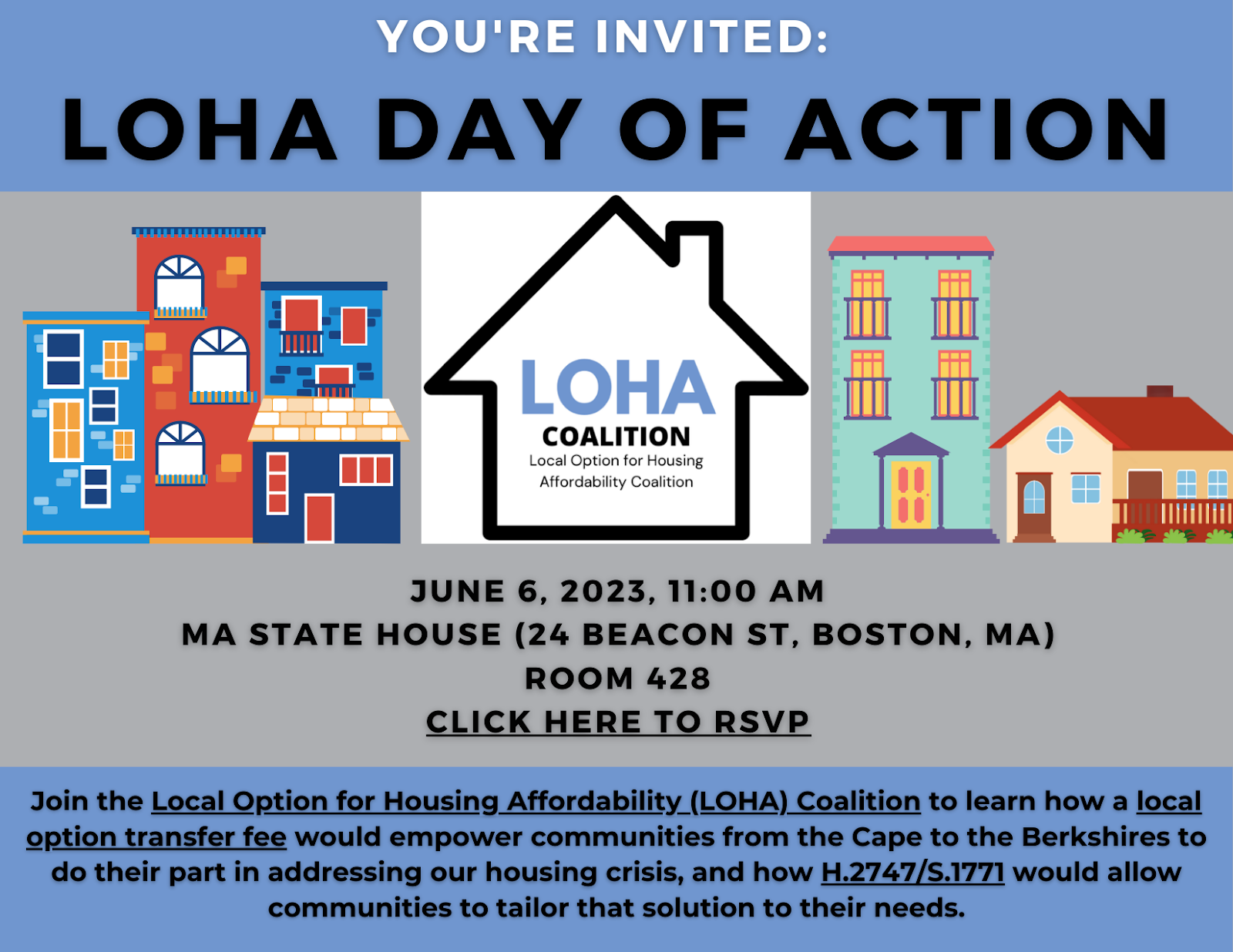
Tuesday, June 6 @ 11 am at the State House: Transfer Fee Coalition Lobby Day —RSVP here

Join the Local Option for Housing Affordability (LOHA) Coalition on Tuesday, June 6, 11-12 PM for a briefing and day of action in support of Rep. Connolly and Sen. Comerford’s bills H.2747/S.1771 establishing a local option transfer fee to fund affordable housing. Speakers will include advocates, municipal officials, impacted people and housing experts from across the Commonwealth.

LOHA Day of Action

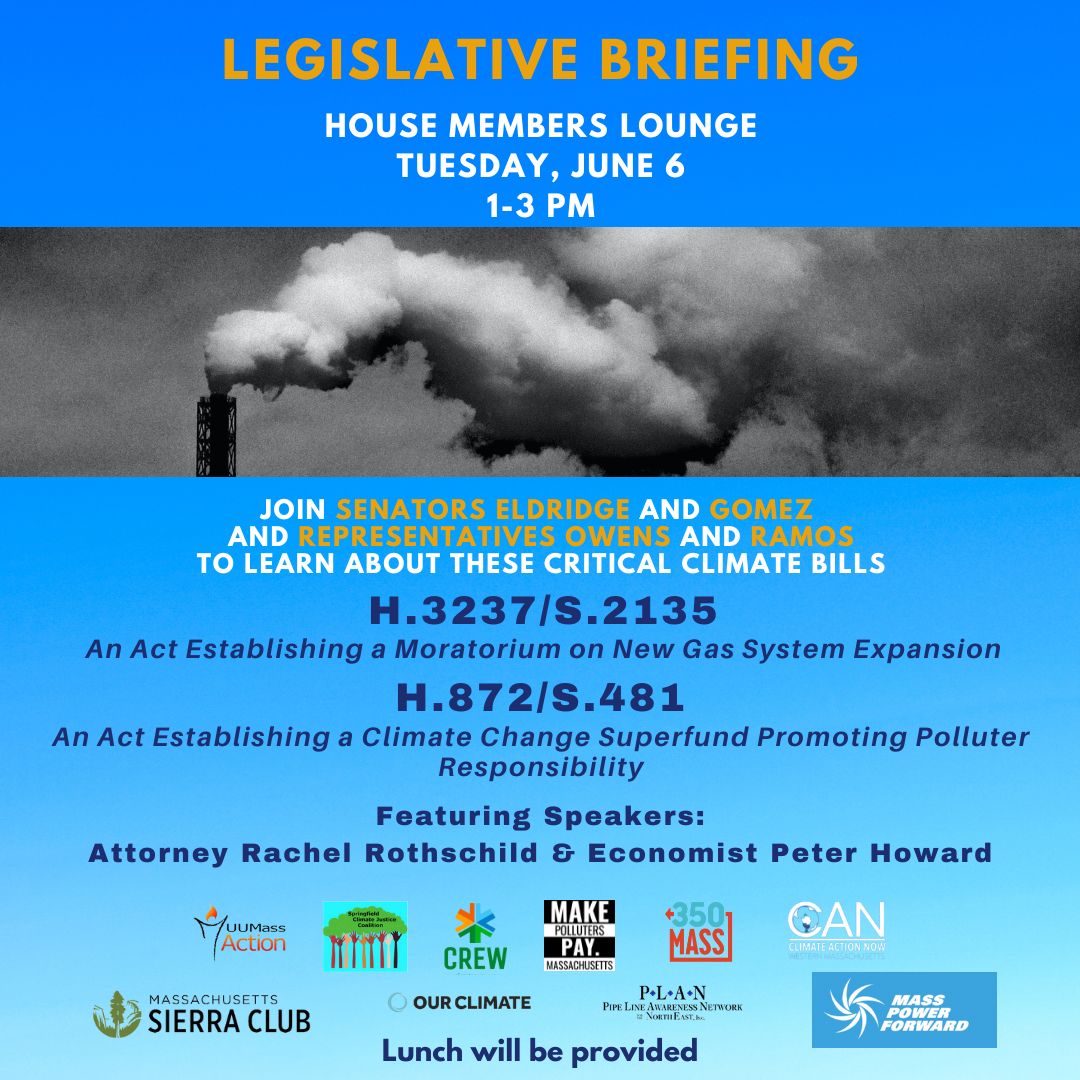
Tuesday, June 6 @ 1 pm at the State House (House Members Lounge) — Polluters Pay & Put Gas in the Past Legislative Briefing

This event will be a presentation for legislators on bills at the center of two Mass Power Forward priority campaigns:

  • For the Make Polluters Pay campaign, (H.872 /S.481), An Act Establishing a Climate Change Superfund Promoting Polluter Responsibility – which we call, for short, the “Polluter Responsibility Superfund Bill”.
  • For the Put Gas in the Past campaign, (S.2135/H.3237), An Act Establishing a Moratorium on New Gas System Expansion. – which we call, for short, the “Gas Expansion Moratorium Bill”

Invite your legislators to the briefing with this toolkit.

Legislative Briefing - Tuesday, June 6

Wednesday, June 7 @ 2 pm at the State House — Youth Justice Lobby Day

Join activists across the state to advocate for bills that would end the school-to-prison pipeline and ensure better outcomes for our youth. The lobby day will focus on bills to keep 18-to 20-year-olds out of the adult criminal justice system, expand opportunities to expunge criminal records, create opportunities for diversion, and more.

Youth Justice Lobby Day 2023

In solidarity,
Jonathan Cohn
Policy Director
Progressive Massachusetts

“More and more residents are unable to afford to live in our commonwealth anymore”

Green affordable housing

Tuesday, May 9, 2023 

Chair Eldridge, Chair Day, and Members of the Joint Committee on Housing: 

My name is Jonathan Cohn, and I am the policy director at Progressive Massachusetts. We are a statewide, multi-issue, grassroots membership organization focused on fighting for policy that would make our Commonwealth more equitable, just, sustainable, and democratic. 

We see it all the time in polls, we hear it on the doors, and we see it in the data: Massachusetts has a housing crisis. More and more residents are unable to afford to live in our commonwealth anymore, priced out from one community to another and then out entirely, or face severe housing instability. 

We need a comprehensive approach to the housing crisis, and strong protections for tenants must be a part of it. We urge you to give a favorable report to the following bills: 

S.864/H.1731: An Act promoting access to counsel and housing stability in Massachusetts

S.956/H.1690: An Act promoting housing opportunity and mobility through eviction sealing (HOMES)

Right to Counsel (S.864/H.1731): These bills would provide legal representation for low-income tenants and low-income owner-occupants in eviction proceedings. The eviction moratorium that the Legislature passed earlier in the pandemic was a vital lifeline for so many, but eviction filings have now been climbing past what they were in 2019, pre-pandemic. Tenants enter such eviction proceedings at a major disadvantage: according to FY2022 Trial Court data, while 86% of landlords are represented, only 11.5% of tenants are represented. Tenants facing eviction are disproportionately poor, female, and BIPOC, and evictions can have lasting negative impacts on physical and mental health. Connecticut, Maryland, and Washington have already passed Right to Counsel policies, and Massachusetts should join them. 

HOMES Act (S.956/H.1690): Having an eviction record is creating a devastating barrier for tenants looking for housing. Records are created as soon as a case is filed and are publicly available forever––regardless of the outcome. These records impact people’s ability to obtain housing, credit, and employment, harming many, especially women and people of color. 

Regardless of whether one does anything wrong or is actually evicted, being party to an eviction or housing case is being unfairly held against tenants when they try to rent a new place. Even winning in court hurts tenants. However, there is no current process by which a tenant can seal an eviction record, as there already is in states such as California, Colorado, Illinois, Minnesota, Nevada, New Jersey, Oregon, Utah, and Texas. 

Notably, the Legislature already passed language around eviction sealing in early 2021, only for it to fail to become law due to a last-minute veto by former governor Charlie Baker. We urge you not to wait longer before bringing this issue back up, and we urge you to strengthen the language of these bills to allow eviction sealing to be automatic in certain cases, as opposed by merely by petition: the families facing eviction are least likely to be able to navigate a maze of paperwork. 

Sincerely, 

Jonathan Cohn 

Policy Director 

Progressive Massachusetts 

PM Joins Organizations in Calling for an Extension to Eviction Protections

March 17, 2023
Trial Court Chief Justice Jeffrey Locke
Housing Court Chief Justice Timothy Sullivan
Senate President Karen Spilka
Speaker of the House Ronald Mariano
Senate Ways and Means Committee Chair Michael Rodrigues
House Ways and Means Committee Chair Aaron Michlewitz
Members of the Massachusetts Legislature

Re: Take swift action to extend Chapter 257 eviction protections before they expire on March 31st


Dear Chief Justice Locke, Chief Justice Sullivan, Senate President Spilka, Speaker Mariano, Chairperson Rodrigues, Chairperson Michlewitz, and Members of the Legislature:


“Chapter 257”, a key eviction prevention tool, is set to expire on March 31st. Chapter 257 provides an avenue for a tenant who has applied for rental assistance but is in eviction proceedings to request, and requires the judge to grant, a continuance of the case or postponement of physical eviction until a decision is made on the rental assistance application. Allowing this critical tool to expire now could result in evictions where tenancies could have been resolved with rental assistance, pushing many families and individuals into homelessness. We call upon you to take immediate action to extend these protections until July 31, 2024 to allow more time for a permanent solution to be put into place.


The Legislature first enacted Chapter 257 of the Acts of 2020 to ensure tenants are not physically evicted while rental assistance applications are pending. The Legislature extended the deadline in Chapter 20 of the Acts of 2021, and extended it again through March 31, 2023 in Chapter 42 of the Acts of 2022. The law ensures that tenants are not needlessly displaced and maximizes rental assistance payments to landlords. It also requires landlords to upload notice to quit letters to a state tracking system, enabling agencies administering rental assistance to conduct outreach to landlords and tenants to prevent evictions. While not perfect, Chapter 257 has been an essential protection for tenants waiting for rental assistance applications to be processed.


The number of families and individuals applying for assistance through the Residential Assistance for Families in Transition (RAFT) homelessness prevention program remains at very high levels, reflecting the experience of tenants and advocates on the ground that Chapter 257 protections are still extremely important. Although the Department of Housing and Community Development (DHCD) has made efforts to streamline the program, the RAFT application process is complex and can require a significant amount of time for a tenant to gather their paperwork, the property owner to input their information, and the administering agency to process each application. The unfortunate reality is that many landlords are simply unwilling to wait for RAFT funds — even if the result could be receiving money they are owed and preventing families and individuals from experiencing homelessness.

Before Chapter 257 was enacted, tenants awaiting rental assistance who already were in eviction proceedings had few options. Since going into effect in January 2021, at least 9,000 case continuances have been granted under the law, and untold numbers of tenants have been able to stabilize their housing and prevent eviction simply by having the chance to complete the rental assistance process. There is broad agreement among policymakers that residents across
Massachusetts are experiencing a housing crisis. Chapter 257 is a key homelessness prevention tool that we know is working, at a time when housing instability is on the rise and the state is struggling to provide adequate shelter to families and individuals who are unhoused. Extending Chapter 257 is a simple and commonsense action that will prevent unnecessary evictions, as the state works to address the broader housing crisis.


Judges, court staff, attorneys, and rental assistance providers are familiar with how Chapter 257 operates, and it has undoubtedly saved tenancies and provided money to landlords. Legislation already has been filed that includes language to codify Chapter 257 protections.1 While we await legislative action on that bill, we call upon the Trial Courts or Legislature to act immediately to extend Chapter 257 until at least July 31, 2024, either through a standing
order, attaching language to pending legislation, or with the filing of a new targeted bill, that ensures that protections afforded in Chapter 257 continue without disruption.

We look forward to working with you in the days and weeks ahead to promote greater housing stability.

[1] See An Act relative to summary process and rental assistance, House Docket 3096 (filed by Representative Sam Montaño) and Senate Docket 1883 (filed by Senator Liz Miranda.)


Sincerely,

Massachusetts Law Reform Institute
Andrea M. Park
Director of Community Driven Advocacy
apark@mlri.org


Massachusetts Coalition for the Homeless
Kelly Turley
Associate Director
kelly@mahomeless.org

Endorsing Organizations (in alphabetical order):
2 Birds No Stones LLC
Amherst Affordable Housing Trust
Amherst Community Connections
Amherst Survival Center

Arise For Social Justice
Bay Cove Human Services
Behavioral Health Network, Inc.
Berkshire Community College
Berkshire County Regional Housing Authority
Berkshire Housing
Berkshire Immigrant Center
Berkshire United Way
Boston Children’s Hospital
Breaktime
Cathedral of the Beloved
Center for Human Development (CHD)/Family Outreach of Amherst
Center for Living & Working, Inc
Center for New Americans
Central Hampshire Veterans’ Services
Central Massachusetts Housing Alliance
Central West Justice Center
Chelsea Black Community
Chelsea Chamber of Commerce
Citizen STEAM
Citizens’ Housing And Planning Association
City of Chelsea Acting City Manager Edward Keefe
City of Chelsea Department of Housing and Community Development
City of Chelsea Police Department
City of Chelsea Public Schools
City of Somerville Mayor Katjana Ballantyne
City of Somerville Office of Housing Stability
Coghlin Electrical Contractors
Commonwealth Care Alliance
Community Action Agency of Somerville, Inc.
Community Action Pioneer Valley
Community Action Programs Inter-City
Community Healthlink
Comunidades Enraizadas Community Land Trust, Inc.
Craig’s Doors
Disability Law Center
Dismas House of Massachusetts
DOVE, Inc.
Economic Mobility Pathways (EMPath)
Eliot CHS Homeless Services
FamilyAid
Fenway Community Development Corporation
First Parish in Brookline
Franklin County DIAL SELF Inc.
Friendly House, Inc.
Friends of Hampshire County Homeless Individuals
Greater Boston Legal Services
GreenRoots
Grow Food Northampton
HarborCOV
Harvard Legal Aid Bureau

Homeless Prevention Council
Homes for All Massachusetts
HomeStart, Inc.
Housing Families Inc.
Housing Greenfield
HousingMatch.org
Humanity First Landlords
Independence House
Institute for Community Health
Jewish Alliance for Law and Social Action
Justice Resource Institute, Inc.
La Colaborativa, Inc.
Lawrence CommunityWorks
Lynn United for Change
Manaa
Mass Alliance of HUD Tenants
Mass General Brigham
Mass Senior Action Council
Massachusetts Coalition for the Homeless
Massachusetts Health & Hospital Association
Massachusetts Immigrant and Refugee Advocacy Coalition
Massachusetts Law Reform Institute
Massachusetts Public Health Association
McCarter Law Office
Metro Housing|Boston
MetroWest Legal Services
MLPB (formerly Medical Legal Partnership | Boston)
Neighbor to Neighbor MA
NeighborWorks Housing Solutions
New England Learning Center for Women in Transition, Inc
New England United 4 Justice
New Lynn Coalition
Northampton Survival Center
Northeast Justice Center
Old Lesbians Organizing for Change, Western Massachusetts Chapter
One Family
OUR Resurge
Pax Christi Beverly
Progressive Democrats of Massachusetts
Progressive Massachusetts
Public Health Institute of Western Massachusetts
RCAP Solutions
Reclaim Roxbury
Regional Housing Network of Massachusetts
Roots & Dreams and Mustard Seeds Inc.
Sisters of St. Joseph of Boston
Southeast Center for Independent Living
Springfield No One Leaves
St. Luke’s-San Lucas Episcopal Church
The Food Bank of Western Massachusetts
The Midas Collaborative

The Neighborhood Developers Inc.
United Way of Central Massachusetts
United Way of Massachusetts Bay and Merrimack Valley
Vasquez Mary Kay
Way Finders
Western Massachusetts Network to End Homelessness
Worcester City Councilor Etel Haxhiaj
Worcester Common Ground, Inc.
Worcester Community Action Council
Worcester Interfaith
Worcester Together
YWCA Central Massachusetts


cc: Trial Court Administrator Tom Ambrosino
DHCD Undersecretary Jennifer Maddox