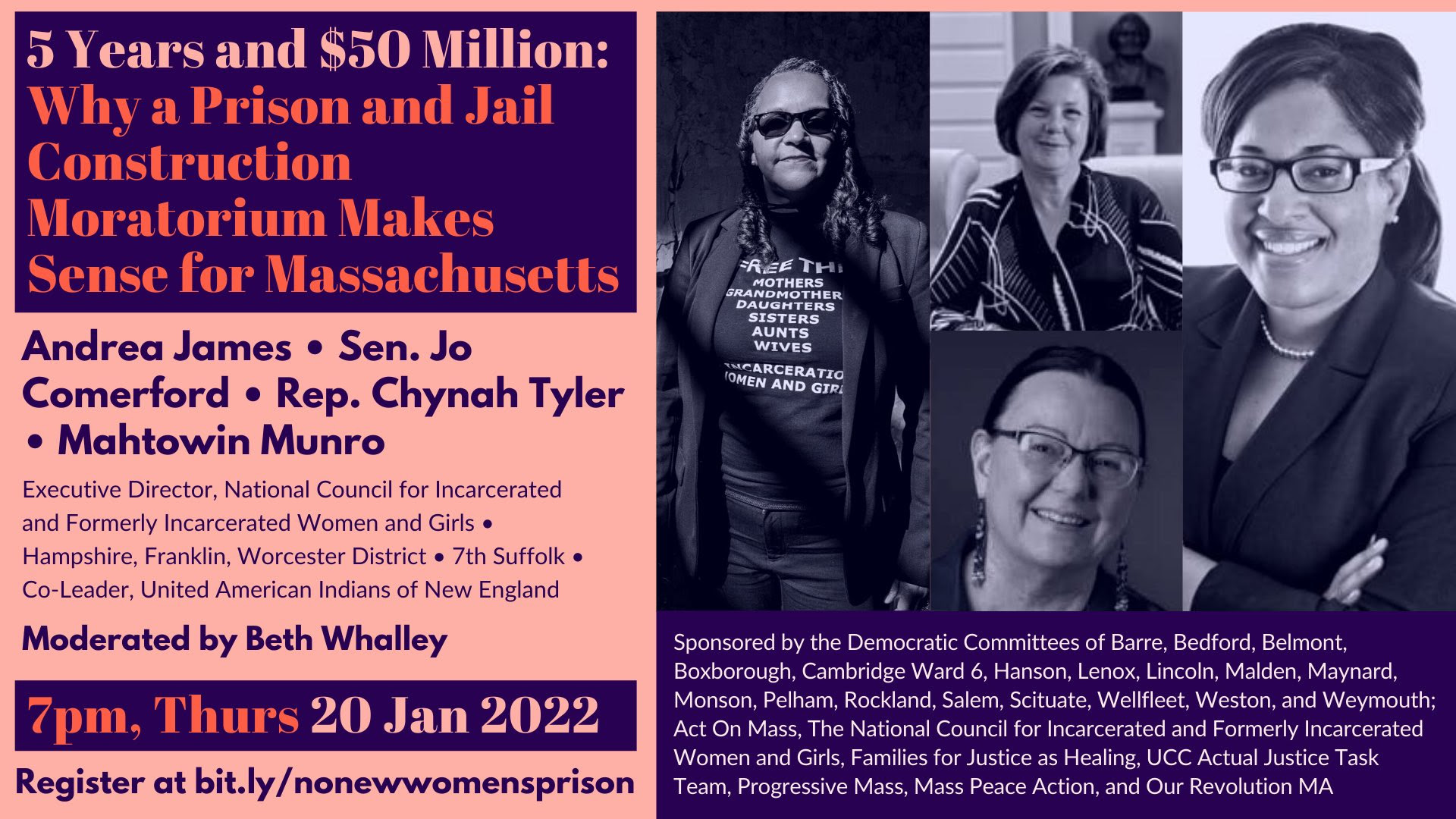
On Wednesday, exactly five months before the November 8 general election, the House and Senate released their final agreement on language for the VOTES Act. Yesterday, the Senate voted 37 to 3 in support of the final version of the bill, and the House is expected to vote soon.
The negotiations around the VOTES Act have been going on for months. The Senate passed a bill back in October, and then the House passed one back in January. There has always been strong support from both chambers this session for making the widely popular vote-by-mail and expanded early voting reforms from 2020 permanent, but House leaders have remained fiercely opposed to Same Day Registration or even a narrower Election Day Registration despite ongoing Senate support. Rep. Mike Moran (D-Brighton), one of the most vociferous opponents of Same Day Registration in the House debate, was one of the House appointees to the Conference Committee negotiating the bill.
The opposition to Same Day Registration / Election Day Registration is revealing. Reforms like vote-by-mail and expanded early voting can give incumbents a clearer picture of who is voting and who has already voted. SDR/EDR means that new people with whom they may not have spoken could show up at the polls. That uncertainty terrifies many representatives, and rather than stepping up their work at engaging all residents of their districts, they would rather shut such prospective voters out of the process entirely.
The final version of the VOTES Act, to be clear, contains a number of wins, some big and some modest. Special credit to the Democracy Behind Bars coalition for elevating the issue of jail-based voting during the debate and the negotiations around the bill.
Here are the key provisions of the Conference bill:
Voter Registration
Reducing the voter registration deadline from 20 days before the election to 10 days. Unfortunately, the Conference bill left out Same Day Registration or Election Day Registration, which, as noted, had been a major point of contention in negotiations. The Senate has now voted to pass Same Day Registration three times, only to see it fail each time due to House intransigence. Same Day Registration is one of the simplest and most effective ways to increase turnout, and it is especially important for working-class voters, BIPOC voters, young voters, and renters, and it continues to be appalling that our Democratic supermajority in the House is too afraid of new people participating in the democratic process to embrace this reform.
Requiring the Secretary of State to make the online registration portal accessible in English, Spanish, Portuguese, Chinese, and other languages deemed necessary or required by law
Reasserting that the Automatic Voter Registration law passed in 2018 is a back-end rather than front-end opt-out system. Secretary Bill Galvin has been refusing to implement the bill as passed, creating instead what is called a “front-end opt-out system” in which eligible registrants are given the opportunity to opt out during the initial transaction as opposed to afterwards. For more on this issue, read this.
Requiring the Secretary Galvin to enroll Massachusetts in theElectronic Registration Information Center (ERIC), which helps states keep more accurate voting rolls, no later than July 1, 2022. This too was required in the 2018 AVR bill, and Galvin has refused to adhere to the law.
Vote By Mail
Permanent early voting by mail for all elections (unless municipalities vote to opt out in a public vote of the local legislative body for local elections)
Application deadline of the fifth business day before the election (the Tuesday before the election for all regularly scheduled Tuesday elections, and the Monday before the election when the primary falls on the week of Labor Day)
Special accommodations for those with disabilities seeking to vote by mail.
Creation of an online portal for VBM requests, as well as publication of the application on the Secretary website and the websites of each city and town
Mailing of VBM applications no later than 45 days before the election to all voters registered no later than 60 days before the election
VBM applications and ballots postage-paid, pre-addressed, and available in all languages as required by law.
Mailing of applications with the voter registration acknowledgement letters sent out after registering to vote or updating registration
Deadline of 5 pm on the third day after the election for receipt of VBM ballots mailed on or before Election Day
Unfortunately, there are no requirements around the number or accessibility of drop boxes for cities and towns to make available for return of VBM ballots.
Early Voting
Two weeks for biennial state elections (Saturday two weeks before GOTV Saturday through the Friday before the election)
One week for primary elections (Saturday before GOTV Saturday through the Friday before the election)
Posting of early voting sites at least two weeks prior
Local option for early voting in municipal elections (Majority of registrars must request, and then local legislative body must approve. The early voting period must exist within 17 days before the election and 2 business days prior. For Tuesday elections, this would mean between the Saturday two weeks before GOTV Saturday and the Friday before the election.)
See below for early voting requirements by city/town population
Staffing the Polls
Enabling cities and towns to appoint poll workers from outside the city/town if there is insufficient staffing
Granting the power to determine the staffing of police officers of the polls to the local legislative bodies, rather than the police departments
Jail-Based Voting Reforms
Ensures that individuals who are incarcerated who are currently eligible to vote are provided with voting information and materials to exercise their right to vote
Requires correctional facilities to display and distribute information about voting rights and procedures, as prepared by the Secretary of the Commonwealth
Requires facilities to assist individuals who are incarcerated in registering, applying for, and returning mail ballots
Ensures that individuals who are incarcerated are properly notified of their right to vote upon release and given the opportunity to fill out a voter registration form
Creates systems for data collection on jail-based voting, as well as the ability of incarcerated individuals to submit complaints
Unfortunately, the JBV language only applies to state/federal elections (and does not include municipal elections), but it is still a big win.
First of all, happy Earth Day! This Earth Day, I’m thinking about how the investments from the Fair Share Amendment will help us improve our public transit systems, a vital part of our response to climate change (as well as reducing air pollution and expanding economic opportunity). The Fair Share campaign recently launched new social media accounts, so if you haven’t followed them yet, make sure to do so on Facebook, Twitter, and Instagram.
A Budget Is a Moral Document
Last week, the MA House Ways & Means Committee released its budget for the next fiscal year.
The Good: The budget avoids the regressive tax cuts for the rich proposed by Republican Governor Charlie Baker, includes the new investments in public schools required by the Student Opportunity Act, and ends the exploitative practice of charging incarcerated individuals for phone calls to loved ones.
The Bad: At the same time, the budget continues our chronic underfunding of public transit and fails to deliver on the investments in child care necessary for true affordability and accessibility.
How the Budget Could Be Better: The House will be considering various amendments next week to improve the budget and better deliver on the promise of shared prosperity and justice for all.
Amendment #47 (New American Voters Fund), filed by Reps. Ultrino & Donato: Would allocate $4 million to municipalities and community organizations to hire bilingual election workers, pay for professional translators and interpreters, and train elections departments.
Justice for All
Amendment #902 (ACES), filed by Rep. Sabadosa: Would ensure that every call to 911 gets the best response by providing funding to communities that want to develop alternatives to police response for calls better handled by mental and community health providers, like social workers and peer specialists.
Amendment #936 (Community Empowerment and Reinvestment Grant), filed by Rep. Mary Keefe: Would provide $15 Million for the Community Empowerment Reinvestment Grant Program, which funds reentry and intervention programs.
Amendment #1346 (Youth Bail Fees), filed by Rep. Fluker Oakley: Would (1) eliminate the statutorily-required $40 administrative bail fees charged to juveniles when they are arrested overnight and (2) shift the decision to release a child to their parent or to impose cash bail decisions from the police officer on call to the Bail Magistrate, a neutral 3rd party.
The House budget remains poised to earmark millions of dollars for the incarceration of men civilly committed for treatment of substance use disorder under the statute known as “Section 35” (M.G.L. c.123 s.35).
Amendment #332 (Section 35), filed by Rep. Balser: Would eliminate the Governor’s proposed funding for correctional section 35 facilities.
Amendment #333 (Access to Addiction Services), filed by Rep. Balser: Would ensure sufficient bed space in DPH or DMH facilities for men committed under section 35.
Economic Security for All
Amendment #181 (Lift Kids Out of Deep Poverty FY23), filed by Rep. Decker: Would raise cash assistance grants for very low-income families with children, elders, and persons with disabilities by 20% for FY 23.
Amendment #640 (Excluding Temporary COVID Relief Income from FY23 Means Testing), filed by Rep. Elugardo: Would ensure that economic assistance from the CARES Act does not count against anyone’s eligibility for means-tested public assistance programs.
Amendment #802 (Including underemployed and unstably housed youth in “at-risk”), filed by Rep. Elugardo: Would add a focus of creating economic opportunity for youth experiencing homelessness to the YouthWorks Youth Jobs program.
Amendment #881 (Massachusetts Rental Voucher Program), filed by Rep. Madaro: Would cap tenant rent share to 30% income instead of 40% and expand mobile vouchers to cover tenant-paid utilities, among other measures.
Amendments #1068 (RTA Funding) & #1070 (RTA Funding Distribution), filed by Representative Sarah Peake: Would make $101 million in base funding available to the RTAs (an increase from $94 million).
Amendment #1268 (Housing Protections), filed by Rep. Moran: Would extend Chapter 257 eviction protections to cases where landlords seek to recover arrears for non-payment of rent – effectively closing the non-payment loophole – and require landlords to participate in the rental assistance process in good faith before being permitted to file an eviction case in court.
Amendment #1371 (Rental Assistance for Families in Transition), filed by Rep. Decker: Would expand eligibility for RAFT to households with incomes from 50% of the area median income (AMI) up to 60% AMI.
Safe & Welcoming Schools for All
Amendment #1133 (Targeted Intervention to Enhance the Learning of Students in Early Grades), filed by Rep. Uyterhoeven: Would provide funding for student specific supports and interventions that enhance learning during preschool through the third grade and that support the elimination of disciplinary sanctions for this population of students
Amendment #1138 (Student Wellness School Support), filed by Rep. Uyterhoeven: Would provide funding to reduce school exclusion for students in prekindergarten through the third grade by utilizing best practices, increased parent engagement and community-based services to support teachers and school staff to employ alternatives to suspensions and expulsions to address student misbehavior in the early grades
Amendment #1321 (Holistic School Health and Safety Practices Grant Program), filed by Rep. Khan: Would create a grant program, administered by the state’s Department of Elementary and Secondary Education, to support public schools and school districts in transitioning to safety models that do not rely on stationing police in schools.
Election Day is exactly 8 months away: November 8, 2022.
In Maine, New Hampshire, Connecticut, and Vermont, prospective voters will be able to register or update their registration at the polls. But in Massachusetts, they won’t be able to because of our arbitrary, exclusionary, and outdated voter registration cutoff.
Late last month, the Massachusetts House of Representatives voted in favor of the VOTES Act, pledging their support for making permanent critical electoral reforms like mail-in and early in-person voting. However, the House chose to leave out the heart of the VOTES Act: Election Day Registration (EDR). Now, because the House and Senate versions of the VOTES Act differ, a small group of legislators are finalizing the bill in conference committee.
EDR has been proven to make elections more equitable and efficient in 20 states. By reducing voter registration barriers, EDR boosts voter turnout for all, especially BIPOC, low-income, immigrant, and young voters. It also decreases administrative burdens of running elections by allowing election workers to update registration information on the spot.
Before November will be the primaries on September 6 to determine who advances. And before that will be the party conventions in June that determine who even makes the ballot in the first place.
Over the past month, Democratic ward and town committees have been holding caucuses to elect delegates to the state party convention. If you want to take part, check out the caucus calendar here to see if your caucus has happened yet or is still to come.
And if you didn’t get elected or can’t make your caucus, you might still be able to become a delegate. You can find additional opportunities here.
Know What’s on the Ballot
Do you know what an Attorney General, an Auditor, or a Secretary of the Commonwealth does?
Do you want to know?
And do you want to find out more about what the candidates vying for these important statewide positions plan to do with these offices?
Jonathan Cohn and Kristina Mensik in CommonWealth:
“House leadership and members must vote to include same-day registration and strong jail-based voting reforms in the VOTES Act so that we can guarantee that no eligible voter who wants to participate in our democratic process gets turned away. Then, it’s time for all of us to roll up our sleeves and work on the harder, and year-round, task of increasing the number of people who want to participate in the first place.”
President Biden, Senator Warren, Senator Markey, all 9 of our US Representatives, and all 37 Democratic members of the MA Senate support allowing eligible voters to register or update their registration at the polls, and yet the MA House remains undemocratically opposed.
During that floor debate, several House Democrats—Assistant Majority Leader Mike Moran (D-Brighton), Rep. Danielle Gregoire (D-Marlborough), Rep. Mike Day (D-Stoneham), Rep. Tackey Chan (D-Quincy), Rep. Kip Diggs (D-Barnstable), Rep. Joan Meschino (D-Hull), Rep. Dan Hunt (D-Dorchester), and Rep. Kathy LaNatra (D-Kingston)—spoke against implementing Same Day Registration or Election Day Registration (terms often used interchangeably, but in the context different as to whether or not the early voting period would be included for at-the-polls registration), delivering remarks filled with specious arguments and factual inaccuracies. Their colleagues have given similarly specious defenses of the vote to constituents afterwards. Let’s go through them.
Bad Argument #1: We are already a leader on voting rights.
“When I think about what we have done — pre-registration, where we allow our young kids ages 16 and 17 to pre-register so they automatically are registered — you can go online right now. We require the secretary of state to have an online portal where you can register to vote online. It takes approximately 12 to 15 minutes to register to vote online on your phone. If you’re moving and you need to change your address or change your voter registration address, you can do it online. You can follow your ballot online, much like FedEx lets you track your package. We’ve also done election day audits and early voting by mail. All of these are part of the package we should be very proud to talk about in this Legislature. The very last thing we did, automatic voter registration, might be one of the most impactful pieces of legislation we’ve done relative to voters.” (MORAN)
“We have enacted the most sweeping voter protection laws in the nation. No one is more frustrated about what is going on in this country and the attacks on voting.” (GREGOIRE)
“Based on some of the debate some might conclude we’re sitting in the Georgia State House. We seem to be losing sight of the gains we are making. Our constituents expect us to determine what’s best for here, not other states. Here in Massachusetts, we lead the country in making the franchise available and accessible to all eligible voters. No other state offers pre-registration, mail-in voting, outdoor ballot boxes, automatic and online registration and online updating.” (DAY)
“The gentleman from Stoneham was saying some say this is voter suppression. I say give me a break. Massachusetts has been a leader. I think our work today proves that.” (HUNT)
Massachusetts Democrats often like to describe our state as a leader in small “d” democracy, but it’s a claim in desperate need of a reality check. Massachusetts only began allowing early voting, pre-registration, and online registration after the election reform package in 2014 (we were a late adopter). Massachusetts was not the first state to adopt Automatic Voter Registration; we were the 14th. Our 20-day voter registration cutoff puts us to the right of most states. Eight states mail every eligible voter a ballot, going even further than the mail-in voting reforms discussed in Massachusetts (which, to be clear, have lapsed and which did not exist before 2020).
According to the National Conference of State Legislatures, California, Colorado, Hawaii, Nevada, Vermont, and Washington have Same Day Registration, Automatic Voter Registration, online registration, and all-mail elections (with the equivalent of in-person early voting with the drop-off centers). DC, Illinois, Maryland, and Michigan have Same Day Registration, Automatic Voter Registration, online registration, in-person early voting, and no-excuse absentee voting. So our current laws, or even the bill passed by the House, do not make us a leader.
But what if we were? What if our election laws were the best in the country? Simply “being better than other states” is not a sufficient benchmark; the question is always whether we are doing all that we can. And we’re not.
Bad Argument #2: It is a solution in search of a problem.
“The very last thing we did, automatic voter registration, might be one of the most impactful pieces of legislation we’ve done relative to voters. We have an opt out system, so when you engage with the Registry of Motor Vehicles or other agencies, you have to tell them you don’t want to be registered. I can tell you when we passed that vote, I won’t divulge names, one of the advocacy groups said to me, “You’re making it very, very challenging for us to make the case for same day voter registration.” I agreed with her then, but I think we have something to do in that direction, and that is what this further amendment is about.” (MORAN)
“I rise in support of the further amendment for several reasons, not the least of which is that the underlying proposals are solutions looking for problems. We do not have a voter registration problem, we have a perception problem here. This past November, in the election, that was historic, only 28.9 percent of registered voters cast a ballot. In the last municipal election before COVID in Marlborough, the turnout was 25 percent… However, enacting solutions to non-existent problems does nothing to change the national discourse. It creates issues and opens us to unprecedented criticism.” (GREGOIRE)
People move, and that includes moving close to Election Day. Especially when our state primary is so close to a major move-in day in Boston (i.e., September 1). The act of moving close to Election Day, or even being evicted close to Election Day, can lead to disenfranchisement if people are far away from their old polling location, and that is an injustice.
Moreover, these arguments are ignorant of the many stresses that working-class people face: planning more than 20 days (or even 10 days) in advance can be difficult for those balancing family commitments and multiple jobs with erratic work schedules, not to mention an array of bills and other responsibilities. Missing deadlines is common (the legislature does it all the time), and managing a deadline that far in advance can be difficult for those with ADHD (one Election Day is easier to get a handle of than the many steps that need to be juggled prior). None of that should make someone less worthy of participation.
Imagine as well how likely of a scenario it could be that someone thought they had registered but, indeed, hadn’t (they already get to fill out a provisional ballot, so why not let them register? ) Or imagine if someone’s pre-marriage or pre-divorce name, or deadname, were the one on the rolls, differing from what they use now and what their ID shows. Or, since poll workers are human, imagine if there was a clerical error in the books. Why should none of this be able to be fixed?
Automatic Voter Registration is great, but it will never capture everyone, both for the reasons stated above and for the fact that not everyone would be interfacing with a designated agency (not everyone has a license!).
That legislators would not see a need for Election Day Registration shows that they are not talking with their constituents with the greatest need. And that’s a problem.
Bad Argument #3: It doesn’t even lead to any demonstrable increases in turnout.
“To the contrary of the lady before me, I found the National Conference of State Legislatures, research from them has concluded that there is no demonstrable increase in voter participation in states that have same day or election day registration.” (GREGOIRE)
From the very website referenced: “There is strong evidence that same-day and Election Day registration increases voter turnout, but the extent of the impact is difficult to conclude. Immediately following the implementation of SDR, states usually see a boost in voter numbers. SDR states also tend to outperform other states in terms of turnout percentages. Many states that have implemented SDR have historically produced higher voter numbers, making changes hard to gauge. Multiple studies place the effect between an increase of 3% to 7%, with an average of a 5% increase.”
Bad Argument #4: We haven’t done the research, and we don’t know the cost and the impact. We need to study this.
“Now we come to the further amendment. The further amendment would call on the secretary of state to create a report. One of the things that having some institutional knowledge gives you is you have some sense of where this comes and where this is going. For years, it was something we talked about, it was debated in bills, but it wasn’t something that we really took in a serious way and did any real prudent research on.” (MORAN)
“When you’re talking about paying for same-day voter registration or the mechanisms you need to put in place and what that means to 351 cities and towns that range in size from 89, which is Gosnell, to Boston, it means very different things to very different cities and towns. What this report would hopefully do is identify some of those challenges that we would have.” (MORAN)
“I think it’s important to get it right and reject the argument this is suppression. It’s not a study in procedure only. It’s a true study. We have 351 cities and towns because when they were founded, individuals in one town got fed up with government, went to the next plot of land and started over. I think it’s important to spend some time and get down to the facts and get it right. The argument that this is voter suppression is not unlike Mona Lisa Vito. It does not hold water.” (HUNT)
The fact that the House has done no research on this issue, if true, is damning. The Joint Committee on Election Laws held a hearing on the VOTES Act in May of last year. If cost were a genuine concern, the Committee had ample time to investigate that question. Why does it exist if not to perform due diligence on bills?
Moreover, Same Day Registration has been filed each session at least going back to the 2000s, and it was voted on by the MA Senate in 2007 and 2014 (in both cases, the House refused to take it up). Why did the Joint Committee on Election Laws never collect such desired information in the hearings or meetings in the past? The only logical conclusion is that they never wanted to do it, and that they still don’t.
A “study” that has no deadline and no funding is not a study. Sending a bill or amendment to “study” is a common procedural trick in the Legislature to avoid having to formally vote yes or no. It is done all the time. The House routinely uses “further amendments” (which send an amendment to study) to nullify Republican messaging amendments that Democratic members are afraid to vote on. It gives people the ability to deflect from criticism of having opposed the thing itself: they didn’t oppose it; they just asked for a study. It is an insult to everyone’s intelligence.
“I had a chat with the clerk with the city of Marlborough and his assertion was that if we implement same day or election day voting in addition to codifying emergency measures, the additional burden would be a logistical nightmare he was unsure of how it would work.” (GREGOIRE)
“A lot has been said today about clerks. Yes, we do read every single thing you send us. Reading the letters and the communications from the clerk and speaking with the women, the clerks, in my communities, they actually share our commitment to increasing voter access and engaging voters. These women are trained and knowledgeable in every facet of elections, including the parts you don’t see. They are committed to ensuring integrity, making sure it is a smooth easy process. They do a fantastic job. If they are the ones reaching out and asking us to just take a small pause, I think we owe it to them to listen to the people who do this work. I’m asking you to join me in supporting the further amendment.” (MESCHINO)
“In speaking with the clerks in my district, same day registration would be an overwhelming task to add to what is already a daunting process.” (LANATRA)
To the contrary, the Town Clerks’ Association expressed support for Election Day Registration (see their letter here). They disagreed with allowing voters to register at the polls during early voting. We can debate whether or not their opposition has merit (it doesn’t; other states have handled it fine), but the legislators are clearly disingenuous in invoking clerks to cover for themselves.
Bad Argument #6: This would be burdensome for staffing.
“In our caucus earlier, the gentlelady from Gloucester brought up some of the staffing issues and staffing levels that would have to happen in the state to do this. Also brought up was training people to know how to do this correctly. There’s more than 2,000 precincts in Massachusetts and approximately 1,220 polling locations, and there are 391 early voting locations. All of those would need to be looked at to see how they could appropriately carry out the process of same-day voter registration. In many of those locations, they’ve never even considered it.” (MORAN)
“Other issues we need to consider: bilingual residence. How many additional staff do we need across the commonwealth to make sure those people coming in have their voices heard?” (MORAN)
“Those who spend quite a bit of time at polling locations know that there is a challenge regarding staffing election days. The expansion of early voting prompted a lot of questions about staffing. Challenges were met and overcome but it took some time. The same issue applies to linguistic access to polling places, people that you can find on election day to work polls, to talk to people who don’t speak English to help them to vote. I want to have a system where no one is disenfranchised or one that makes people feel small when they have the opportunity to cast a vote.” (CHAN)
If legislators had good faith concerns about staffing, they would have asked for an analysis last year or years prior and made the necessary appropriation. The feigned concern for overworked small towns is undermined by the fact that the House made early voting requirements more burdensome for small municipalities than the Senate did (see the chart below). Having more early voting hours is, obviously, better than having fewer ones, but it demonstrates that staffing is not a genuine concern.
Furthermore, our poll workers, on whom our democracy depends, have to prepare for full turnout every election. We never get close to that unfortunately; turnout more than 50% is often deemed impressive. But what that means is that going into Election Day, we need to assume that everyone who has not yet voted by mail or voted early could show up to vote. The additional voters that EDR could turn out will be small in comparison to that (although meaningful in terms of election results).
Bad Argument #7: We do not have the technology.
“Internet accessibility was brought up by the gentleman from Quincy. There are parts of this commonwealth we have yet to get appropriate access. Are we going to have a closed system, where only clerks are limited to using that system? Or is it going to be held in the cloud? These are lots of challenging things we’ve never really thought about when it comes to same-day voter registration.” (MORAN)
“We do not have a plan before us to equip them with technology and access to the internets [sic] they would need to implement these proposals. We do not have a sense of what it would cost. Our clerks describe a normal election day, charitably, as a nonstop fire drill, sometimes ending days later. Clerks have not been provided with information about these changes. This amendment would do just that. You want same day or election-day voting? Let’s figure it out. That’s what this amendment does. As enshrined in this bill voters may register up to the day before.” (DAY)
Maine has had Election Day Registration since the 1970s, and New Hampshire has since the 1990s. We are no less technologically advanced. It is not a question of technology; it is a question of political will.
Moreover, the small towns in Massachusetts that have bad Internet access (digital inequities are real) are places where voting likely occurs at one location: their city hall—a place that will have decent Internet access. (Additionally, Rep. Day’s comment that “voters may register up to the day before” is factually untrue; the underlying bill only narrows the cutoff period to ten days.)
Bad Argument #8: What if it leads to more people voting in a pandemic?
“What about queuing in line, where there are many people who want to vote but the facility has a queue that can’t build up? What about COVID? What about the next variant? How serious is that going to be? We all took that vote last year. Our clerks and the people that administer our elections are essential workers to us. These are things that we have not really fleshed out or considered when thinking about same-day voter registration.” (MORAN)
First of all, this frames higher turnout as an inherently bad thing, a disappointing thing to hear from an elected.
Second of all, see the comments about staffing earlier.
Third, isn’t the very purpose of mail-in voting and early voting to spread out when voting occurs to avoid lines? This bill is creating less work on the day of by doing so.
Bad Argument #9: People should have to register in advance; it’s a vital step of responsibility and a part of political education.
“It is a privilege and it comes with responsibilities and efforts in registration, in a timely way. We agree that they are benchmarks of our democracy. Forward thinking people of all races walked over the trenches in the South to get here to vote. I am a professional boxer but to have to fight on same day voting is a bit much. I will fight for anyone in the state to vote but I feel that they have to register in time. They have from now until 10 days before our voting day. And then we can give 10 days to mail in or walk in to vote. We have plenty of time to vote and that is the best way to do it.” (Diggs)
“I have a different perspective as a person who in his 20s stood on street corners to register voters. This was some 25 or so years ago today. And in Quincy at the time it was predominantly Chinese and people of color. We had to engage them one on one. I didn’t do this sitting at a fair, it was a direct approach for engagement. Voter education is a large part of voter registration and the need to explain why it is important to register. This is very time consuming. Since my days of registering people in person, new ways have come up. The ability to vote online which at the time websites were not used that much back then, but it is very commonplace now. I never thought that we would have automatic voter registration through the RMV. There are many new ways to cross different barriers. I am concerned about the impact on the underlying amendment because the engagement of registering to vote is a one on one experience. To have the linguistic ability present at the polls to explain to people how to manage a ballot, how to register is important.” (CHAN)
To some extent, the response is the same in #2 about the need that Election Day Registration fills, especially among BIPOC communities, working-class communities, immigrant communities, young people, and renters.
But both of these comments ignore the simple fact that figuring out that an election is happening, finding your polling place, and doing some research on candidates—all things that people who show up at the polls have done—is a demonstration of the very responsibility and political education that they are demanding. To Rep. Chan’s remarks, the work of civic engagement is year-round, and that reality is not an excuse for turning anyone away from the polls.
Bad Argument #10: This would allow voter fraud.
“From my conversation with constituents, there is a sense that same day or election day voting could give a fog of potential nefariousness. I have faith in our clerks and the secretary to have fair elections but I do have concerns over that sentiment, which I believe is false. I’ve heard from constituents who are looking for this underlying amendment and numerous who have great concern.” (HUNT)
It should be beneath any Democrat, and any elected official, to dignify voter fraud myths that have been debunked time and time again and are only ever invoked as a justification for racist and exclusionary policies.
Bad Argument #11: We didn’t have a veto-proof (two-thirds majority) for Election Day Registration, and Baker would have vetoed it.
Several state reps have said this in response to constituents, arguing that they themselves don’t oppose Election Day Registration but that the votes aren’t there in the caucus and they wanted to do something. None of them are willing to name the colleagues that are the roadblocks; they just seek to absolve themselves of all blame.
It is unclear why a study with no funding and no deadline that is never intended to actually happen is the solution to a political question. Given the centralization of power in the House, if the votes are wanted for something, the votes are typically corralled one way or another (when one is in charge, one has many tools at one’s disposal). Framing a fake study as a “consensus, second-best outcome” is an insult to the intelligence of voters, and it also conveniently ignores how many of the people who voted for this study are vehement opponents of Election Day Registration (indeed, almost every Republican voted for it, with the only ones opposing it doing it because they thought even a study was too much).
A Democratic supermajority should not lower its ambitions to cater to a Republican governor, especially now.
Bad Argument #12: If we allowed people to register to vote on Election Day, then people in my district I don’t know—such as college students, recent graduates, renters, working-class people, immigrants, members of BIPOC communities, etc.—might show up to voteand not for me.
No one said this out loud, but it’s the dominant reason why many are opposed. And if they want people not to show up to vote for someone else, they should do the work of engaging with their constituents and welcoming new ones. Indeed, isn’t that what representative democracy is about?
I don’t know what tomorrow’s Wordle will be, but the most important five-letter word in the MA House tomorrow is VOTES.
Why? Because the MA House will finally be taking up the VOTES Act, a voting rights package that makes pandemic-era voting reforms like mail-in voting and early voting permanent.
But there’s a problem. Whereas the Senate’s bill, passed last fall, included Same Day Registration and strong Jail-Based Voting language, the House bill doesn’t.
Maine, Vermont, New Hampshire, and Connecticut all have Same Day Registration, and Massachusetts should too. It’s one of the most proven ways to increase voter turnout. Every single Democratic member of the US Congress supports Same Day Registration, so why doesn’t our Democratic supermajority?
And individuals incarcerated with non-felony convictions maintain the right to vote under the law, but that right often doesn’t exist in practice. We are all worse off when anyone’s right to vote is denied.
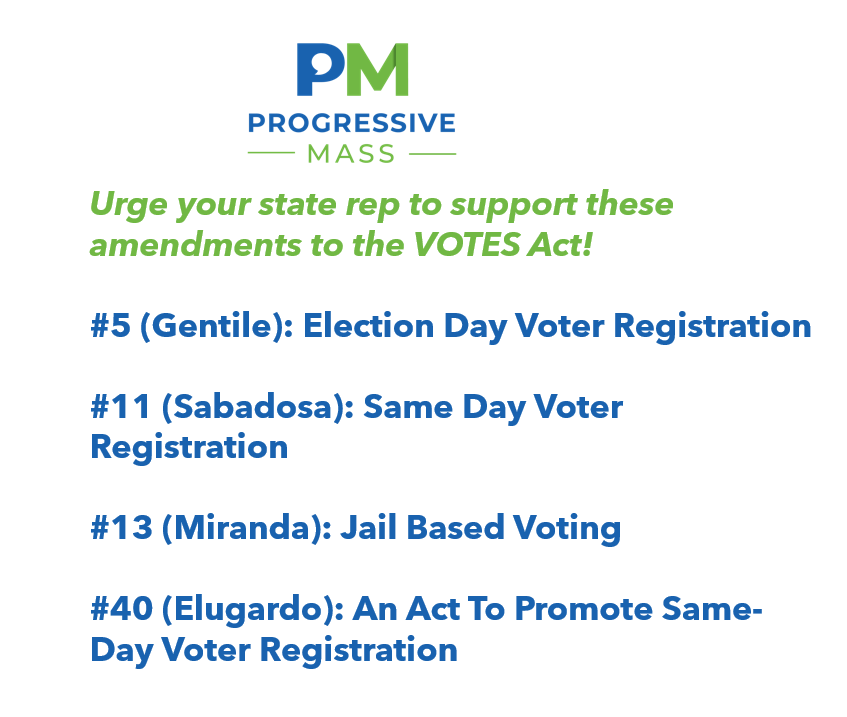
State representatives have already filed amendments to fix this, but your rep needs to hear from you.
Amendments #5, 11, and 40 (Same Day Registration) would enable voters to register to vote or update their registration on Election Day.
Amendment #13 (Jail Based Voting) strengthens reporting requirements for houses of corrections and builds voter registration into the re-entry process.
Last week was a bad week for voting rights in the US Senate, as Senators Joe Manchin and Kyrsten Sinema refused to support rules changes that would allow for important voting rights packages to pass amidst Republican opposition.
But this week—with your help—might be a good week for voting rights in Massachusetts. Last October, the MA Senate passed the VOTES Act, which not only makes vote-by-mail and expanded early voting permanent but also goes further by eliminating our arbitrary, exclusionary voter registration cutoff and strengthening protections for jail-based voting.
The MA House is expected to take up this bill this week: on Thursday, January 27.
It’s important that the House pass the VOTES Act in full, especially the provisions on Same Day Registration and strengthening Jail-Based Voting.
Driving Families Forward Virtual Briefing Series Continues
Join the Driving Families Forward Coalition for part II of the Driving Families Forward Coalition Virtual Briefing series! Over the last year, the Driving Families Forward Coalition has worked tirelessly gaining the support of more than 270 endorsing organizations, including community, health, faith, labor, business, and law enforcement for the Work and Family Mobility Act, which would ensure that immigration status is not a barrier to obtaining a driver’s license.
Tune in on Facebook Live at the Driving Families Forward page Tuesday, January, 25th to hear from law enforcement leaders supporting our legislation across the state.
Common Start Roundtable: Tuesday @ 6:30 pm
Tomorrow at 6:30 pm, the Common Start Coalition will be hosting a virtual roundtable–featuring Congresswoman Katherine Clark–about the child care crisis and the solutions for it, especially the Common Start bill.
Massachusetts Power Forward Day of Action
Climate Justice can’t wait! Massachusetts needs decision-makers to act fast and move more climate justice policy now!
Join the Massachusetts Power Forward coalition this Thursday for a day of action. 9AM – 10AM : Action Hour, call your legislators https://fb.me/e/1i7OF5oNc 12pm- 1pm: Action hour, take a selfie photo petition and post on twitter to push our legislators https://fb.me/e/3lr4Lo33T
Yesterday, on Martin Luther King, Jr. Day, politicians across the Commonwealth (and the country) honored Martin Luther King, Jr., for his commitment to racial equity and social justice.
It was a reminder of how much work we still have to do here in Massachusetts to deliver on his vision, and how we need to demand that elected officials follow through with their rhetoric from yesterday all 365 days of the year.
Three Quick Actions You Can Take Today
(1) Write to Your State Rep in Support of the VOTES Act
While Congress remains stalemated on voting rights action due to Republican and conservative Democratic (we’re looking at you, Joe Manchin and Kyrsten Sinema) opposition, we have important action to take here in MA.
Last fall, the MA Senate passed the VOTES Act, which would make pandemic voting reforms like expanded mail-in voting and expanded early voting permanent as well as enact Same Day Voter Registration and stronger protections for jail-based voting. But the House needs to take action too. Write to your state representative today — and if you already have recently, follow up with them.
(2) Write to the Public Safety Committee in support of the Safe Communities Act.
Immigrant justice and racial justice are deeply intertwined. Longstanding state and local involvement in deportations discourages immigrants from seeking medical care, and prevents immigrant victims and witnesses from seeking police and court protection. Many immigrants—and their children—fear that seeking help from local authorities will result in deportation and family separation.
(3) Pledge to be a Fair Share Voter: For years, Massachusetts’ communities of color have been harmed by inequitable and inadequate access to transportation and public education. Now, the pandemic has heightened these economic and racial inequities that prevent shared prosperity.
The Fair Share Amendment is a transformative opportunity to raise revenue to build a more equitable commonwealth by investing in public education and transportation. Pledge your support for Fair Share today!
Wednesday, Jan 19, 4 pm: Legislative Briefing on No Cost Calls
This Wednesday, the MA Legislature’s Criminal Justice Reform Caucus is hosting a “NO COST CALLS” legislative briefing, open to the public. RSVP here.
They are partnering with the No Cost Calls Coalition and Prisoners’ Legal Services to explain how this legislation will remove barriers to communication between incarcerated people and their loved ones as Connecticut, New York City, Los Angeles, San Francisco, and San Diego Counties have already done. Join this briefing to hear firsthand accounts of the hardships that phone charges impose and the benefits of facilitating family contact. Worth Rises, based on its experience in jurisdictions that have already eliminated charges, will present a fiscal analysis showing how cost-effective this legislation would be.
Thursday, Jan 20, 7 pm: #NoNewWomensPrison Virtual Forum
Join this Thursday to learn more about S.2030/H.1905, An Act Establishing A [5-year] Jail and Prison Construction Moratorium, and how to take action to support it. The forum will discuss what this bill does and doesn’t do, how it would be implemented, and what it would mean for Massachusetts to invest $50 million into communities, instead of incarceration.
Featured speakers include bill sponsors Sen. Jo Comerford and Rep. Chynah Tyler along with Mahtowin Munro of the United American Indians of New England, and Andrea James of Families for Justice as Healing and The National Council for Incarcerated and Formerly Incarcerated Women and Girls.
One year ago today (Jan. 6, 2021), right-wing extremists, aided by our ex-president, assaulted the Capitol building in an attempt to overturn the election results and subvert our democracy.
It’s a timely day to reflect on democracy and how it needs strengthening at all levels. And, yes, that means here in MA, too.
The central principle of democracy is that every person’s voice matters. And far too often, communities of color and working-class communities face unnecessary, arbitrary, and sometimes insurmountable barriers to making their voice heard. And we are all worse off because of it.
In Massachusetts, we haven’t been a leader on voting rights. The COVID elections package from 2020 finally brought us up to where many other states have been for years, with expanded options to vote by mail and to vote early. But the Legislature let that expire.
Our neighbors in Maine and New Hampshire have had Same Day Registration for decades, but Massachusetts still has an arbitrary voter registration cutoff, rooted in anti-immigrant sentiment from a century ago.
And despite the fact that many individuals incarcerated in prisons and jails maintain the right to vote, that right often doesn’t exist in practice due to misinformation and indifference from correctional officers.
We can do better. And we need to do better.
The MA Senate played its part, passing the VOTES Act in October. The VOTES Act not only makes vote-by-mail and expanded early voting permanent but also goes further by eliminating our arbitrary, exclusionary voter registration cutoff and strengthening protections for jail-based voting.
“Action at the city level is what will make national momentum possible on our most urgent issues, and this is the level of government where we are closest to people, where we can innovate and move quickly. Most importantly, this is the level of government where we uniquely are in the position to earn the trust of our communities.”
“Solitary confinement is a punishment that correctional officers wield freely, and its harms are catastrophic. The practice — confinement in a cell for up to 24 hours a day — can lead to psychosis, self-mutilation, and suicide. A study of people incarcerated in North Carolina found that those subjected to solitary were almost 80 percent more likely to die by suicide within a year after their release than those not placed in solitary.”
“Many municipalities benefited from these reforms, but still, they’re set to expire Wednesday….There was talk of extending them while the House and Senate hashed out a more permanent solution. But with the legislature not in formal session, it appears highly unlikely they will act to do so in time.”
“While the race largely turned into a turf battle pitting D’Ambrosio’s solid base of support in Revere against Edwards’s strength in Boston and Cambridge, it was also a referendum on whether the district would embrace the progressive wave has that sent Wu, Pressley, and other political change agents into office in recent years or stick to a more moderate Democratic lane.”
“What I’ve been consistent about is talking about how as a senator, you can take a regional approach, which is necessary to deal with housing, to deal with transportation, to deal with environmental justice, to deal with education … dealing with the opioid crisis, there is no one city or town that can do it alone.”
“But those diversity and equity goals collided with lawmakers’ penchant for using budget negotiations to fund pet projects in their districts. The result: The bulk of arts funding in the huge spending bill is tied up in local earmarks, only a small percentage of which are geared toward organizations led by or primarily serving people of color.”
“Let’s be real about this: communities all over this state still experience the painful impacts of the War on Drugs today. The families that have been torn apart by over-policing and over-enforcement should be the first to benefit now that marijuana is legal. Massachusetts knows what it takes to make sure equity materializes, and now is the time to carry out its promise by investing in those who deserve to participate in this industry.”
“The report recommends funding — including public spending — to support patients seeking abortion for travel expenses such as gas, lodging, transportation and child care. It asks lawmakers to reimburse abortion providers for services to those who can’t afford to pay — including those who travel to California from other states whose income is low enough that they would qualify for state-funded abortions under Medicaid if they lived there.”


.png "Common Start Roundtable")