This International Women’s Day and Always: better health, not more prisons

Happy International Women’s Day!

Today should serve as a reminder of the fundamentally intersectional nature of the push for women’s rights. Women need pay equity, universal health care (including and especially reproductive health care), affordable child care, affordable housing, and so much more.

This International Women’s Day, take action on two important issues: saying no to another women’s prison and saying yes to creating a better maternal health care system. 


No New Women’s Prison

Massachusetts is planning to spend $50 million to build a new women’s prison to replace MCI-Framingham. As of January 1, 2022, the population in MCI-Framingham stood at 179, with more than 20% held in pre-trial detention. Why would we expand a system that costs $235,000 per person and only causes further harm?

That is the question that women from MCI-Framingham asked in a historic hearing last summer when they were able to testify to state legislators about the myriad better uses of that $50 million, especially in terms of investing in communities and support services at MCI-Framingham, expanding programming, and improving access to health care.

Studies have repeatedly shown that society cannot incarcerate its way to safety, and the family separation of incarceration and the well-documented inhumane conditions in Massachusetts’s prisons and jails fuel the community instability that is detrimental to public safety. Instead, investments in housing, health care, economic opportunity, and other social supports have been shown to be the true foundation of public safety for all.

Can you write to your state legislators in support of a moratorium on new prison and jail construction?

The Prison Moratorium bill (S.1979) would create a 5-year pause on major jail and prison construction and expansion, without preventing essential repairs, to allow for a focus on reducing the number of people in prison, implementing alternatives, and investing in communities.

The Legislature, in fact, has already gone on record in support of this bill by passing it at the end of the session, but Republican Governor Charlie Baker vetoed it. Let’s finish the work this year.

Find out if your legislators are already co-sponsors here.

  Demand a Better Maternal Health Care System

Massachusetts is facing a maternal health care crisis, which is devastating all of our communities, and hitting Black, Indigenous and people of color especially hard. This crisis has been compounded by a cascade of maternity care closures across the state. Policies are urgently needed to reverse this alarming trend.

A study published by the Massachusetts Department of Public Health last year revealed that rates of severe maternal health complications nearly doubled between 2011 and 2020. The situation is especially dire for black women, who are twice as likely than white women to die from maternal health complications in Massachusetts.

We need to demand that all women and birthing parents have access to the care that they need.

Can you write your state legislators along with the Chairs of the Committees on Public Health and Health Care Financing in support of access to midwives and birthing options?

An Act promoting access to midwifery care and out-of-hospital birth options (H.2209/S.145) would improve maternal health outcomes and promote racial and economic justice by expanding access to midwifery care and birthing choices, eliminating maternal care deserts and increasing access for low-income families.

Just In: What’s a Living Wage in Massachusetts?

MIT’s Living Wage Calculator analyzes the hourly rate that an individual must earn to support themselves and/or their family, working full-time, meeting basic needs like food, health care, housing, and transportation. 

They just updated it a few weeks ago, and the living wage for a single adult in Massachusetts now stands at $27.89. In households with children, the number is even higher. It’s clear that we have a cost-of-living crisis.

We can solve that in two ways: by bringing down costs or bringing up wages. And we need to do both. In 2018, Massachusetts set an example for other states and the country by passing a $15 minimum wage.

It’s time to raise the minimum wage again. Legislation filed this session (H.1925/S.1200) would raise the minimum wage to $20 per hour, bringing it much closer to a living wage.

Can you ask your state rep and state senator to co-sponsor and champion legislation to raise the minimum wage to $20?
Find out if your legislators are already co-sponsors here.

Massachusetts workers deserve better. Let’s make sure all workers receive a living wage. 

Here’s How Your Legislators Can Hold the DOC Accountable

Fires with no functioning sprinklers to put them out. Tear gas used against individuals in confinement. Individuals being denied access to basic medication. Amputations due to a lack of care and supplies. Year-long delays in access to recommended treatment. Retaliation against individuals who submit grievances. Conditions so bad that the Department of Justice under Donald Trump called out the Department of Correction for its failings.

All of these happen in Massachusetts’s prisons, regularly with little scrutiny or corrective action.

There are many steps needed for robust accountability and a top-to-bottom rethink of the criminal justice system.

But there’s one that can happen now: your state legislators can start actually visiting prisons themselves.

State legislators, who vote to provide funding for the Department of Correction, should view it as incumbent upon themselves to follow up about how that funding is being used, not used, and misused. And they should be willing to listen to and meet with their constituents who are behind the wall when they raise the alarm about inhumane conditions.

Can you ask your state rep and state senator to commit to visiting a Department of Correction prison at least once before the end of the session? 

Only a few state legislators visit prisons at all. Even fewer do so unannounced, a statutory right that all state representatives, senators, and governor’s councillors have and a more potent tool for accountability.

We plan to track which legislators follow through in our Legislator Scorecard, so let us know if and when you hear back.

Join MEJA’s We <3 Our Public Schools Day!

In honor of Valentine’s Day, MEJA (Massachusetts Education Justice Alliance) is having a We <3 Our Public Schools Day tomorrow.

Here are actions you can take to show your support for public schools on Valentine’s Day!

Share on social media what you love about public schools!

  • Share a photo of you holding a sign saying what you love about your school
  • Post photos with students, friends, teachers, staff, or anyone else in the school who has made a positive impact on you, students and school community!
  • Use the hashtag #welovepublicschools and tag @massedjustice!

Upload your photos and videos to the MEJA Soapboxx!

Check out MEJA’s folder and toolkit for some more ideas and social media prompts!

Tomorrow is an important deadline at the State House

Tomorrow is an important deadline at the State House: Joint Rule 10 Day.

According to this State House rule, every joint committee (i.e., committee of both the House and Senate) must take action on the bills before them by the first Wednesday in February.

That action can be to give the bill a favorable report (It advances!), to give the bill an adverse report (It’s done for the session), to send the bill to study (It’s effectively done for the session), or to give the bill an extension (It has more time).

The State House relies on deadlines to spur action, so expect to see a flurry of action on bills later this week.

That also means it’s a great time to contact the committees in support of critical bills.

Can you commit to sending at least one email by tomorrow? See below for some action tools.


Keep Up the Momentum for Criminal Justice Reform

If we want to continue to move past the failed model of mass incarceration – a model that costs outrageous sums, breaks apart communities, and does not increase public safety – then we need more policy action this year.

Urge the Judiciary Committee to advance key bills before a critical February 7 deadline.

  • Raise the Age (H.1710 and S.942: An Act to promote public safety and better outcomes for young adults): When young adults (18, 19, 20) are kept in the juvenile system, they are able to have better access to school and rehabilitative programming.
  • Prison Moratorium (H.1795: An Act establishing a jail and prison construction moratorium): Massachusetts does not need to build new prisons and jails. We need to be investing in programming, re-entry services, and community supports.
  • Clean Slate Bills (H.1598/S.979: An Act providing easier and greater access to sealing & H.1493/S.998: An Act to remove collateral consequences and protect the presumption of innocence): Too many people are trapped in poverty and deprived of jobs, housing and other chances for success because of their criminal and juvenile records. We need to allow for automatic record sealing in certain cases, rather than relying only on burdensome case-by-case petitions.

Can you write to the Judiciary Committee today in support of these key bills?

Let’s Set up all Students and Families for Success

Every student deserves the support and resources to thrive. That’s why we’ve been such strong supporters of the Common Start bills and the Thrive Act.

Common Start (H.489 and S.301): While Massachusetts is a nationwide leader on early education and child care and we’ve made important progress in recent years, the current system remains broken and access to quality early education and care remains out of reach for too many families. The Common Start framework would provide the specific structure that is needed to deliver affordable care options for families; significantly better pay and benefits for early educators; a new, stable source of funding for providers; high-quality programs and services for children; and substantial relief for businesses and our economy.

Thrive Act (H.495 / S.246): Massachusetts’ state takeover law and the state’s misuse of the MCAS as a graduation requirement are failing our students and disrupting their education. The Thrive Act would end the failed system of state takeovers of school districts, and replace it with a comprehensive support and improvement system that focuses on giving students and educators the tools and resources they need to succeed. The legislation would also support students by establishing a modified high school graduation requirement in which coursework would replace the MCAS test as the basis for showing student mastery of state standards. And, the legislation would create a commission to give our communities a voice in building a better assessment and accountability system.

Can you email the Joint Committee on Education in support of these bills?


It’s Time to Make Polluters Pay

Massachusetts communities are already experiencing the devastating and costly effects of climate change even without considering the HUGE cost of building the climate resilient infrastructure recommended by Climate Chief Hoffer in her 2023 report.

Unless action is taken, our communities will continue to bear the financial and emotional costs of climate change while the fossil fuel companies responsible for climate-related damages make record profits. These companies must bear the cost.

The Make Polluters Pay Bill (S.481/H.872) is a pathway to making that happen.

It would require top polluters to contribute to a superfund used to pay for climate-related damages in Massachusetts. It would create the Climate Change Adaptation Cost Recovery Program, generating $75 billion over the next 25 years for climate adaptation and resilience projects. These funds will then be dispensed through the Climate Change Adaptation Fund, with at least 40% of the funds going to projects directly benefiting environmental justice communities.

Can you write to the Joint Environment and Natural Resources Committee in support of these bills?

MA Needs to Lead on Democracy

In the late 1990s, after incarcerated individuals in MCI-Norfolk started political organizing, Republican Governor Paul Cellucci and the Massachusetts Legislature responded with retaliation and a multi-step process of disenfranchisement. Our commonwealth did something rare in recent history: it took away the right to vote from a category of people who were formerly enfranchised.

According to a new fact sheet from The Sentencing Project, over 7,700 otherwise eligible citizens in Massachusetts are disenfranchised due to a felony conviction. The report further underscores the racial disparities in the Massachusetts criminal legal system that leads to Black and Latinx residents being disproportionately denied their right to vote.

On April 26, 2023, the Joint Committee on Election Laws gave a favorable report to S.8/H.26, constitutional amendments filed by Sen. Liz Miranda and Adam Gomez and Rep. Erika Uyterhoeven that would ensure that incarceration never leads to a loss of voting rights.

Now, the Election Laws Committee must advance S.428/H.724 before the Feb. 7 deadline. This legislation would make relevant changes in state law, and is needed to accompany the constitutional amendments. Passing the constitutional amendments this year would be historic — we need to make sure these bills that change the law for local elections are moving at the same pace.

Can you write to the Joint Election Laws Committee in support of these bills?

Let’s Build on Recent Progress for Criminal Legal Reform

Earlier this month, MassInc published a study on MA’s 2018 criminal legal reform omnibus bill.

Takeaway #1: The bill led to significant reductions in incarceration without undermining public safety.

Takeaway #2: The work isn’t over.

If we want to continue to move past the failed model of mass incarceration – a model that costs outrageous sums, breaks apart communities, and does not increase public safety – then we need more policy action this year.

Urge the Judiciary Committee to advance key bills before a critical February 7 deadline.

  • Raise the Age (H.1710 and S.942: An Act to promote public safety and better outcomes for young adults): When young adults (18, 19, 20) are kept in the juvenile system, they are able to have better access to school and rehabilitative programming.
  • Prison Moratorium (H.1795: An Act establishing a jail and prison construction moratorium): Massachusetts does not need to build new prisons and jails. We need to be investing in programming, re-entry services, and community supports.
  • Clean Slate Bills (H.1598/S.979: An Act providing easier and greater access to sealing & H.1493/S.998: An Act to remove collateral consequences and protect the presumption of innocence): Too many people are trapped in poverty and deprived of jobs, housing and other chances for success because of their criminal and juvenile records. We need to allow for automatic record sealing in certain cases, rather than relying only on burdensome case-by-case petitions.

Can you write to the Judiciary Committee today in support of these key bills?

Tell Gov. Healey to Stop the Cuts

Earlier this month, Governor Healey responded to a revenue shortfall by making $375 million in unilateral 9C cuts to the budget, including cuts to cash assistance to the lowest-income families in the Commonwealth.Please help keep up the pressure on the Governor to rescind the cash assistance cuts that eliminated the 10% grant increases slated to take effect in April. We should not be balancing the budget on the backs of our lowest-income children and families, elders, and people with disabilities.

Call and/or e-mail Governor Healey to urge her to reverse the cuts to cash assistance:

Call (888) 870-7770

Suggested script:  “This is [name] from [city/town].  I’m calling to urge the Governor to rescind the 9C cuts to the TAFDC and EAEDC cash assistance programs.  The grant amounts are still far below even half of the federal poverty level.  It is unconscionable for Massachusetts to fill gaps in the budget by cutting cash assistance for our lowest income families with children, elders, and people with disabilities.”

Click here to send an e-mail.

Your Senator Needs to Hear from You on Gun Safety

Back in October, the MA House passed a comprehensive gun safety bill aimed to build upon and continue MA’s leadership in gun violence prevention. The bill included a more robust assault weapons ban; measures to crack down on ghost guns; prohibitions on firearms in government buildings, polling places, and educational institutions; and more comprehensive data collection — among other key measures.

The action now turns to the Senate.   The Senate is expected to release its own bill later this month. It’s time to contact your state senator and let them know that you want to see bold and comprehensive legislation.  Join the Massachusetts Coalition to Prevent Gun Violence in calling for a comprehensive bill that includes, among other key provisions: Industry accountability: Victims and survivors of gun violence are rarely able to hold those who have harmed them accountable due to a federal law that provides unique protections for the firearms industry. MA has the opportunity to create an avenue for victims and survivors to seek justice in the civil court system by creating a code of conduct that the firearms industry must adhere to, ensuring that their products don’t end up in the wrong hands and ultimately preventing harm.

Regulating ghost guns: Ghost guns are untraceable, unserialized firearms that can be assembled at home from a kit purchased online without a background check. MA must update our definitions of a firearm and require that all ghost gun kits and parts can only be sold to those with a license to carry firearms.

Gun violence data analysis: MA has been collecting data on guns recovered in connection with a crime for years, and we must use that data to better understand how guns are ending up in our communities. Looking more deeply at data on guns recovered in MA will allow us to close any loopholes in our laws and prevent future violence.

Email your state senator.

Let’s Get Comprehensive Housing Policy Passed This Session

Massachusetts faces a growing affordable housing crisis, and we can see it everywhere in the Commonwealth.

And the only way to tackle that housing crisis is with a multi-pronged approach of protecting tenants from displacement, increasing housing production, and investing more in affordable housing.

Fortunately, Governor Healey’s housing bond bill (the Affordable Homes Act) offers a strong foundation. But it can be improved in key ways.

That’s where you come in. The Joint Committee on Housing is hearing testimony this Thursday on the housing bond bill.

Can you write to the committee in support of a comprehensive approach to the housing crisis?

Here’s what that would mean:

  • Allowing accessory dwelling units to be built by right in cities and towns across the state in order to increase the supply of housing (already in the bond bill — let’s keep it there!)
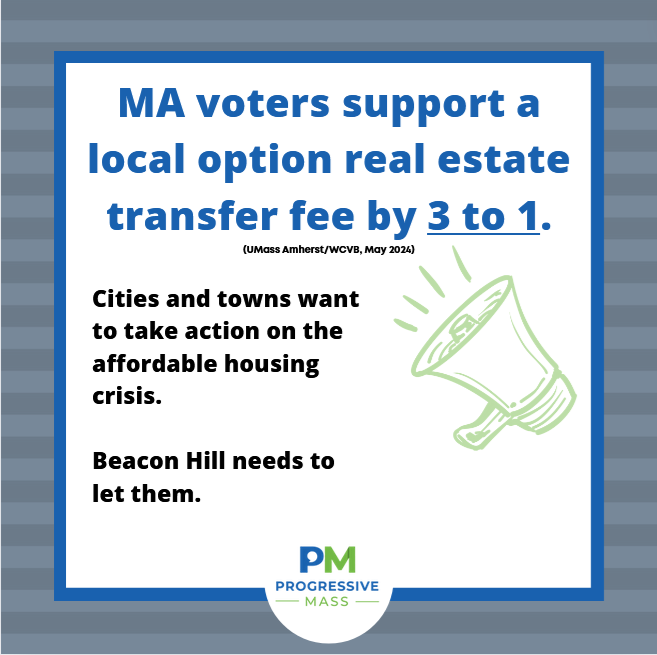
  • A real estate transfer fee local option that is accessible to cities and towns across the state as a way to raise money for affordable housing production and preservation (in the bond bill — but could be stronger)
  • Creating a process for the sealing of eviction records so that they no longer remain a permanent mark on tenants and make it more harder to secure housing (in the bond bill — but could be stronger)
  • Guaranteeing access to counsel so that all tenants have legal representation in eviction court (not in the bond bill — but could be!)
  • Repealing the ban on rent control and enabling municipalities to enact local rent control ordinances to stabilize housing costs and prevent no-cause evictions (not in the bond bill — but could be!)
  • Establishing a statewide Foreclosure Prevention Program to require servicers to participate in pre-foreclosure mediation with homeowners to explore alternatives to foreclosures (not in the bond bill — but could be!)

A Recent Win + An Urgent Need for Action

A recent win: Earlier this month, one of our priority bills — No Cost Calls — became law after Governor Healey signed legislation to guarantee free access to phone calls to individuals behind bars, which will take effect on December 1 (this Friday).

We are delighted to see the Legislature listened to impacted communities and recognized the importance of ending the predatory practice of charging incarcerated individuals and their loved ones exorbitant fees to stay connected. No family should have to choose between affording basic needs like rent or food and staying connected with loved ones.The No Cost Calls victory is a win for families and a win for all people fighting for a more just commonwealth.
 
 Your Voice Needed: Take Action in Support of Families Experiencing Homelessness
That was the good news — and it’s really good news. But here’s some less good news. Last month, Governor Healey announced that the state would cap the number of placements in the Emergency Assistance (EA) family shelter program and related state-funded family shelter sites due to financial, space, and staffing constraints.After hitting the cap earlier this month, the Administration began implementing a waiting list for families approved for EA shelter, without providing families with alternative safe places to stay.

On November 15, the Legislature ended formal sessions for the calendar year without approving a supplemental budget that would provide critical funding to serve families experiencing homelessness.

With winter rapidly approaching, it is vital for the Legislature to take action.Can you write to your legislators today to underscore the importance of passing such funding and requiring that some of it be earmarked for overflow shelters? Email your legislators